


















 Epixel Analytics: Growth and Influence Insights
Direct selling has grown to be a massive industry hosting millions of distributors beyond the limitations of demographic and geographic barriers. The industry sees millions of new entrants every year, some stay back, some quit. The reason behind this decision is not product quality, personal effort, support, or company culture. They point to a story about economic structure.
Direct selling industry has about 102.9 million distributors globally and generates a global retail sale of $167.7 billion. It faces an approximate distributor churn rate of 56% and a sector Gini Coefficient of 0.62. However, these data do not point directly to what causes distributor churn or how to set the right engagement level across global distributor networks. Direct selling industry, with its large network of member companies and Direct Selling Associations, has conducted lots of studies and surveys to understand the specifics. Everything points to one common factor, the economic structure.
The article analyzes the fact through distributor data collected from various countries by the Epixel MLM Software Data Team and those that are publicly available from the WFDSA, DSA, AARP, FTC, and other sources related to direct selling economics.
Distributor income distribution: The foundation of MLM economics
An economic reality in MLM networks is that income is not evenly distributed. This is also a fact that rarely makes it into recruitment meetings. Majority of distributors in the network earn low to no income, but a small group earns the majority of income. This pattern is common in most models but in MLM it becomes much more visible due to the system’s structure and compensation plan design.
| Income Tier | % of Distributors | AARP/FTC Reference | Notes |
|---|---|---|---|
| $0 earned | ~73% | FTC/AARP studies | No commission received |
| $1 – $100/month | ~18% | Aggregated IDS data | Below minimum income level |
| $101 – $1,000/month | ~6% | DSA/Epixel Data Team | Part-time income |
| $1,001 – $25,000/year | ~3% | AARP: ~4% earn $25K+ | Stable income level |
| $25,000+ / year | ~4% | AARP: 0.05% earn $100K+ | Top earners |
Fig. 1 – Income distribution by distributor segment
Data source: AARP MLM study; FTC income disclosure statement analysis; Epixel MLM Software Data Team aggregated IDS review.
The earnings of an average MLM distributor are $0. Majority of the income is earned by a small group of top performers whose incomes distort the data represented by companies in their income disclosure statements.
The difference between median income and average income shows the reality in the distribution of earnings in MLM networks. Industry data shows that the average monthly income for active distributors is about $200 but when you look at the median income across the entire distributor network, including inactive members, it is close to zero. The industry’s Gini Coefficient of 0.62 points at this imbalance which is higher than income inequality levels in many national economies. This cannot be ignored as accidental because it is structurally built into compensation plans.
Strategic insight
Your income disclosure statement shows your network’s economic design not individual distributor effort. If your Gini Coefficient rises above 0.65, it becomes a risk indicator for regulatory scrutiny and distributor churn.
Leaders must understand that the average income figures are not reliable success standards for new distributors. They are the result of the compensation structure and not what most distributors earn.
The time-to-earn curve: A hidden gap
After a distributor starts their journey with a company, there is a kickstart period, usually the first 60-90 days, that determines their success in direct selling. Companies mostly dedicate this period to onboarding and training them on products and recruitment. But, they often don’t realize that the requirement is to reduce the time between enrollment and first monetary reward.
| Milestone | Estimated duration | Impact on retention |
|---|---|---|
| First sale (active distributors) | 14–21 days (median) | Strong predictor of long-term retention |
| First commission payment | 30–45 days | Early confidence booster |
| Break-even point (active builders) | 6–18 months | Filters committed from casual |
| Rank 1–2 lifespan | 3–6 months (average) | Early activation dropout phase |
| Rank 3–4 lifespan | 6–18 months (average) | Growth acceleration phase |
Fig. 2 – Time-to-earn milestones
Data source: Epixel MLM Software platform data, Harvard Business Review retention research, and MLM.com retention analysis.
Most distributors leave their MLM career before reaching the economic activation point where their effort begins to produce real income.
Research from Harvard Business Review shows that the first 14 days of a distributor predict the possibility of remaining active for six or more years. MLM organizations who have taken the smart move with fast-start programs and small, frequent bonuses in the first 30 days are set to report 90-day active retention rates of 20–35 percentage points higher.
Strategic insight
Design compensation plans with early rewards, preferably within 14-21 days of enrollment. The amount matters less than the motivation it would create.
Distributor Lifetime Value (DLTV): The structural imbalance

DLTV is an ignored metric in direct selling performance management. Companies mostly track recruitment volume, rank advancements, and total network size. Cumulative revenue and commission value generated per distributor are important but mostly ignored. And most importantly, distributor segments are also not considered. But once these are applied in analysis, they will understand that most of the value is contributed by a small group of distributors.
| Segment | Avg. active lifespan | Avg. revenue generated | Avg. commission earned | Network DLTV contribution |
|---|---|---|---|---|
| Inactive | < 30 days | $0 – $50 | $0 | < 1% |
| Casual | 2–5 months | $150 – $600 | $15 – $80 | 3–6% |
| Active Seller | 8–18 months | $1,200 – $6,000 | $180 – $900 | 18–25% |
| Builder | 18–36 months | $8,000 – $40,000 | $2,000 – $12,000 | 25–35% |
| Leader | 36–72+ months | $50,000 – $500,000+ | $15,000 – $150,000+ | 35–55% |
Fig. 3 – Distributor Lifetime Value by behavioral segment
Data source: Epixel MLM Software Data Team. DLTV ranges based on aggregated platform data, 2022–2024.
In most direct selling networks, less than 5% of distributors generate more than 50% of the revenue. When the network expands, top performers become stronger and lower performing distributors quit or stay inactive.
When a company loses a rank-5 distributor with a downline volume of $100,000 per month 10 months early, it loses approximately $1 million in lost sales. This happens not because of the capability issue of the distributor but because of the DLTV management failure. It clearly shows that the company did not do enough to retain that top performer.
Strategic insight
Resources for retention must be allocated in proportion to DLTV, not by the number of distributors. The churn of a top leader is 100 times more damaging than a casual distributor’s churn. Build AI-powered churn predictors and detectors to identify churn signals in high value distributors before they disengage.
Retention and churn economics: The invisible revenue leak
On an MLM company’s income statement churn almost never factors in. A company that has 100,000 active distributors and a 50% annual churn rate must be recruiting around 50,000 new distributors to only maintain its existing network size.
| Timeframe / Stage | Retention / Churn rate | Source |
|---|---|---|
| End of Year 1 | ~40% retained of original cohort | Industry cohort modelling |
| End of Year 2 | ~16% of original cohort | Quora and industry analysis |
| End of Year 3 | ~6.5% of original cohort | Direct selling research |
| Annual churn (industry avg.) | ~56% churn | Direct Selling Association |
| Quarterly network loss | 10–15% per quarter | Direct Selling News |
| Teams without digital infrastructure | Up to 80% annual churn | MindsMLM and industry studies |
Fig 4. Retention benchmarks across the distributor lifecycle
Data source: Direct Selling Association churn studies; Direct Selling News industry reports; Epixel MLM Software Data Team cohort analysis.
The economic sustainability of an MLM network depends on retention more than recruitment. If a company can reduce its annual churn from 60% to 45%, it is equal to adding 15,000 active distributors without spending any additional recruitment cost.
Distributor attrition normally happens at three key lifecycle points:
- Sign-up to first login gap
- Post first sale period
- Post first commission period
According to a distributor retention study done by Epixel’s Research Team, it was reported that around 60% of MLM distributors who leave point to insufficient training and operational support as reasons. Product quality and market saturation are the least reported reasons. Churn increases when support decreases.
Strategic insight
Implement a retention funnel at the three lifecycle points. An improvement of even 10 points in 90 days has a greater positive impact on the network than increasing your recruitment advertisement expenses.
Recruitment vs. sales contribution: How top leaders balance income
An existing myth in MLM is that top earners achieve higher income through aggressive recruitment. The behavioral data of top performing distributors suggests otherwise. The top earners always maintain a balance between retail sales and network building.
| Distributor segment | Direct sales contribution | Network/recruitment contribution |
|---|---|---|
| Leaders (Top 5%) | ~40% direct retail | ~60% network override |
| Active sellers | ~72% direct retail | ~28% network |
| Builders | ~45% direct | ~55% recruitment-driven |
| Casual | ~85% personal use/minor retail | < 15% |
Fig. 5 – Revenue composition by distributor archetype
Data source: Epixel MLM Software Data Team revenue composition analysis across multiple direct selling networks, 2022–2024. DSA: US direct sellers averaged $6,016 in retail sales (2023).
Top earners earn not on recruitment alone. They efficiently balance sales with recruitment to achieve success and income consistently.
When distributors build sales through personal purchases just to qualify for a rank or commission, the network becomes weak. As soon as recruitment slows down, real customer sales decreases. This is the concern raised by regulatory bodies like FTC, and the available data underlines its economic validity.
Strategic insight
Compensation structure should mandate retail customer acquisition as a qualification for higher ranks and commissions. A distributor-to-customer ratio of 3:1 will have lower regulatory risk, higher product trust, and consistent income for top leaders.
Importance of a structured genealogy
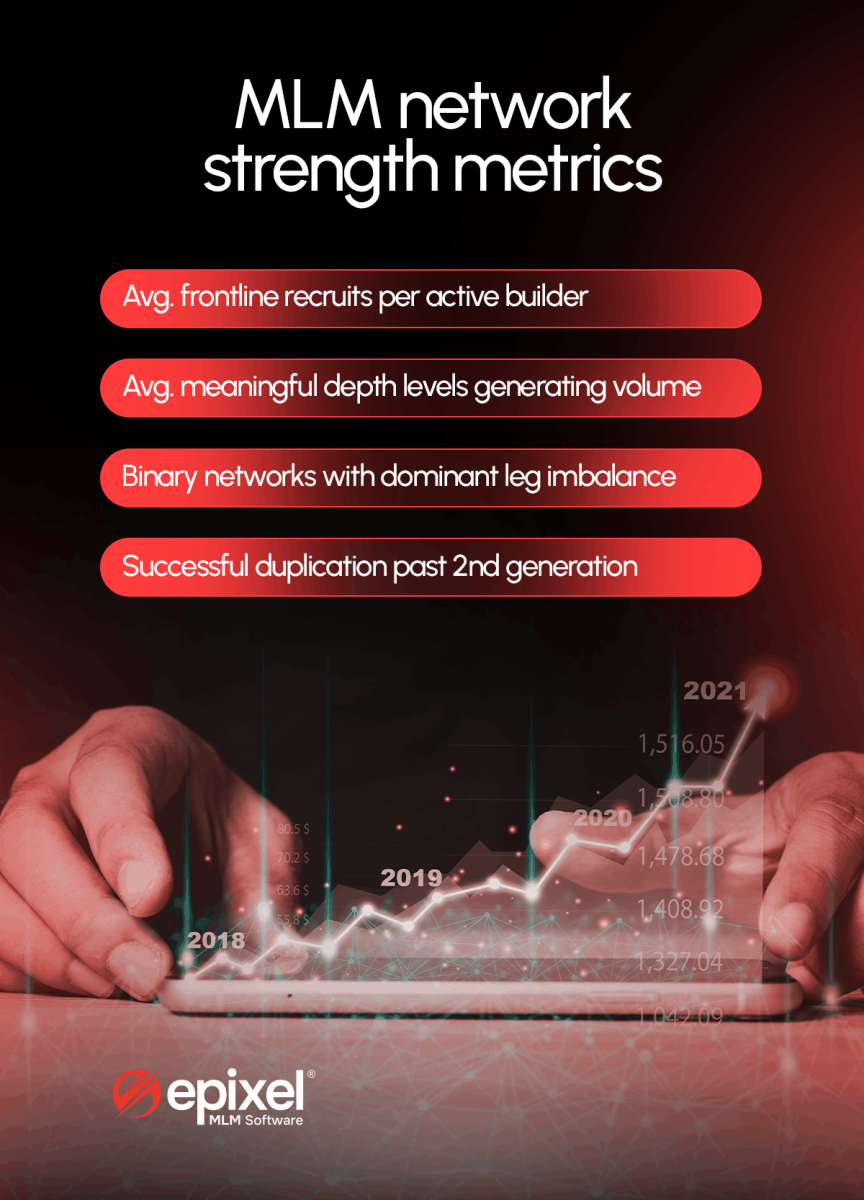
The structure of MLM network, its width and depth, and how evenly volume is distributed across legs determines the level of income equality within the network. This detail is ignored and that affects network growth.
| Metric | Benchmark | Implication |
|---|---|---|
| Avg. frontline recruits per active builder | 7–12 | Width (direct reach) |
| Avg. meaningful depth levels generating volume | 3–5 | Economic depth |
| Binary networks with dominant leg imbalance | ~68% | Structural payout inefficiency |
| Successful duplication past 2nd generation | <22% | The duplication gap |
Fig. 6 – Network structure benchmarks
Data source: Epixel MLM Software Data Team network analysis across binary and unilevel compensation structures, 2022–2024.
Duplication is a serious problem in binary networks. One strong leg and one weak leg create imbalance, limiting earnings, and increasing dependence on upline support.
Almost 68% of active distributors in binary networks report operating with a leg imbalance. Binary plans pay based on matched volume from both legs, but this has a hidden inefficiency. Distributors may generate more sales in one leg but the other fail to complement, distributor loses earnings and this creates inequality. This built-in limitation in the binary plan is the reason for higher income inequality than in unilevel plan.
Strategic insight
Companies must monitor the weak leg ratio because it indicates the economic health of the network. If more than 70% of distributors have a 3:1 or more imbalance, i.e., if one leg is 3x bigger than the other, then the network is highly imbalanced. In such a network, distributors are actively increasing sales but can’t earn fully for the invested efforts because payouts need balanced legs.
Compensation plan design: A core economic layer
Compensation plan designs directly impact distributor behavior and economic outcomes. A compensation plan that rewards early wins and downline building with larger overrides creates a positive economic and motivational impact in network growth.
| Plan type | Avg. payout ratio | Income equality | Rank advancement rate | Best for |
|---|---|---|---|---|
| Binary | 42–52% | Lower (high concentration) | Moderate — leg balance barrier | Faster network growth and promotes team building culture |
| Unilevel | 38–46% | Higher (distributed) | Higher — no balancing limitations | Subscription and service-based businesses |
| Matrix | 35–42% | Moderate — controlled | Lower — depends on spillover | Startups and controlled growth |
| Hybrid | 40–55% | Varies by design | High — multiple opportunities | Mature networks and multiple markets |
Fig. 7 Compensation plan comparison
Data source: Epixel MLM Software Data Team analysis of compensation structures across 40+ direct selling networks. Benchmarks from Epixel MLM Health Score framework.
Sustainable compensation plans allocate 42%-46% of revenue for commission payouts. When plans exceed 55%, they face long-term financial sustainability risk and those below 38% collapses distributor motivation.
The effectiveness of a compensation plan in contributing to network and business’ growth is measured through bonus qualification rate, which is the percentage of distributors who meet the conditions to receive bonuses in a cycle. When an analysis over multiple networks were done, it revealed that 40% of bonuses earned normally go unclaimed due to volume shortfalls, leg imbalances, or rank requirements. These phantom payouts may act like a safety buffer for the company but are a serious blow to distributor trust.
Strategic insight
Every quarterly evaluation of compensation plan must have bonus audits. If more than 35% of distributors fail to qualify for bonuses they believe they are earning, then understand that your plan is complex and not feasible for your network. It is not an issue with the capability of your network. Simplify your qualification criteria because this earns you better retention rates than a bonus percentage increase.
Product economics built on consumption
In direct selling, how long does a distributor earn selling a single product depends on how many times a customer makes repeat purchases of that product. This is a critical product-related concern in direct selling but this is taken lightly and is not given due weightage as compensation or recruitment.
| Category | % of global MLM sales | Est. repeat purchase rate | Economic sustainability |
|---|---|---|---|
| Wellness and nutrition | 31.7% | ~72% | High – Steady repeat purchases |
| Cosmetics and personal care | 24.2% | ~58% | Medium-High – Fair repeat buying |
| Home goods and durables | 17% | ~38% | Medium-low purchase frequency |
| Digital/services (Subscription) | ~7% | ~80%+ where active | High if customers stay subscribed |
| Travel and others | ~7% | ~22% | Low – Irregular purchases |
Fig. 8 – Economic performance by product category
Data source: WFDSA 2023 Global Direct Selling Report; Epixel MLM Software product category analysis. Repeat purchase rates are benchmark estimates based on consumable category data.
A top performing direct selling network is built from consistent buying habits than recruitment.
Wellness and nutrition still remain the most sought after product category in direct selling. This is because nutritional supplements and health products create a natural monthly purchase cycle. If a distributor has 30 wellness customers purchasing monthly, he will have consistent monthly income even without new recruitment.
Strategic insight
Customer repeat purchase rate is a key business health metric than recruitment volume and must be monitored regularly. A network with over 65% repeat purchase rate from customers is stronger than a network that drives the same volume through distributors’ personal consumption.
Behavioral segmentation: Analyzing 5 economies within one network
MLM network is not a single economic unit, it is composed of five overlapping economic behaviors that operates under the same compensation structure with specific income profiles, retention rates, and value-generation patterns.
| Archetype | % of total network | Avg monthly income | Avg retention | Avg network size |
|---|---|---|---|---|
| Inactive | ~45–55% | $0 | < 60 days | 0–2 recruits |
| Casual | ~20–25% | $15 – $80 | 3–6 months | 2–5 recruits |
| Active seller | ~12–15% | $150 – $900 | 10–24 months | 5–20 recruits |
| Builder | ~5–8% | $1,000 – $5,000 | 18–42 months | 20–150 network |
| Leader | ~1–3% | $5,000 – $50,000+ | 36–72+ months | 500–10,000+ network |
Fig. 9 – The five distributor behavioral archetypes
Data source: Epixel MLM Software Data Team. Behavioral segmentation model based on aggregated activity data, 2022–2024. Archetype definitions are activity-based, not compensation-tier-based.
MLM network functions as different economic units with five parallel economic behaviors under one compensations structure. Managing them as a single unit only creates poor business outcomes.
The impact on operations is important because a training program designed for leaders will not be relevant to casuals or newbies. A retention strategy implemented for inactive distributors might undermine active distributor performance. A single strategy for the entire distributor network will not bring expected results. A best behavioral indicator in direct selling is the rate at which casual distributors change into active distributors. This is more powerful success contributor than new signups.
Strategic insight
Design dashboards based on behavioral segmentation, work better than rank-based ones. If your network shows 2-3 percentage points increase in casual-to-active distributor conversion, it represents an improved economic gain than what a 20% increase in recruitment volume could bring.
Discover how we build resilient businesses with advanced MLM functionalities



Drop-off analysis: The economics of attrition in MLM
A serious economic leakage in direct selling happens in the first 30 days of a distributors’ lifecycle even before the company plans its onboarding strategies. The drop-off funnel data reveals that inactivity during the early days is an addressable economic inefficiency in MLM organizations.
| Funnel stage | Conversion rate | Drop-off |
|---|---|---|
| 100 signups → Complete onboarding/first login | ~62% | ~38% lost at step one |
| Complete onboarding → Make first sale | ~45% of those who log in | ~34% of total lost |
| First sale → Receive first commission | ~64% of those who sell | ~10% of total lost |
| First commission → Active at 90 days | ~67% of those who earn | ~6% of total lost |
| Active at 90 days (final) | ~12% of original 100 | ~88 of 100 economically inactive |
Fig. 10 – The distributor activation funnel (Per 100 signups)
Data source: Epixel MLM Software Data Team. Funnel estimates based on aggregated onboarding and activity data across multiple direct selling networks. Rates may vary by company, product category, and onboarding design.
Out of every 100 new distributors, 88 quit before they start getting economic benefits. The funnel leaks before it fills.
Organizations must have an efficient onboarding system that guarantees a first commission through fast-start programs, lower initial qualification limits, or customer acquisition incentives. And, those who have will see an increase of 20-35 percentage points in retention rates within 90 days.
Strategic insight
Design your signup-to-commission funnel as efficiently as a SaaS company does in their trial-to-paid conversion. Identify that drop-off point which causes the largest economic leak and invest there.
Economic variations across geography and industry
MLM economics vary by geography and industry. The income distribution patterns, retention rates, and product performance, all change for each region and industry. These variations are not random, they are structurally explained by market maturity, cultural attitudes toward direct selling, regulatory environment, and product category fit.
| Region | 2023 sales | Market share | 5-year growth (2019–2023) |
|---|---|---|---|
| Asia Pacific | $67.6 billion | 40.3% | -7.2% (compression) |
| Americas | $62.6 billion | 37.3% | +6.8% |
| Europe | $36.1 billion | 21.6% | +8.6% (strongest) |
| Africa & Middle East | $1.3 billion | 0.8% | -22.5% |
| High-growth markets (2023) | Kazakhstan: +30.4%, India: +11.8% | New Zealand: +6.7% | Emerging market opportunity |
Fig. 11 – Regional market performance (WFDSA 2023 report)
Data source: World Federation of Direct Selling Associations (WFDSA) 2023 Global Direct Selling Report; Epixel MLM Software statistics compilation.
Europe is the fastest growing direct selling market in the world when analyzed over a period of five years. Asia Pacific even with a dominant volume is experiencing economic compression.
Volume concentration and growth opportunity are decoupled. The global direct selling data draws the attention of MLM companies operating in international markets toward a strategic insight. A market generating 500 new signups a month and with a 70% 90-day churn is less valuable than the one generating 200 signups with 55% 90-day retention. Hence, decisions on geographic expansion should be made based on cohort retention data than recruitment volume.
Strategic insight
Measure retention rate as the primary health metric when measuring the performance of each regional market. The most promising growth-to-churn ratios are seen in emerging markets like Kazakhstan, India and select European markets.
Top performer analysis

The analysis of behavioral patterns of the top 5% of earners shows consistent and predictable patterns that differentiate them from the rest of the distributors in the network. These patterns can be identified as early as in the first 30-60 days of a distributor’s journey.
| Behavioral metric | Top 5% benchmark | Median distributor |
|---|---|---|
| Platform login frequency (first 30 days) | 4–6x higher | 1–2x per week |
| Time to first sale | < 7 days | 14–21 days |
| Retail customers per frontline recruit | 3–5 customers | < 1 customer |
| Income composition (leaders) | 60% override/40% direct | 80%+ override |
| Weak leg active management (binary) | Active intervention | Passive/no action |
Fig. 12 – Top performer behavioral pattern
Data source: Epixel MLM Software Data Team. Behavioral pattern analysis of top-5% earner cohorts across multiple direct selling platforms, 2022–2024.
The top 5% are more talented and consistent in their behavior. Their patterns can be detected in the first two weeks and predict long-term success.
Platform activity data shows that performers who hit the top spots make their first sale within 7 days of enrollment before onboarding and training is completed. They make sure to maintain a customer base together with new recruits and a sustainable retail-to-recruit ratio that ensure income during low recruitment periods. Top performers in a binary genealogy are not the ones with a dominant power leg but the ones that smartly manage their weaker leg.
Track distributor behavior such as login frequency, first-sale timing, and onboarding completion for the first 14 days to identify top performers early. Assign topnotch mentor support to this segment immediately. The cost of supporting 50 high-potential distributors may seem high but it is dwarfed by the value generated by a single top performer in three years.
Economic sustainability metrics

Most MLM companies build strategies around optimizing growth but only a few built them around optimizing sustainability. In the long run, the former builds a weak network structure that may collapse in the next five years and the latter builds a network that stays active for decades.
| Metric | Industry benchmark | Interpretation |
|---|---|---|
| Sustainable payout ratio (commission/revenue) | 42–46% | Below 38%: motivation risk; Above 55%: financial risk |
| Avg monthly gross income, active distributors | ~$200 (industry) | Median is $0 (full base) |
| Sector Gini Coefficient | ~0.62 | Above 0.65: Regulatory risk signal |
| Annual recruitment needed to maintain 100k network at 60% churn | 60,000 new recruits | Before any growth occurs |
| Revenue Per Active Distributor (RPAD) | Varies; track trend | Declining RPAD in growing company shows thinning network density. |
Fig. 13 – Sustainability benchmark dashboard
Data source: Epixel MLM Software MLM Health Score (MHS) framework; WFDSA distributor data; industry payout ratio benchmarks.
Growth metrics only show how the network is expanding currently by measuring recruitment volume and revenue. Sustainability metrics show whether the network can survive and stay stable over years. Sadly, most companies only track the former.
MLM Health Score (MHS) framework invented by Epixel integrates active days ratio, churn-adjusted NPS, and downline diversity index into a single complete score that gives a holistic view of the network’s economic health.
Strategic insight
Revenue Per Active Distributor (RPAD) is a more honest performance indicator than gross revenue. So, introduce it as a board-level reporting metric together with total revenue. If a company’s revenue is growing but RPAD is declining, then it shows that the network’s economic density is declining. Here, growth is maintained by adding distributors faster but value per distributor is decreasing.
Longitudinal trends: A long-term pattern analysis
A rarest and most valuable analysis in direct selling is the cohort analysis, the one that tracks income and retention of distributor groups who joined the network in the same period over multiple years. When you track the data over a particular period alone, there are chances of missing hidden trends. Networks may show faster growth in the early days but these same networks may later show weak financial performance as they mature.
| Cohort year | Income trend (Survivors) | Network size trend | Strategic signal |
|---|---|---|---|
| Year 1 | Base (100%) | Growing rapidly | Healthy activation |
| Year 2 | +78% income growth | Continuing growth | Network momentum |
| Year 3 | +65% Vs Year 1 (Decelerating) | Still growing | Watch for decline in density |
| Year 4–5 | Plateau or decline for >60% of cohort | Growth continuing | Network vs. income divergence |
| Year 5+ | Declining RPAD | Appears healthy on surface | Pre-disengagement signal |
Fig. 14 – Cohort income and retention trends (Illustrative pattern)
Data source: Epixel MLM Software Data Team cohort modelling. Pattern based on aggregated longitudinal data across mature direct selling networks. WFDSA 2023: Global retail sales -2.3% despite distributor headcount growth.
Network size and income per distributor move apart in mature markets. There may be more people in the network but fewer revenue per distributor. This is one of the early signs of structural economic compression.
When we look at the global direct selling data in the WFDSA reports, we can see that there was a 2.3% decline in global direct selling retail sales in 2023 even with a salesforce growth. This suggests that adding distributors is not giving a sustainable growth condition and per-distributor productivity is decreasing across the industry.
Strategic insight
Cohort income tracking should be listed as a board-level metric. When you see a flat or declining income in your year-3 distributor cohort but year-1 cohort shows strong growth, understand that you are seeing a retention failure masked by recruitment spike, not a healthy network growth.
AI and predictive insights forecast your network’s future
The next phase of MLM economics focuses on forecasting what we cannot currently see, identifying emerging leaders before they know that themselves, detecting disengagement early among active distributors, and recognizing network decline before it shows up in KPIs.
| Predictive application | Demonstrated accuracy or impact | Source |
|---|---|---|
| Churn prediction window | 14 days with 78–85% accuracy | Industry ML retention research |
| Churn detection for rank 5+ distributors | 89% accuracy | MLM.com machine learning study |
| Churn reduction from AI health score interventions | 16–28% | Customer health score research |
| ROI on ML-driven retention vs. equivalent recruitment spend | 3–5x | Epixel platform data modelling |
| Early success prediction window | 14–30 days behavioral signals | Epixel MLM Software Data Team |
Fig 15 – AI predictive capability benchmarks in direct selling
Data source: MLM.com machine learning retention analysis; customer health score intervention research; Epixel MLM Software AI development data.
MLM success patterns are very much predictable within the first 14 days. Data-driven behavioral prediction can help you make the best optimization strategies for sustainable network growth.
Machine learning when applied to distributor behavioral data creates three ways of predictive intervention:
- Churn prediction: Machine learning models analyze behavioral warning signs such as decline in login frequency, reduction in the number of orders, and decreasing recruitment efforts. When these patterns match past distributors who have left, the system can predict churn with accuracy levels surpassing 85%.
- Success prediction: This focuses on spotting future top performers early. This is done by analyzing potential distributor behavior such as frequent activity, fast first sales, early recruitment efforts, and strong engagement with tools and content within the first 14-30 days of joining.
- Network structure optimization: This is about identifying hidden structural issues in the network before they affect income. AI looks for patterns like imbalanced team structures, over reliance on top performers, and weak legs before these lead to income compression.
Strategic insight
Your MLM software platform should be capable of analyzing behavioral data, not just commission calculation. Every distributor activity is a prediction of a future pattern. Hence companies must invest in advanced analytics technology to accurately predict sales, retention, leader development, and network economics.
Conclusion
This analysis does not challenge the legitimacy of the MLM model, it clarifies it. Uneven income distribution, high churn rates, and uneven results are not anomalies. They are the direct result of how compensation plans, onboarding timelines, and support systems are designed. Industry data clearly shows that churn, success, and network growth are predictable but they are mostly ignored. This puts the industry at a point where every company in the industry has to shift from growth-focused strategies to sustainability-driven strategies. Companies who act on these insights will build more strong and equitable systems.
















Leave your comment
Fill up and remark your valuable comment.