



















 Epixel Insights: Compensation and Payouts
Commission payouts are one of the largest investments made by direct selling companies but some organizations do not measure the influence of payouts on distributor behavior. Hence compensation for these companies remains as one static instrument that does not adapt to the dynamic nature of distributor engagement, market conditions, and network performance. These companies miss to understand critical compensation performance aspects like which incentive structures create consistent growth opportunities, which payout frequency will contribute to higher engagement levels, or what volume improves retention without affecting margins.
When compensation structures remain unadaptable, it weakens distributor trust, motivation, and apparently network health. The Epixel MLM Software Data Team has been analyzing payout data across various industries and markets. This study is based on the aggregated data collected from different distributor segments, industry sources, and software platform data. The study argues that paying more commissions does not help in building smarter networks. Companies must understand the compensation factors that influences distributor behavior.
"A compensation plan should be measured by the behaviors it encourages, not just by the commissions it distributes."

“For most of our clients, compensation is one of the largest business expenses. Yet, once a compensation plan is designed and launched, it is often left unchanged for years. We built our Compensation Intelligence platform because we believe compensation should continuously learn from distributor behavior. It should identify which incentives bring meaningful engagement, which improve retention, and where the network is losing the spirit. That is the change we are trying to bring at Epixel.”
Dhanesh Haridas, CEO, Epixel MLM Software
Artificial Intelligence in direct selling compensation payouts will let the companies see the inside of a compensation structure. Meaning, how it effectively promotes distributor behavior, how well an incentive performs, and the changes that would possibly make it perform better. The study explains that AI-optimizing payouts can make it an adaptive, behavior, and profit-conscious system.
The financial reality of traditional compensation models
Before we introduce AI in compensation design, it is important to look into the economic reality of the global direct selling industry. The $163.9 billion market operates with around 104.3 million independent representatives. These figures show the industry’s size but not its economic efficiency. In order to understand that, we need to examine how compensation is distributed within the network and how distributors respond to it.
According to industry standards, a fair and profitable MLM compensation plan allocates about 40-45% of wholesale revenue to commissions. Plans that allocate below 35% find it difficult to attract and retain quality distributors. And for those paying above 50%, initial excitement is a bonus but the network collapses with expansion as the compensation cannot adapt to the growing network without affecting profits.
Epixel Data Team analyzed about 40 direct selling networks to derive a safe payout range. We found 42-46% to be a comfortable range but still companies may face decline in profits if their active-to-registered distributor ratio is poor.
Key data observation:
In the networks analyzed, about 40% of bonuses earned in a payout cycle go unclaimed due to failed volume requirements, rank criteria, or leg imbalances. Although these bonuses are budgeted, they fail to reach distributors reducing their motivation and causing payout leakage.
The payout concentration problem in multi-level marketing networks is equally worrying. More than 50% of the total revenue is generated by less than 5% of distributors and top 1% of distributors receive a large share of commission payouts. FTC’s analysis of 70 income disclosure statements of different direct selling companies underlined this fact. The analysis found that a large number of participants earned $1000 or less annually and in at least 17 companies, the majority of participants earned nothing.
This puts direct selling companies in a challenging situation. The compensation plan implemented to accelerate growth through distributor acquisition is not effective in long-term distributor retention. Because not all new distributors can fulfill every requirement outlined in the plan to earn a commission or a rank.
“Most MLM companies know how much they pay in commissions but only a few companies know whether those payouts are shaping the desired distributor behavior.”
Commission Health Scorecard
The following framework is based on aggregated industry benchmarks and data patterns as observed in the Epixel platform.
| Data category | Benchmark/Pattern | AI use case | Business impact |
|---|---|---|---|
| Commission-to-revenue ratio | 40–45% of wholesale revenue (industry standard) | Testing payout efficiency | Margin protection |
| Unclaimed bonus rate | ~40% of earned bonuses remain unclaimed per payout cycle | Detecting commission leakages | Improve motivation with allocated commission budgets |
| Top 5% revenue share | Top 5% generate more than half of network revenue | Incentive targeting by distributor segment | Reduce the risk of payout concentration |
| Average distributor income | Majority earn $1,000 or less annually (FTC 2024 analysis) | Optimization of earning probabilities | Ensure fairness and increase retention |
| First-year attrition | 50–77% of registered distributors leave within 12 months | Churn prediction and intervention | Increase lifetime value |
| Payout errors (manual) | Error rate of up to 10% through manual commission calculations (PwC) | AI-automated accuracy | Improve trust and reduce disputes |
Distributor behavior analysis for AI-driven compensation optimization
The effect of payouts on distributor behavior is a neglected aspect in compensation design. Compensation triggers emotional and motivational behaviors in distributors which further leads to increased activity and interest in achieving new goals. When a payout is missed, opaque, or unexplainable it just reverses the outcome.
Behavioral pattern observed across various direct selling networks shows that in the seven days before a payout distributor login frequency, follow-up activity, and orders increase. Distributors get motivated to achieve ranks and milestones in the hope of receiving payouts. On the day of payout and the week that follows platform engagement, training completion, and recruiting activity increases compared to the initial weeks. 30-days after payout processing, distributor performance declines if not given an achievable milestone or motivational incentive.
Strategic insight
AI’s purpose should not be limited to calculating commissions alone. It should learn which payouts produce what behavior and identify the ones that create temporary spike followed by declining engagement rates.

“Our analysis of payout data shows that commissions influence distributor behavior more than just earnings. After receiving a payout, distributors are more likely to log in, place orders, and reach out to prospects. However, this increase in activity often declines within a few weeks if there are no follow-up incentives or engagement efforts. These patterns help companies identify the right time to support distributors with relevant incentives, improving long-term engagement and network performance.”
Athira Prasad, Head of Customer Success, Data & Operations, Epixel MLM Software
Distributor activity in the early days contributes more toward long-term retention. When the Epixel Data Team analyzed distributor behavior across different MLM platforms over a two-year period from 2022–2024, it found that MLM compensation plans with fast-start programs and small but frequent bonuses within the first 30 days of enrollment reported 90-day active retention rates that were 20–35 percentage points higher than networks without this type of compensation structure.
Research from Harvard Business Review also indicated that a distributor’s behavior during the first 14 days can predict whether the distributor will remain active over the following months. AI must learn from early distributor actions like making a first sale, recruiting a new downline, or completing a training session, to recommend insights on optimization of incentive structures before distributor engagement fades off.
The behavioral data that drives AI compensation decisions
An AI-powered compensation and incentive system that operates based on distributor behavioral data should monitor and act on the following behavioral signals.
| Behavior signal | Time window | Triggered AI action |
|---|---|---|
| Login frequency | 7 days before or after payout | Recalculate engagement score and decide next incentive timing |
| Order creation rate | 7–30 days after payout | Product campaign targeting and AOV optimization |
| Recruiting activity | 14 days after payout | Activate recruiter incentives or team builder engagement |
| Training completion | 7 days after payout | Update rank progress and activate bonus linked to specific distributor skills |
| Downline activity | 30 days after payout | Leader mentoring incentive, team health alert |
| Wallet balance check | 1–3 days after payout | Reinvestment prompt and product autoship alert |
| No activity (absence) | Any 14-day window | Alert churn risk and reactivate engagement campaign |
Setting the right payout frequency
Timing is a critical compensation decision that influences distributor activity, retention, and revenue. We cannot derive a single payout frequency that can be applied to all MLM compensation structures. It depends on distributor segment and behavior because a new distributor has a different motivational need than a mid-level distributor. Also, an payout frequency that motivates a top leader may not work well for a new joiner.
Binary compensation plans go by weekly commission cycles for it creates a motivational advantage among distributors. This works well for distributors who are still in their activation phase as it reduces the gap between effort and reward. Research also shows that reducing the gap can improve performance, especially in MLM and gig economy.
Comparison of payout frequency vs. consistent performance
The benchmark comparison tabulated below is derived from the analysis of aggregated behavioral data from distributor cohorts and hypothetical modeling by the Epixel MLM Software Data Team.
| Payout model | Activity increase (vs. baseline) | Retention impact | Profitability impact | Ideal distributor segment |
|---|---|---|---|---|
| Monthly | Baseline | Baseline | Highest margin | Experienced leaders and residual earners |
| Bi-weekly | +12–18% | +8–12% | Moderate margin compression | Active mid-tier distributors |
| Weekly | +22–30% | +15–20% | Moderate compression, manageable | New distributors and binary plan active builders |
| Instant wallet | +28–38% (short-term) | +10–14% (90-day) | Highest processing costs | High-activity and event-driven earners |
Note: Activity increase and retention figures are estimated from hypothetical modeling and industry behavioral benchmarks, and presented for illustrative purposes only. Actual performance may vary and depend on network structure, product category, and distributor segments.
Strategic insight
AI can identify the payout frequency that increases consistent distributor activity per commission dollar. It recommends the right frequency for each distributor segment based on their growth stages.
It is important that distributors know when their commissions will arrive and can verify how much they will receive in advance. This improves their trust, reduces disputes, and engages them in training than those in opaque payout cycles. AI-optimized payout systems must work hard on this predictability aspect of payouts balancing the “when” and “how much”.
Segment-based compensation design
Distributor segments differ in skills, performance, and market. Hence the compensation plan for these diverse networks cannot be the same. Each incentive hits differently at each distributor level. Companies with a universal plan compromise on network health and distributor performance. The behavioral analysis led by Epixel MLM Software’s Data Team points to the exact same aspect. A commission that motivates a new joiner may not be appealing to a top leader because their goals, career level, and performance standards are completely different.
Each distributor achievement like recruiting a new distributor, closing a sale, completing distributor onboarding, or progressing toward a higher rank are all based on distributor capacities and predicts future success. It does not depend on demographic factors like age, region, education, etc.
AI-optimized compensation model must segment distributors based on their current behavior and personalize incentives that transform their behavior in a mutually beneficial way.
AI incentive recommendation by distributor segment
| Distributor segment | Key data signals | AI incentive recommendation |
|---|---|---|
| New distributors (Days 1–60) | Time to first sale, first commission, onboarding completion | Fast-start bonus, milestone-based gamification rewards, lower initial payout threshold |
| Casual/part-time sellers | Re-engagement gap, small order frequency, support ticket volume | Micro-bonus for early activity, product discount incentive, 21-day re-engagement incentive |
| Active retail sellers | AOV, repeat customer ratio, subscription renewal rate | Repeat purchase bonus, subscription reward, commission accelerator for customer sales |
| Recruiters/builders | Recruit volume, active recruit activation rate, new recruit first-sale rate | Bonus linked to recruit's first sale, not just enrollment |
| Emerging leaders | Near-rank gap, team activation rate, downline order consistency | Rank advancement bonus, mentoring reward, team volume incentive |
| Established leaders | Downline productivity, team retention rate, rank requalification rate | Leadership pool reward, network stability bonus, team performance incentive |
| At-risk distributors | Declining login, missed commission, payout threshold failure | Personalized reactivation incentive, training completion reward, recognition for renewed activity |
Strategic insight
The question an AI-optimized compensation should answer is not “what did this distributor earn?” but “which incentive this distributor should receive next to produce the best possible outcome for the company and the best motivation outcome for the distributor?”
Predicting rank advancements
Ranks are an integral part of an MLM plan and the same weightage holds for a distributor who is focused on establishing a successful multi-level marketing career. The rank analytics data across MLM networks explains the impact of a failed rank advancement. A distributor who nearly missed to achieve a rank is likely to exit the network in the next 60 days.
The behavioral data also cites a common cause for retention due to rank disqualification. The volume where distributors struggle to progress are the ranks that cause inactivity and attrition. When a distributor fails to achieve a rank, continuously for three times in a row, their interest slowly declines, turns into frustration, disengages, and quits.
A distributor training program or motivational incentive alone cannot hold them back. AI-optimized compensation plans analyze the reason behind the rank advancement lag and then offers the most relevant rank advancement strategy, action or incentive at the best possible time when the action is most likely to help the distributor in achieving the rank or qualification criteria.
AI rank advancement prediction framework
Listed below are the key metrics for an AI prediction engine based on industry benchmarks and Epixel platform patterns.
- Time to rank advancement can be different for different plans. In binary plans, rank progression is faster for initial ranks due to the spillover rules. But in unilevel and stairstep plans, the rewards are slower and focus on consistent team building.
- Rank requalification rate shows the health of the compensation plan. Distributors who miss rank requalification twice in plans where it is a mandatory monthly requirement have 60% probability of churn within the following quarter. (Hypothetical analysis based on platform patterns.)
- Near-miss data represents an important ROI opportunity in an MLM network. A distributor who has already achieved 85–90% of the required volume but falls short in a particular cycle only needs small changes to achieve the next rank. This achievement translates into motivation and long-term retention for the company with an additional boost to ROI.
- Downline contribution dependency is a structural risk indicator. If the rank qualification of leaders depends on fewer than three downline distributors, then that network structure is completely fragile. In such a network, when a single team member leaves, ranks drop and motivation of the remaining members decline.
- Leg imbalance in binary networks is also a main cause for churn. Epixel Platform Data reveals that about 68% of active distributors in binary networks operate with leg imbalance and this reduces their earning potential.
“Modern compensation strategies focus more than rewarding rank achievements. They help distributors realize their potential by providing timely guidance, incentives, and support before opportunities are missed.”
AI rank intervention recommendations
When an AI-optimized compensation system detects a distributor who is close to achieving a rank, it can recommend:
- Recognition trigger that publicly recognizes the distributor’s progress till date to encourage them to keep going.
- Targeted training module which provides personalized training based on identified distributor needs to improve performance.
- Team building action asking the distributor’s upline to step in with coaching, mentoring, or a team campaign that helps the distributor achieve the remaining requirements.
- Product or customer campaigns to help distributors quickly increase their personal sales volume if that is what is needed for the particular rank qualification.
- Conditional micro-bonus which is a small bonus that a distributor earns only if they meet the remaining qualification requirements within a designated time period.
The ROI of AI-powered compensation
Every bonus and commission in an MLM compensation is an investment, but not every one of them returns the same value. Once companies design a bonus or commission, it remains unchanged until the company gets into a crisis. In an AI-optimized payout system, each bonus is continuously tracked and its return is optimized to ensure maximum profit. Total commissions paid, commission-to-revenue ratio, and average distributor earnings are the common metrics companies track to understand the effectiveness of bonus structures but there are other metrics that efficiently evaluate the effectiveness of bonuses and commissions.
- Revenue generated per commission dollar across different distributor cohorts and bonuses.
- Gross margin after payouts. This is tracked every quarter to detect patterns that ensure sustainable growth.
- Incremental revenue from specific bonus programs from each distributor group.
- Cost per active distributor which is tracked from enrollment to the completion of their first year.
- Payback period for each bonus type.
- Payout leakage rate that measures bonuses that fail to produce the intended behavior or business results.
Industry benchmark analysis of incentive ROI matrix
The framework tabulated below provides an estimated ROI comparison for different MLM bonuses based on distributor behavior and industry benchmark data.
| Bonus type | Relative cost | Revenue lift pattern | Retention lift | Primary risk |
|---|---|---|---|---|
| Fast-start bonus | Low–Medium | Activates short term spikes with medium long-term retention. | High (90 days) | Engagement and long-term retention are possible only if followed by an additional incentive. |
| Binary weekly bonus | Medium | Supports consistent long-term activity among active distributors. | Medium–High | Leg imbalance causes payout concentration risk. |
| Matching bonus | Medium–High | Encourages team mentoring and collaboration with leadership quality. | High (leaders) | Delivers low returns when downline activity is weak, as it may reward inactive upline. |
| Leadership / generation bonus | High | Offers the highest retention rates for top leaders with minimal effect on new and less active distributors. | Very High (top 5%) | Compensation costs concentrate on a small performer segment. |
| Rank advancement bonus | Medium | Motivates distributors to qualify for targets but does not support long-term activity. | Medium | Creates only a short term behavioral impact if not followed by new incentives. |
| Retail customer bonus | Low | Promotes sales growth by encouraging product purchases and ensuring customer retention. | Medium | Misjudged for its ability to generate consistent product sales. |
| Pool / profit-share bonus | High | Encourages loyalty among leaders and motivates mid-level distributors to progress to higher ranks. | High (qualified) | Low motivational impact as many distributors fail to understand its working. |
Strategic insight
Bonuses should be measured as an investment, not like a single standard structure. Every bonus should be evaluated for the value it contributes to the growth of the business and the distributor.
Discover how we build resilient businesses with advanced MLM functionalities



Optimizing compensation for network health
Individual payouts can affect network stability. AI-optimized compensation evaluates compensation decisions for the effect they have on individual distributors and on the whole network. A payout that benefits one distributor in the short term can weaken network performance for the long-term if its broad effects are ignored.
One common example in that way is the binary leg imbalance. According to Epixel Platform Data, approximately 68% of active distributors in binary networks operate with a leg imbalance. Since commissions are calculated based on the weaker leg, distributors with a strong-performing leg and a weak-performing leg earn less than expected. This can affect leader motivation and increase attrition. When a leader leaves the network, downlines experience 30-60% decrease in active volume within 90 days.
Compression can become another challenge if it rewards distributors who do not have the needed sales volume or customer numbers for achieving those earnings. In due course, when the structure of the compensation changes, these distributors lose interest because their income was linked to compression, not performance.
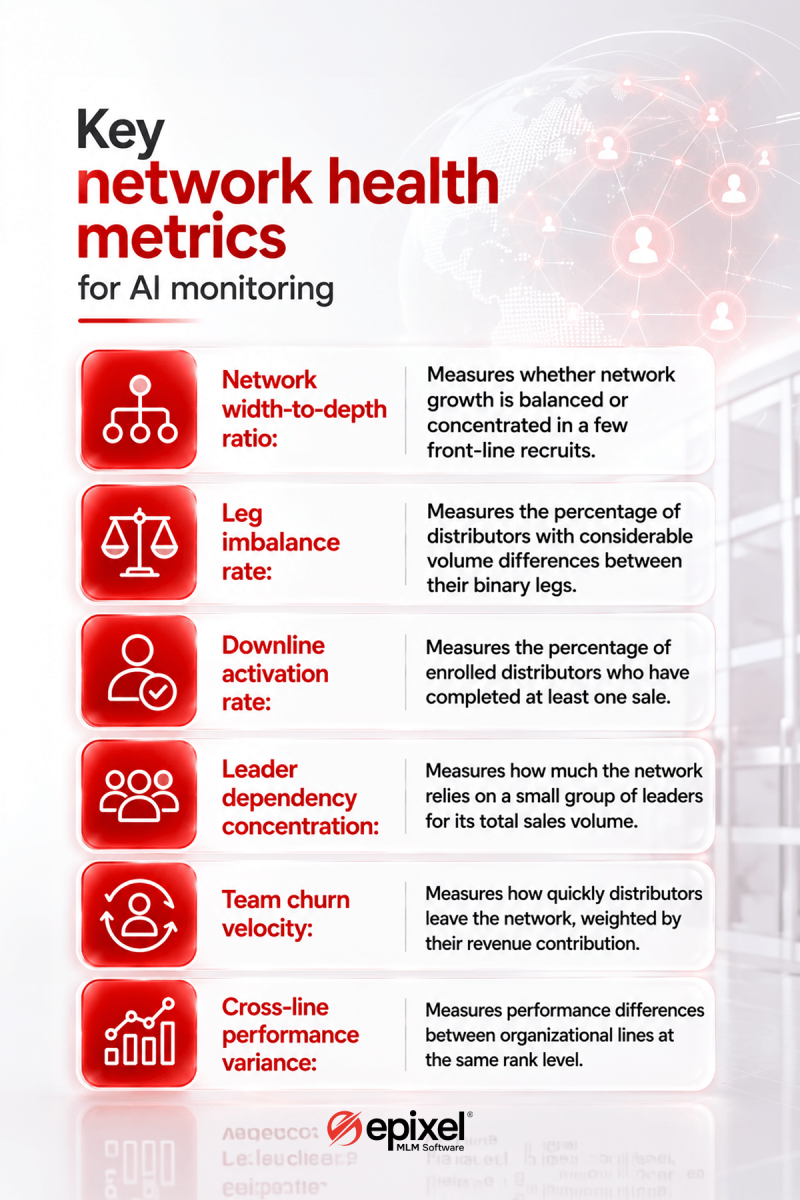
"AI-driven compensation optimization must be beneficial to overall network health and not only for distributors. A payout that motivates one distributor but weakens network stability is not a successful compensation structure. It becomes a disguised liability for the organization."
Churn prediction with AI-optimized compensation system
An alarming fact in multi-level marketing is that between 50%-77% of distributors exit within their first year. The average lifespan of a distributor is estimated at approximately 4.5 months. Even when these figures are known, they are less frequently discussed. One good news is that a major portion of this figure is preventable if the compensation can detect the early signals of churn on time.
Traditional compensation plans lack the capability to detect the churn risks, they only calculate and pay what needs to be paid. But AI-optimized payouts through detailed distributor behavior analysis can detect early signals of disengagement and inactivity to help businesses act on them at the right time.
Early warning framework with high-confidence churn signals
| Churn signal | Risk window | AI-recommended intervention |
|---|---|---|
| No first commission within 14 days | Critical (highest early churn risk) | Activate fast-start bonus, initiate onboarding support, and alert upline |
| No first commission within 30 days | High (dropout expected within 60 days) | Launch reactivation campaigns, reduce micro-bonus threshold, start product campaigns |
| Declining commission trend (3+ cycles) | Medium-High | Start training sessions for upskilling, analyze rank gaps, and set achievable personalized goals |
| Repeated payout threshold failure | High (economic discouragement) | Put threshold adjustment signal for executive review, launch strong training and support |
| Commission dispute filed | Medium (trust erosion risk) | Prioritize support escalation, give detailed explanation on the dispute cause, and follow-up for satisfaction |
| Failed payout (technical) | High (trust critical) | Prioritize immediate resolution, introduce a recovery incentive, and ensure strong communication |
| No downline activity in 21+ days | Medium (Slow or no network growth) | Launch a team-building incentive, generate a downline health report, and offer mentor support |
| No repeat customer orders | Medium (sales quality risk) | Customer relationship training and provide repeat purchase incentive for distributor's customers |
Distributor behavioral analysis across 210+ direct selling networks reveals that 20% of distributor churn is connected to compensation and the remaining 80% is related to psychological behavior triggered by early failures, lack of support, demotivation from social comparison, and loss of interest after initial investment. AI-optimized compensation, hence, must address both aspects, financial and psychological. A re-engagement campaign along with a micro-bonus and public recognition can contribute better to retention than a financial incentive alone.
Key finding
Distributors who earned their first commission within 14-21 days of enrollment showed better retention rates (20-35 percentage points higher) at the completion of 90 days. Timing and recognition matter more than the payout amount and AI should detect and accelerate this event.
Trust, transparency, and explainability in AI-optimized payouts
When compensation systems become advanced, there is a possibility that the payout process becomes opaque and confusing for distributors. Compensation structures are designed to influence distributor behavior but when it becomes opaque, the opposite happens. Commission disputes, payout confusion, and fairness concerns are among the highest churn accelerators in MLM. These are not caused mainly by payout errors or delays but due to the inability of the distributor to understand the logic behind their earnings.
A PwC research found that manual commission calculations can cause 10% higher error rates. Automated payout systems reduce this, and the risks related to overpayments and delays. There again, establishing trust becomes an important factor. Even if a distributor gets paid correctly, the confusion leads to network exits, if not immediately in the following months. An XAI framework can make the payout process transparent and explainable to distributors along with accurate and real-time payouts.
Payout trust metrics for AI to track
The metrics below are very specific to the MLM payout process and tracking them can reveal churn risks across distributor segments.
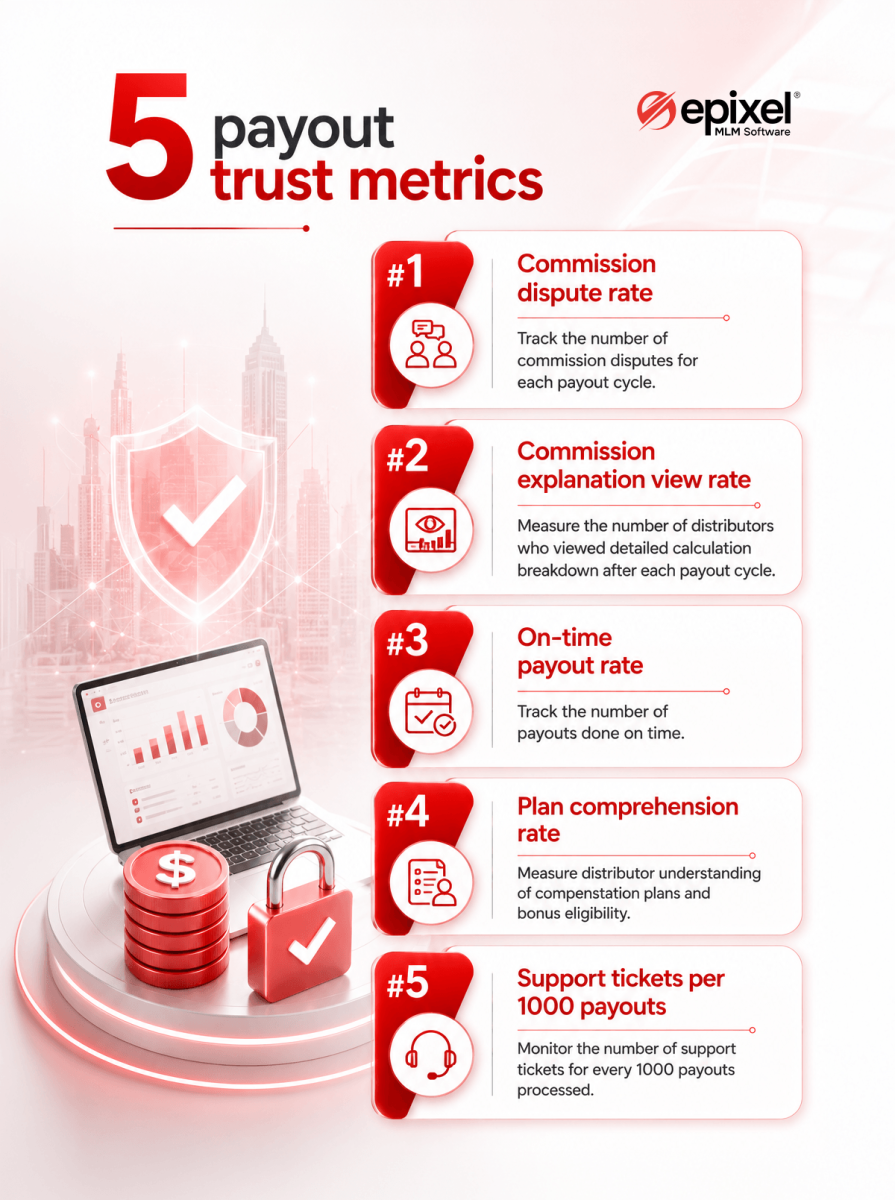
"AI-optimized payouts must be explainable. A distributor should be able to understand the logic behind their earnings and the actions they must take to improve. Optimization without transparency does not build trust, it destroys it."

“Every improvement we make to our compensation platform begins with a simple question: will distributors understand it? AI can help companies recommend better incentives, detect unusual payout patterns, and improve compensation decisions. But if distributors cannot clearly understand how their commissions were calculated, they might not trust the system. That is why transparency is built into our compensation platform from the start. When distributors understand their earnings, they will have greater confidence in the business.”
KPA Sidheeque, Head of Product, Epixel MLM Software
An XAI framework can help companies in building trust by creating a personalized and simple language explanation for every payout which connects distributor actions to their earnings and the gap to their next milestone. This increases the confidence of distributors in a network than any other network offering higher payout rates.
Fraud, compliance, and payout risk detection
When the business expands, risks of compliance and fraud increase. AI can help companies reduce financial losses and maintain compliance across all markets and distributor networks. Some distributors may try to manipulate the compensation system by creating artificial sales for bonus qualification, making large personal purchases, or returning products after receiving commissions. These activities increase compensation costs and can put the company at regulatory risk. Regulators demand companies to be fair around aspects like income claims, genuine product sales, and compensation practices.
Hence companies need Compensation and Incentive AI systems that can detect unusual payout patterns and manage compliance efficiently. AI helps detect risks early so that direct selling companies can protect finances and the integrity of compensation plans.
AI detection framework for payout risks
| Risk signal | Business impact | AI detection logic |
|---|---|---|
| Duplicate account detection | Prevents manipulation of commission criteria and artificial volume increase | Cross-reference enrollment data, device fingerprints, payment details, and address clustering |
| Suspicious order timing patterns | Orders placed at the end of a month only to qualify for commissions | Volume timing analysis, calendar heatmap anomaly detection |
| Refund-after-commission pattern | Commissions paid on orders that are later returned causes highest payout leakage | Refund-to-commission correlation by distributor, lag-adjusted reconciliation |
| Self-purchase concentration | Distributors making personal purchases only to qualify for commissions or ranks pose serious regulatory risk | Retail-to-self-purchase ratio monitoring, customer-to-distributor order ratio |
| Unusual rank advancement speed | Rapid rank advancement which is inconsistent with network growth can signal artificial qualification | Velocity benchmarking against cohort norms, leg composition quality scoring |
| Clawback/reversal rate | Reversals and returns after payouts create trust issues and accounting complexities | Real-time reversal tracking, clawback trend analysis by product category and region |
| Cross-border payout anomalies | Exchange rate manipulation, tax compliance gaps due to incorrect payout calculations, regulatory compliance violations | Region-specific payout logic, KYC verification, compliance moderation |
Strategic insight
AI-optimized payouts should increase earnings and reduce payout risks. A perfect balance keeps business integrity and distributor trust intact. A compensation system that speeds up payout process and parallelly monitors manipulation and non compliance is a risk management asset for MLM companies.
End blind plan changes with scenario simulation
The most advantageous capability of AI for MLM companies is the ability to simulate various compensation conditions and analyze their outputs. This is important for an MLM company because compensation plan changes in an established business are highly risky. Even minor changes can reverberate across various business aspects, and the intensity of impact is only known in final profit statement.
Direct selling industry has seen so many distributor exits due to compensation changes that were not tested before implementation. In some cases, changes intended to stabilize growth have negatively affected top leaders and resulted in mass exits. Simulation makes change management simpler through strategic planning and implementation.
Scenario simulation framework
| Proposed change | What to measure | Risk to watch | Decision trigger |
|---|---|---|---|
| Increase fast-start bonus by 20% | New distributor activation, 90-day retention, incremental cost, churn-rate effect | Higher payout costs without enough retention improvements | Implement if retention-driven ROI exceeds the additional payout cost within six months |
| Reduce payout threshold by 30% | Small-earner activation, wallet activity, total payout volume | Increased payout costs without activity growth | Proceed if the change improves engagement among at-risk distributors |
| Move from monthly to bi-weekly payouts | Activity lift, processing cost, distributor satisfaction | Increased operational costs, cash flow timing | Begin with a pilot group and expand if distributor activity improves by more than 15% |
| Add leadership mentoring bonus | Team activation rate, downline productivity, leader retention | Incentivizing passive earnings without proper team development | Tie rewards to verified team outcomes, such as a recruit's first qualified sale |
| Introduce personalized incentives | Performance improvement compared to standard incentive campaigns | Increased plan complexity and potential fairness concerns | Conduct a 90-day A/B test across matched distributor groups before final deployment |
"The future of MLM compensation is simulation before implementation. Companies should not change compensation plans based on intuitions of executives or competitive pressure. They should test the results before final implementation, especially testing behavioral predictions against past cohort data before committing to structural changes."
Sustainability and fairness in AI compensation
Ethical practices in MLM have always been under discussion especially the ones related to compensation. Payout concentration at the top tiers and stress on recruitment than sales have been the focused two.
With all the advantages AI-optimized systems offer, there are hidden risks when it comes to sustainability and fairness. AI models can improve compensation only with the given rules. Hence it is important to guide the model with the right goals and safeguards. If it is trained to focus only on increasing short-term revenue, it may recommend incentives that accelerate recruitment. This will also be followed by poor quality sales, compliance risks, and distributor churn. Companies must ensure that AI models ensure fairness and compliance along with better compensation plans.
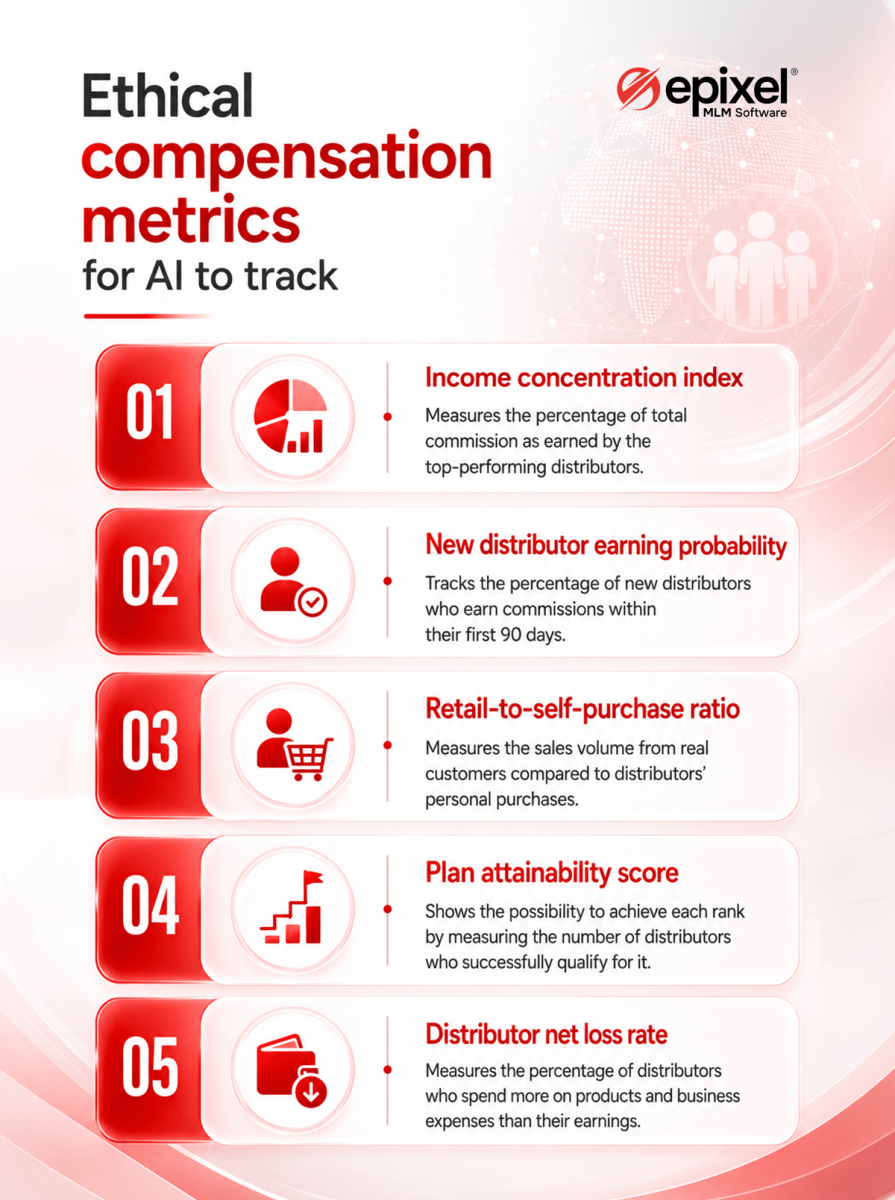
AI-optimized payout systems should alert businesses when the payout concentration increases in a particular distributor segment. MLM companies must focus on building fair compensation systems that offer earning opportunities for the majority of distributors. Fairness in MLM plans can reduce payout concentration, increase distributor lifespan, and a loyal customer base that brings consistent revenue.
Longitudinal learning for adaptive compensation
Another important aspect of AI-optimized compensation system is its ability to learn continuously from its own recommendations and from new data when it becomes available. The system continuously analyzes which incentive works for which distributor segment under what conditions.
AI-optimized compensation plan pushes back the lags caused by a traditional compensation plan in decision making and change management. A decision that takes 12-18 months in a traditional setting happens in real-time in an AI setting. The AI-powered system continuously tracks every payout, incentive performance, and criteria adjustment and correlates the results with subsequent distributor behavior, retention rates, revenue quality, and network health metrics. Over time, the model becomes more accurate and offers precise insights on distributor behavior and market conditions.
What should an AI system learn over time
- Payout model performance trends: It should analyze how the commission-to-activity ratio has changed in various distributor segments over a period of 6-months.
- Distributor retention by enrollment cohort: AI systems must track the activation conditions that produce the highest lifetime value across distributor generations.
- Incentive ROI trends: Check the effectiveness of different bonus types when the network grows, and distributor expectations change.
- Rank progression trends: Monitor the achievability of the ranks as the network grows or becomes increasingly concentrated.
- Revenue quality trends: Track whether the sales that the plan is incentivizing is producing real customer relationships or one-time volume increases.
- Churn prediction accuracy: Measure the efficiency of early warning signals in predicting actual distributor exits.
- Fraud detection calibration: Update anomaly detection thresholds continuously as gaming patterns increase.
- Commission dispute reduction: Track the role of transparency improvements in reducing friction or check whether it is simply moving the complaint from one channel to another.
"Epixel's compensation intelligence is not a static calculator. It is a learning system that is designed to analyze millions of payouts, distributor behaviors, rank movements, and sales outcomes to identify which incentives actually create profitable growth and continuously refine its recommendations over time."
Conclusion
The direct selling industry is entering a new era where static compensation plans are no longer enough. During a time when distributor expectations are changing and digital alternatives are capturing markets, an adaptive compensation system can help companies improve engagement, optimize payouts, and ensure consistent revenue growth irrespective of market and business conditions.
The findings of our study point out that traditional compensation plans must be replaced with intelligent data-driven systems. AI-optimized payout systems enhance the payout process by working level deep into distributor behavior to improve retention, revenue, and compliance. Added to these are the benefits of reduced risks, payout expenses, and commission leakages.
Direct selling companies already have huge amounts of behavioral data. Converting this data into actionable insights is what will make their compensation smarter and business perform better.
“Direct selling companies are sitting on one of the most valuable behavioral data assets in any consumer-facing industry and most of them are using it only to process payroll. Every payout, every rank attempt, every login after a commission, every churn signal that went undetected, all provide insights about what your distributor network needs. The companies that know how to read those insights and act on them in real time will redefine what a compensation plan is capable of.”
Dhanesh Haridas, CEO, Epixel MLM Software













Leave your comment
Fill up and remark your valuable comment.