


















Unilevel plan breakage has never been openly discussed within most multi-level marketing organizations. The unilevel breakage may also cause suspicion and confusion, which may result in resentment and mistrust among distributors. When breakage occurs, distributors suspect that their commission is being embezzled, defrauded, or stolen in favor of the firm. The direct sales industry is aware of its existence, but it is a sensitive topic to be discussed in open forums.
By default, companies do not think of breakages as negative. It actually works to the advantage of the firm in a myriad of ways. The payout ratios are maintained by breakage, particularly when the company is expanding at a high rate. The number of leaders that can quickly qualify because of breakages is low, and this prevents a situation in which the pool is segmented into small portions. Breakage is also the safety net of network marketing firms in case of uncertainty, like refunds, unforeseen currency variations and alterations in rules and regulations.
Since the majority of the MLM companies have structured dashboards to monitor and calculate all sales and remuneration, field leaders insist that they obtain a comprehensive commission breakdown. This is aimed at making the companies handle the breakages effectively without eroding the morale of the distributors.
What is breakage in a unilevel plan?
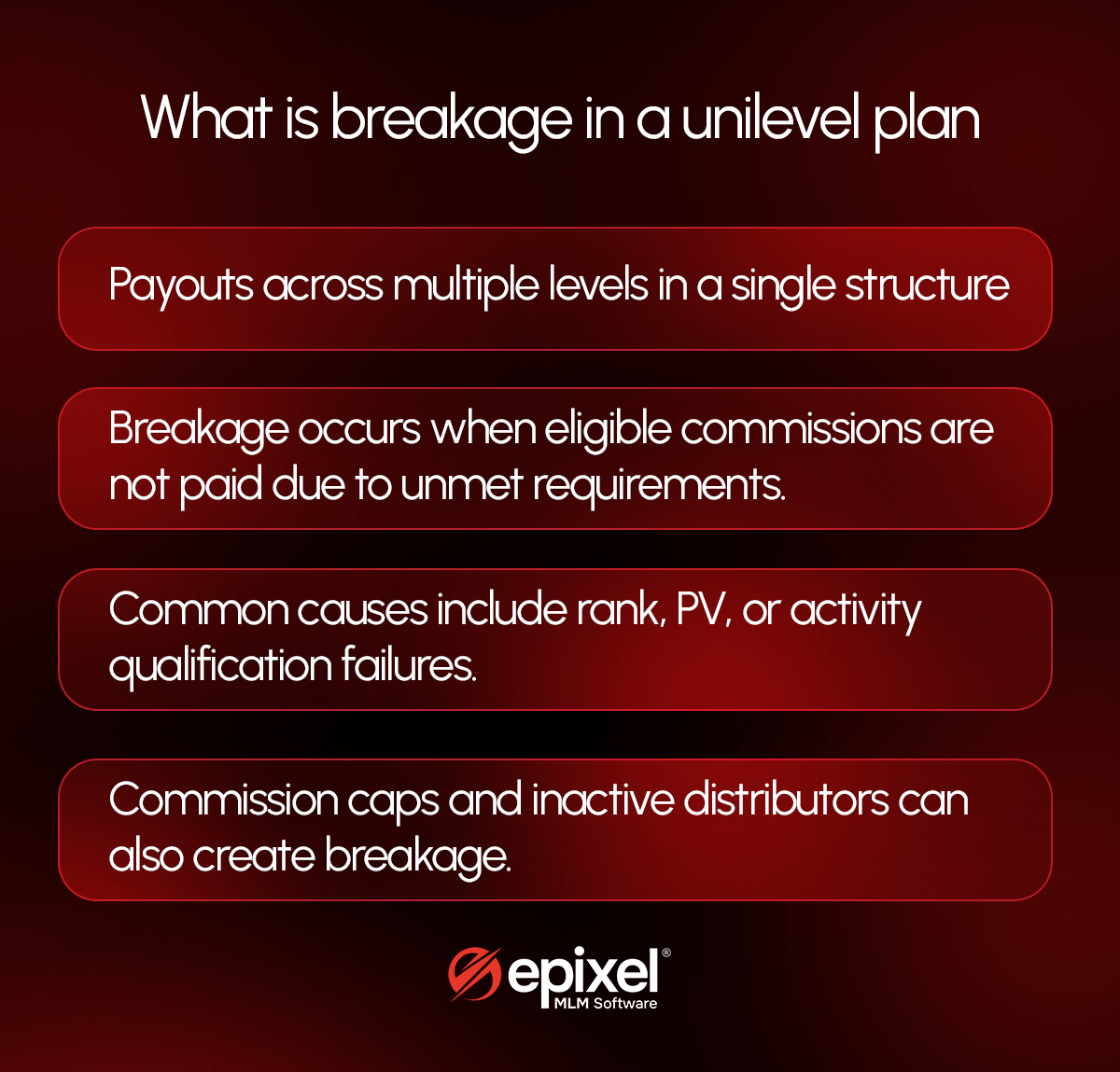
We will first familiarize ourselves with a unilevel MLM plan before we start discussing breakages in a unilevel plan. Unilevel is a single structure having many levels and distributors who recruit people can earn commission out of it up to a few levels down.
A breakage occurs where a distributor in the upline or downline might be eligible for commission, but fails to receive commission because they do not satisfy certain requirements.
When the upline fails to achieve the rank or personal volume requirements, distributors fail to receive commission. Commission will not be paid for the amount earned by the distributors that exceeds the commission cap. The additional funds exceeding the cap will be regarded as a breakage. In case a person is not working or performing well in a network structure, they will not qualify to earn commission and that balance will be termed as a breakage. In some cases only a few leaders in the pool are eligible for the bonus amount. The remaining will be regarded as a breakage.
In short, the breakage of your company is the difference between the theoretical maximum payout and what is actually paid out once all the rules and conditions are put into practice. There are healthy gaps that exist but in some instances, a gap is an indication of incompetent commission plan design.
Companies must make sure that failures in the MLM compensation plan do not occur because of a poorly designed plan. The unilevel MLM software must be able to explain to distributors the commission management policies in a detailed way, why someone was not paid, their qualification status. A traceable breakage should be explainable to distributors which can be accomplished with an explainable commission framework.
Start with a payout model, not with breakage
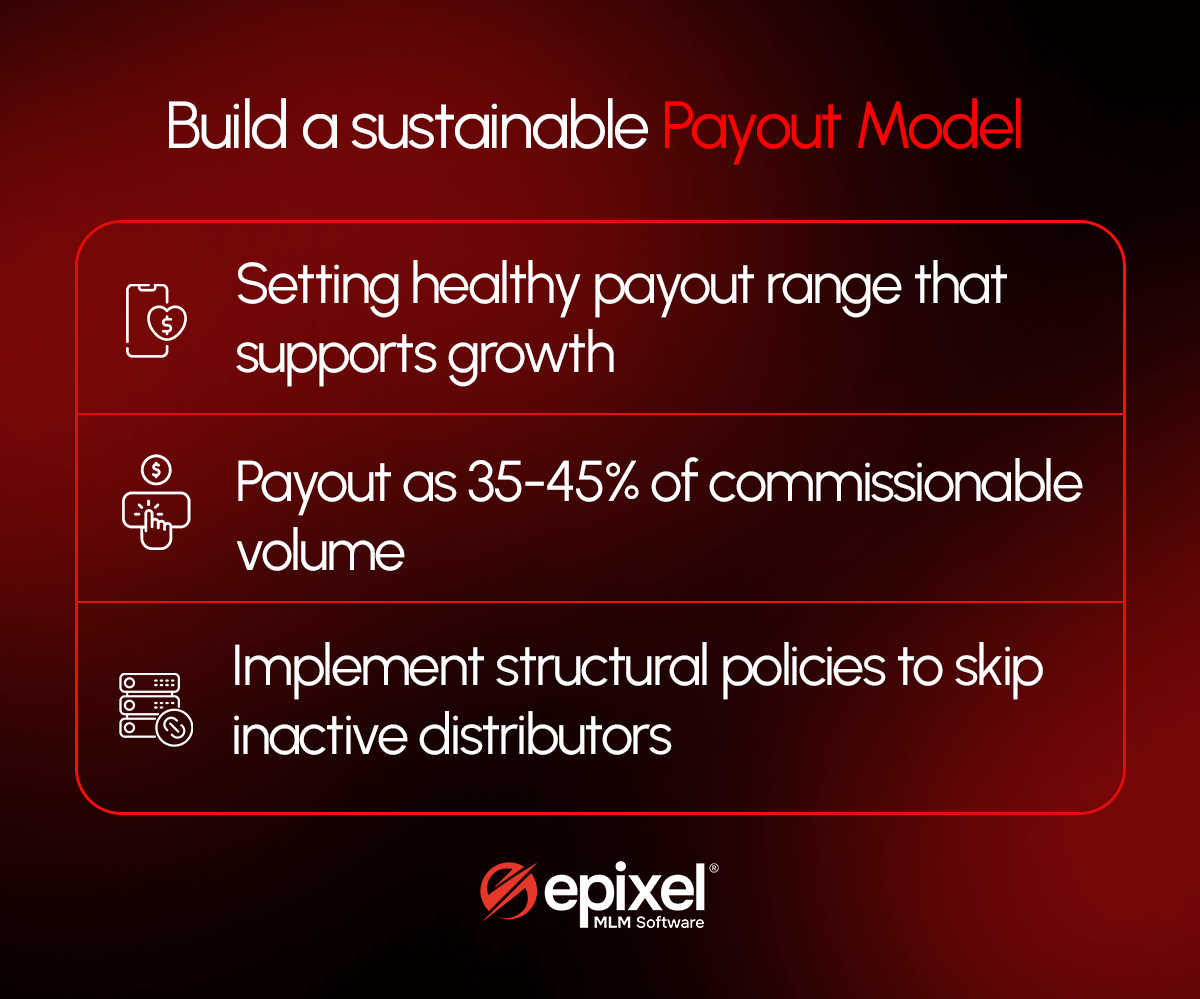
Primarily companies must be positively oriented towards the compensation plan. The company should not immediately start establishing the breakage as part of designing a structured unilevel plan. It should turn attention to creating a healthy payout range which aids growth and prevents churn scenarios.
To substantiate this, it is vital that the company should clarify a couple of things. The payout should remain at 35-45% of commissionable volume. The company ought to establish achievable earning rates at the various levels. The earnings of a part-timer cannot be similar to those of core leaders. When the company is planning, the internal costs should be considered that will include the technology costs, MLM software, apps, and trackers, the logistics, including the warehouse, shipping, and delivery, support costs, and the profit, the money that the company retains to survive and expand.
At this point the company ought to come up with an ideal structure. The first one is to establish the base commission which will give details on the levels, up to which you can receive commissions. Implement dynamic compression or other structure policies that are able to detect and thereby skip the idle distributors and pass the payment to the next active individual in the queue. In addition to the base payment, there are predetermined additional bonuses such as rank bonuses, matching bonuses and money that may be earned through leadership pool bonuses.
The company ought to test the planned model in any business environment prior to making the final decision and releasing it to the market. Observe how the commission plan works with an MLM commission plan template and level at which the breakage occurs. Breakage should be a byproduct of rules established, not a goal.
Make compression rules work for active builders
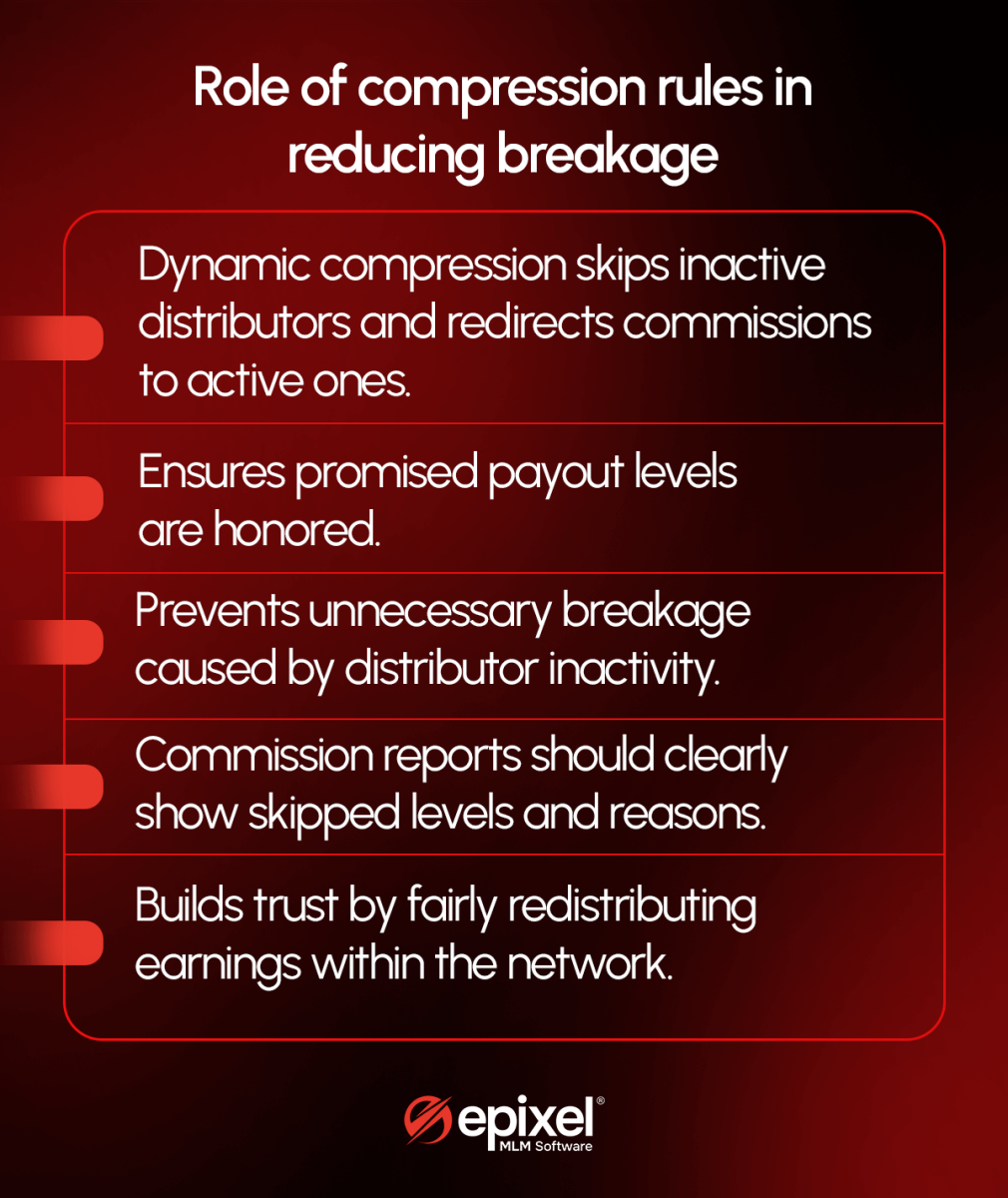
Under unilevel plans, the payout can be stagnant and turn into breakage in cases where there is an inactive distributor. This is avoided by dynamic compression which identifies the inactive builders and skips the money to active builders.
Only inactive builders should be skipped by the compensation plan. As a case in point, it must skip distributors who do not fulfill the PV requirements or are idle over several months. But the plan must pay the levels it has promised to pay. The plan to be used should be communicated to distributors through simple diagrams and images in the commission plan document.
When the commission report is generated, there must be information about what levels were skipped, why it was skipped and who they paid the compression commission to.
This reverses the narrative from the company that denies us our money to the company that fairly redistributes the payout of inactive distributors to the ones that were active in the upline.
Be explicit about where unallocated funds go
Unclear communication will lead to mistrust amongst the distributors in MLM. Unless the company actually reveals the information regarding where the breakage fund goes and why did not some uplines receive payments, distributors tend to assume the worst. This may even lead to the gradual death of the company.
The vast majority of firms reimburse their leadership pools monthly even when the profit margin is low through breakage. This makes sure that the top leadership ranks remain intact and motivated. The technical infrastructure can be enhanced using the breakage money. This will regain confidence of the distributors and the number of complaints will reduce. Another significant area that they can apply the fund is in auditing, ensuring compliance as the companies may incur extreme penalties and legal problems in case they do not comply. To educate and train your distributors, it would always be worth investing in the available training tools and resources. Any network marketing firm is anchored to success by an active distributor who is well acquainted with the business.
To explain it, does not imply that the companies need to explain it line by line, but it is possible to mention the payout limits, how the unallocated money will be used, and assure the people that this strategy will make the company survive the hard times.
The brand story ought to be congruent. The distributors should trust you and have a unified story during your leadership calls, in the compensation manual and support scripts as they form a relationship with them.
Build reports that answer “why” questions, not just “how much”
When your commission statements only give the total payout and the amount of bonuses they received and do not give a breakdown of how they received the bonuses, it contributes to poor assumptions.
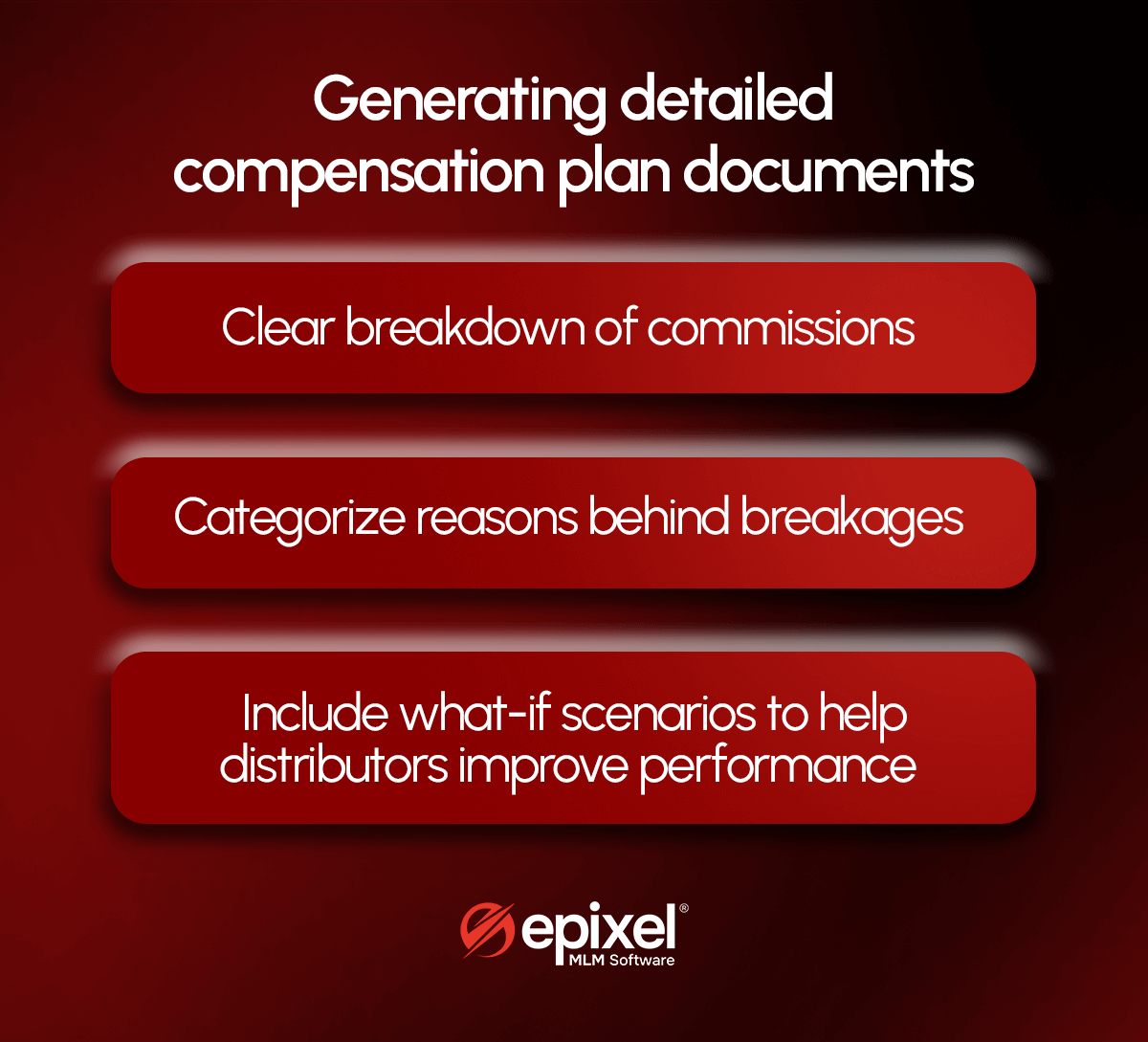
Your back office ought to assist in firm-level analytics about the theoretical and actual payout on a monthly basis, reasons behind breakage ought to be categorized, and the pattern of payout ratios over time ought to be uncovered.
All distributors should be provided with transparency on the payouts. The report should clearly show which order, by which customer, and which level they received the commission from. The reasons for omitting some distributors at a particular level should be mentioned. There should be a good commission path showing the level that was qualified to receive the payment and the level that received the payment.
It is a healthy way to include in the report, the simulation of what-if scenarios. This type of simulation would tell them how much they would have earned had they fulfilled this requirement. This assists the distributors in self-reflection, corrective lessons and ways that they can improve in the future.
Thus, your platform will not be merely an MLM platform, it will be a learning center that sees distributors as worthy individuals and gives advice on how to succeed in the industry.
Communicate breakage as protection, not penalty
Rules and criteria come into existence when something is wrong in the history of the company, or a pattern that is common in the industry was noted. This may be companies paying too high too quick, and unsustainable bonus pools to others where the leaders are making massive amounts as the company is losing money.
Such contexts should be explained to distributors in compensation manuals and at trainings. Talk about how the lack of qualification criteria makes many people eligible for rewards, while good performance goes unnoticed.
This is to explain the existence of some safety measures or limits. When it is explained in the right contexts and logical thought processes, it will be easy for distributors to understand the idea easily and be able to work with it, rather than perceiving it as an obstacle that blocks their reward and commission payouts.
Use policy and software to avoid exploitative patterns
Unhealthy in unilevel plans are foggy conditions and hidden clauses. There are limits and provisions that they did not disclose in the start and surface only during the time of payout.
There are some tips that firms can follow to ensure that they do not repeat the same mistake. The first one is to disclose the rules and make them readable and comprehensible. It will end the perplexity. The plan ought to communicate how income varies at each level.
Instead of taking away the eligibility to receive a commission, inform distributors through trigger notifications. These messages must remind them that they are X% short of being qualified to receive a commission. Clarify to them whether they reached any leg caps so that they will not be caught with surprises.
The company must ensure their financial and legal teams vet the plan to make sure it is not illegal, safe to present it to the auditing team before launching any compensation plan.
The litmus test to see that it is a simple plan is to know whether the plan can be explained in less than 2 sentences. When it is taking more time to explain, then there is a high probability that it will be complicated for the distributors.
The plan should only occupy a single page on paper since it should be understandable by the distributors but the complexity must be addressed by an effective MLM commission software.
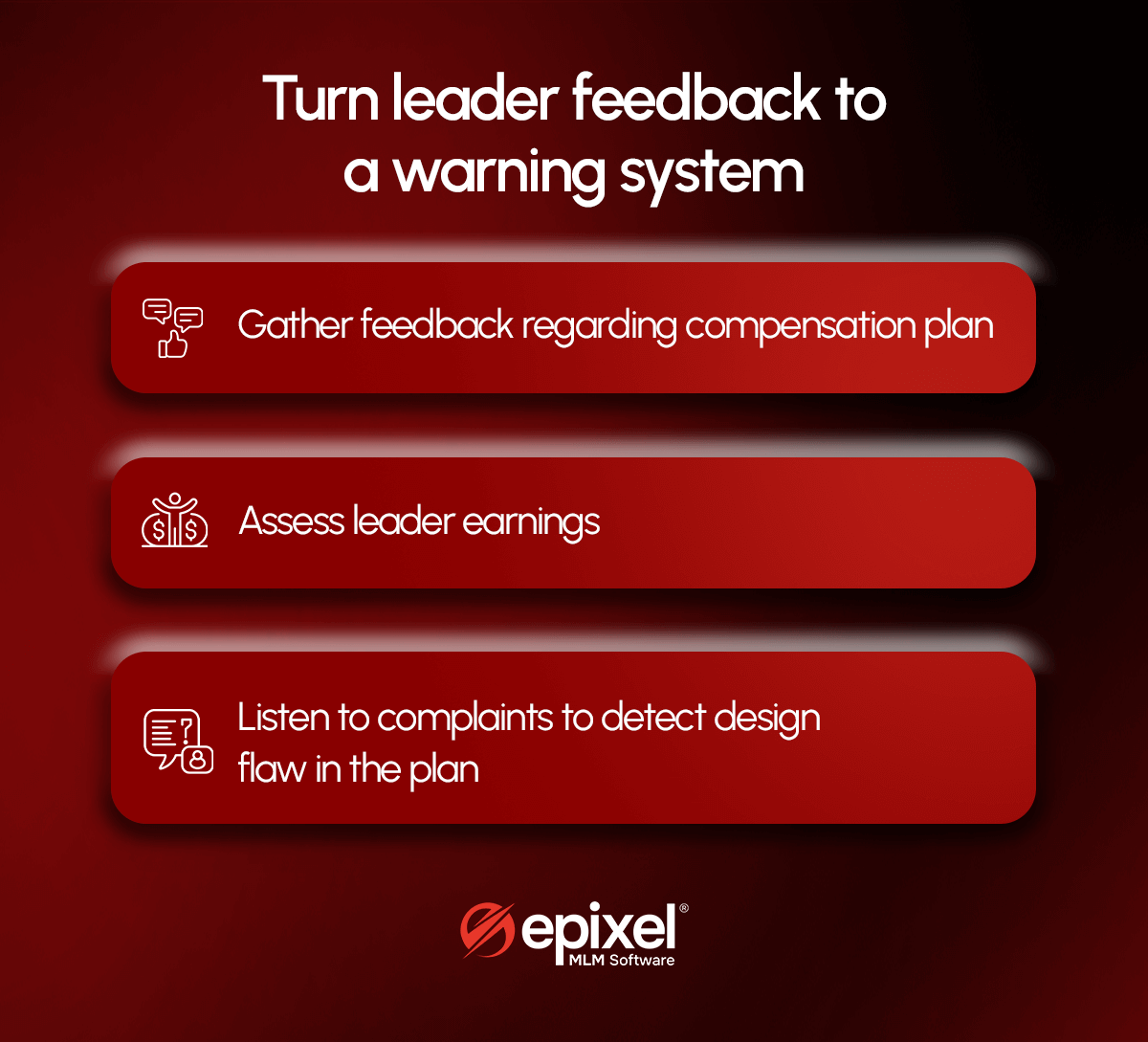
Treat leader feedback as an early warning system
Add routine listening to your support service operation as far as compensation plan is concerned. This may be in the form of quarterly calls to gather feedback regarding the compensation experience.
Companies should initiate surveys on where they are not clear in the plan and where the distributors are surprised or disappointed. Distributors should have a channel through which they can raise a grievance that needs to be addressed.
The company ought to compare this feedback with Excel data. Compare what leaders actually earned with what they should have earned and their ranks. Make sure that breakages are not concentrated on a particular rule. When people are complaining about a single rule in particular, then it is a design or communication flaw.
Use “shadow payout” analysis internally
The company ought to carry out a stress-test simultaneously to determine the effectiveness of the plan using different scenarios. This need not be visible to the distributors.
Shadow scenarios include what the payout would have been if there were no caps, the payout if every account meets minimum PV requirements, and what would be the payout if a different compensation model was applied. After the test MLM companies obtain a detailed report on whether the plan is structurally sound or an unhealthy one that needs fixes. It checks whether the limits set bring financial stability or frequently block the mid-level earners from receiving commission. It checks whether one set of rules is biased towards a certain pattern.
The shadow method cuts through all the noise and provides data-driven insights to improve or fix the plan, if required.
Reserve part of breakage for “shock absorbers”
MLM companies face several uncertainties, and instead of using the breakage fund for all generic issues, companies should keep an official reserve which is funded by breakage money. This will act as a safety or buffer fund to be used in unusual and grave situations.
The reserve fund should have a structured rule. Only a certain percentage of breakage money should be allocated to that emergency reserve. Some pre-agreed uses of such funds include paying leadership pools their monthly bonuses even during downtime, funding compensation adjustments that come with regulatory changes, and supporting changes in plans.
It builds a belief that breakage isn't random but a planned safety net to protect the company.
Anticipate “gaming” behaviors before they appear
Some distributors may try to manipulate the system, plan purchases in such a way that they earn more money than promised in the plan. Hence, companies should design compensation plans like game designers. Use scenario workshops across all departments to design a smart compensation plan.
The finance team should analyze if anybody can manipulate the payout math. Distributors tend to narrow down structures so that some levels don't get paid, or payment stops at a certain level. The technical team should be advanced enough to detect these suspicious activities, strange structural changes, and immediately flag it for the company to take action on it.
No one understands humans better than other humans. Leaders should evaluate whether a rule can be misused or manipulated by the distributors.
Here are a few manipulation tactics to watch out for:
Committing structural manipulation by splitting the branches only to avoid or not hit the earning limits
The end-of-the-month self-consumption that is often done only to qualify for bonuses. This is never done to reach a genuine sales target.
Creating fake inactive accounts so that breakage money gets created, and these distributors redirect the money elsewhere to eventually benefit from it.
The MLM software should not only calculate unilevel commissions but also should watch the distributor's activities and patterns closely. The system should be equipped to immediately flag and provide warning signals to the company regarding suspicious activities by distributors.

Discover how we build resilient businesses with advanced MLM functionalities



Breakage that can be defended, not hidden
It is practically impossible for companies to completely get rid of breakages. But the breakage should feel like an inevitable gap that happened due to genuine rules and qualification conditions.
And for this, companies should build an efficient model, apply compression rules, explain clearly where breakage money goes, provide clarity on why certain safety guardrails are kept, and conduct internal simulation to stress-test your compensation plan prior to launching it.
Then breakage becomes part of the financial safety plan, and it will gain the confidence of distributors and leaders.














Leave your comment
Fill up and remark your valuable comment.