


















Unilevel compensation plans are usually chosen because of their simple design. It has a single structure with many levels and it still carries a manageable distributor field. The simplicity, however, is a cover to a complex design problem, which is to compensate without undermining company growth.
The majority of the MLM companies fall into either of the two extremes. Some do not pay well and lose serious builders in the long run. Some of them make the highest payments and then later find out that their payout ratio does not work over time. A real unilevel MLM plan that is actually sustainable will not just have high commission percentages on it but will be designed with limitations and smart management with the MLM software.
Begin with a payout range, not percentages
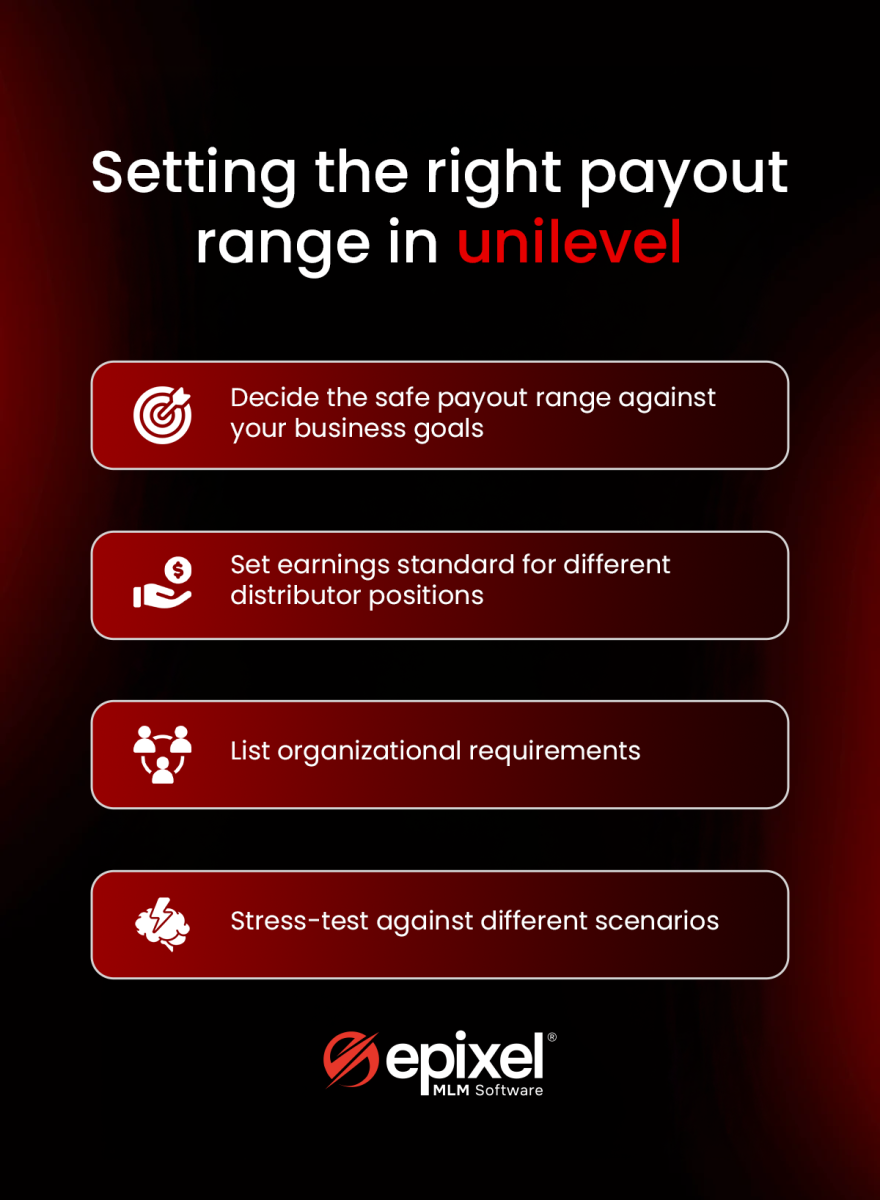
The greatest mistake in compensation plans is creating commission percentages without financial boundaries. The safe payout range should be decided by companies prior to fixing the amount of payment to be made at each level.
The payout range should be more robust, for example, 35-45% of the commissionable volume. The range is used to establish expectations for different positions like part-time builders, team, and senior leaders as regards earnings. The costs of technology, compliance, support, marketing, and the profit margins have to be regulated by the company as well.
The percentages are modeled and stress-tested with various scenarios of high growth rates, low months or high refund cycles. This makes the plan stable under real life conditions.
Shape leader profits to ensure a manageable rise
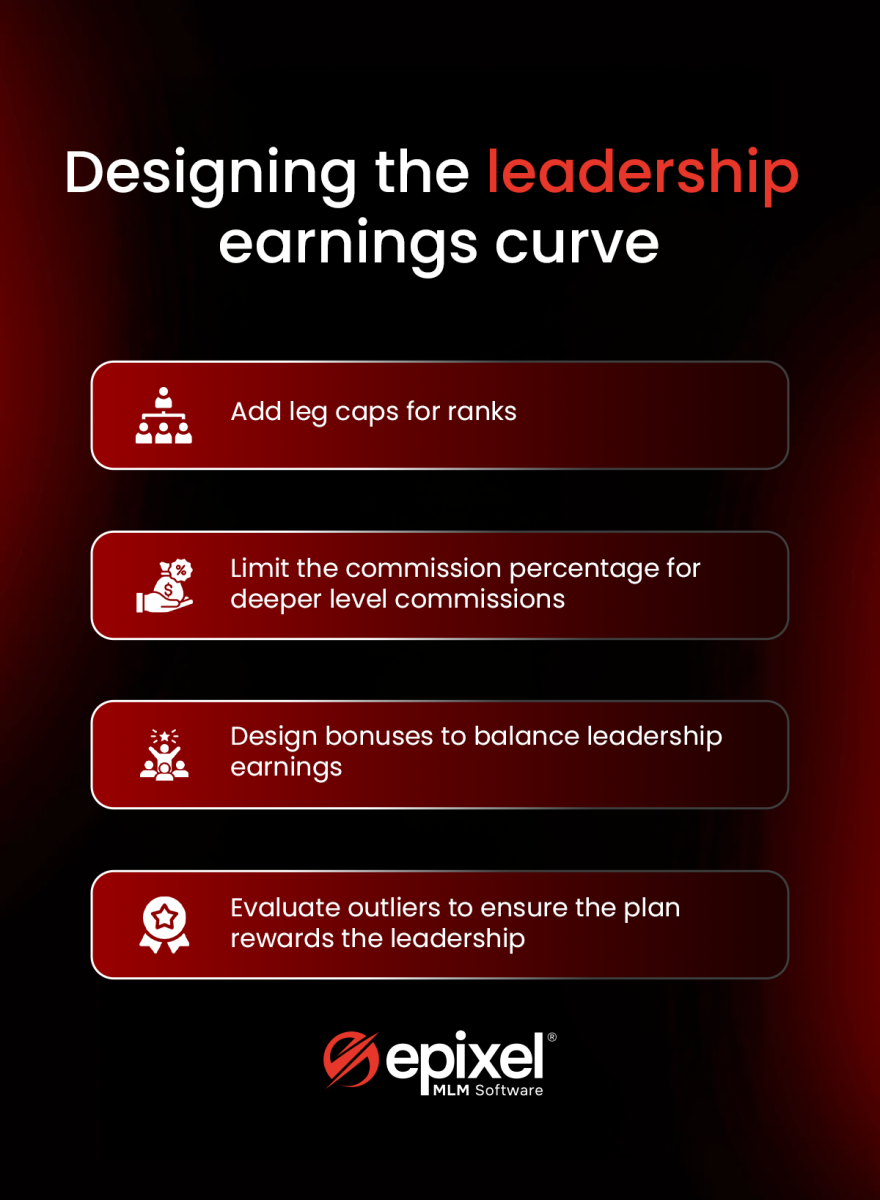
One of the fastest methods of setting up an imbalance in payouts is through the unchecked compensation of leaders. Under the assumption that profits increase indefinitely with volume, a small number of leaders will find themselves with an unrealistic share of commissions.
A financially disciplined model makes use of an earnings curve. Growth in early years should be rewarding and encouraging, but as organizations expand, marginal income needs to increase at a slower rate. This can be through leg caps and deep-level generational commissions for leaders who sponsor.
By estimating earnings variation among ranks and regularly evaluating outliers, it becomes easier to see whether the plan is reasonably rewarding leadership instead of just augmenting structural benefits.
Importance of dynamic compression
Dynamic compression prevents commission payouts for inactive leaders who would otherwise block the commission from travelling into deeper levels which may have more active leaders. This brings additional efficiency, but compression can gradually increase and raise the payout depth even higher than intended if not managed properly.
The ideal way to implement dynamic compression is by treating different depths differently. If someone is inactive in level 1-3, skip them and active members above that position should be qualified for commission. As we proceed it is beneficial to keep a few other criteria for members to receive this commission. From level 4 till level 6, distributors must have a minimum of 2 or 3 active legs, minimum downline volume or a specific rank. Thereby, a person who is merely active in the upline won't receive the payout. When it reaches level 6, other reward systems such as generational bonuses should be used by the companies to only compensate the most performing leaders. This guarantees that the payout is regulated and the company has no financial risk. MLM companies with a unilevel plan can also employ a unilevel MLM software with dynamic compression feature.
Importance of dynamic compression
- Dynamic compression prevents commission payout for inactive distributors
- Compromise exists when compression happens at lower levels
- Payout depth is adopted to assess whether compression rules should be tightened
Healthy leadership rank design
Certain rank structures overpay only a few leaders. This happens when limited leg-based sales volumes are considered.
Careful planning can help avoid these mistakes. The first step is to expand the rank eligibility criteria. So, the rank will be based on how strong and balanced the teams are, along with measuring the total sales.
Distributors should have at least 3 to 4 legs performing well with each leg having an equal amount of total volume. To reach advanced ranks leaders should have high performing team members in their legs. This ensures that the company has a strong leadership position.
Personal volumes and customer volumes of each distributor should be tracked to ensure that they are active and consistent.
The smarter way to design a rank is to create a simple rank health score that is calculated based on leg diversity, activity of second-line leaders, and stability of customer orders vs. one-time spikes.
Implementing such a rank score would show who is the more structurally strong leader among two leaders though they might have the same titles. It will help in rewarding rank-based bonuses efficiently without resulting in future financial risk.
Developing a healthy leadership rank
- Group volume-based rank promotion can discourage leadership
- Sustainable plans are built on volume needs and structural health indicators
- Sophisticated MLM systems can calculate rank health score accurately
- This will prevent overpayment and promote sustainable team building
Keep leadership pools in check
Leadership pools are a well-known strategy to build leadership by rewarding the top distributors. On the other hand, if not designed well, it may result in overpayment. So, the goal is to reward leadership but in a regulated way without unintentionally causing overpayment.
One of the good practices is to keep the number of leadership pools up to 1 to 3 tiers, so that the payouts don't go out of control.
All pools are funded by the company volume. If the leadership pools eat up a large part of the company volume, it can put the company at risk. Assign a percentage according to the proposed safe payout band. In this way, the leaders feel rewarded, the company won't be at risk, and there will be finance to commit other payouts also.
Leadership pools sometimes remain underused when only a few members in a specific pool qualify for the payout. Such underused pools can result in unfair payout among leaders in a pool.
Leadership pools in unilevel MLM plan
- Develop a sense of ownership and long-term loyalty
- Poor construction of leadership pools can create excessive compensation
- Dynamic pool allocation introduces extra stability
Discover how we build resilient businesses with advanced MLM functionalities



Making simulation a permanent activity
Shadow plan simulations are when you create “what-if” scenarios and stress-test your plan. Most companies only do this at the time of launch and consider the compensation plan as permanent. A mature company should conduct shadow plan simulations regularly as routine maintenance.
In this type of simulation, you keep the real plan unchanged and give “what-if” scenarios and get results internally. By doing this you will recognize which constraint is actually saving your money, is the current plan safe, and checks whether future promotions are safe.
Not all markets behave the same. Fast recruitment may work in some markets and in other markets, slow recruitment and reorder purchases may work. It's necessary to stress-test by region. This way you can assess whether the payout plan is safe globally.
Performing regular compensation plan simulation
- Test the effects of eliminating caps
- Check by increasing or decreasing depth
- Simulations reveal the regulations that support financial stability
- Simulations vary according to regions as buyer behavior is diverse
Track anomalies and outliers to identify risks in compensation at an early stage
Overpayment rarely appears as a problem. It is reflected in concentrating payout in a few IDs, abnormally high payout-to-volume ratios or huge income disparities.
By keeping track of these measures, the companies are able to identify design flaws during the early stages. The automated notifications will make sure that the compensation problems are resolved before the funds are significantly lost.
How to identify risks early
- Detect anomalies in patterns
- Fraud cause high payout-to-volume ratio or huge income disparity
- Tracking outliers helps companies to detect risk in early stages
- Automated notifications ensure problems are resolved
The behavioral rewards that build long-term value
Unilevel plans are based more on the stable growth of customers than on short-term volume boosts. The diversity of the legs, regularity of reorders, and level of leaders will be rewarded and will naturally discourage bad practices such as front-loading, and rank stacking.
Stability as such is even rewarded by other companies and leaders are recognized whose organizations have balanced monthly performance.
How behavioral rewards build long-term value
- Stable growth of customers over short-term volume boosts
- Diversity of the legs, regularity of reorders, and level of leaders will be rewarded
- Discourages bad practices such as front-loading and rank stacking
Communicate the rationale behind the plan
Communicating only through figures and percentages won’t be sufficient to earn the trust of distributors. The brand should communicate the reasons for adopting this model through examples.
Distributors would need to know how each rank works. Brands can use rank dashboards to explain why some earners haven't yet reached their next rank or how some others quickly achieved it. Compare two leaders and explain why their incomes differ.
Conclusion
A unilevel MLM plan is simple and brings a balance between generosity and discipline. Companies can develop payout systems that are safe by defining payout limits, designing leader compensation attentively, tracking performance on an ongoing basis, and matching rewards with healthy growth.














Leave your comment
Fill up and remark your valuable comment.