


















 Epixel Playbooks: Compensation Plan Design
Most compensation plans look great on paper but get complicated in real life. The real test is when distributors identify that something in the plan is not adding up or when regulatory authorities raise questions about product-to-recruitment revenue ratios.
When compensation plans are generic, recruitment based commissions will be valued over actual product sales. This leads to the loss of relevance of products. Some plans are either too generous or too stingy in the beginning. In the former case, companies may run out of cash in the long-term and in the latter case distributors will lose motivation and progress will be slow.
Our guide walks you through the practical procedures to build a plan that is feasible, financially sustainable, is legally defensible and can be integrated into your modern MLM software.
Step 1: Define your business model first, structure second
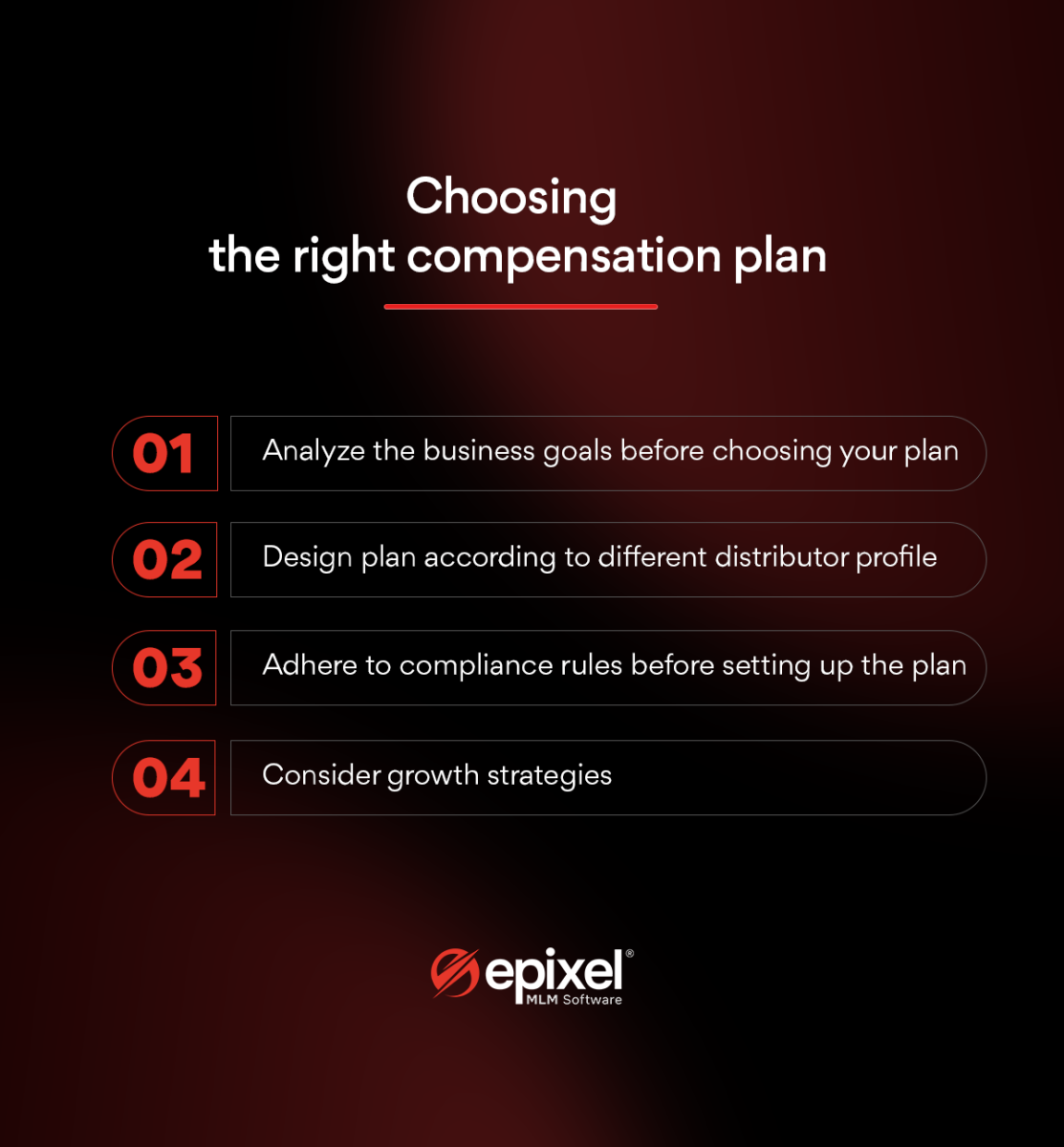
The common mistake leaders make is that they choose a compensation plan before they define their business goals.
Compensation plans should be finalized only after analyzing business goals and common patterns. You need to invest in a plan that is focused on customer acquisition and repurchasing if you have high volume consumables with retail pull. If your company's major income driver is recruitment, you likely have a legal problem.
The next question to answer for developing the right plan is who your major distributors are. Plans designed for full-time entrepreneurs are different from what is designed for part-time beginner distributors. Companies need to thoroughly assess each distributor profile and come up with a plan suitable for the majority of distributors.
Companies that operate across different countries and continents should work on multi-country compensation plans. A plan that looks safe for the US market may require significant adjustments in the European market. This is decided after going through compliance rules by each country or continent.
Growth strategies should be considered while setting up a plan. These are the common factors that need to be considered before you hire a planning consultant and start designing the model.
Step 2: Understand the core compensation architectures
At present, there are five major compensation structures in the industry, and most modern companies use two or more structures known as hybrid.
Binary plan has two legs, and the earnings are based on the weaker leg. Though distributors are excited to grow both legs, over time they will be stressed about ensuring that both legs have enough volume.
In unilevel plan you would have unlimited members under you and would earn commission from several levels down. Compared to binary plan, the earnings are slow but it is clean, easier to understand and legally safe.
Matrix Plan: Matrix plan has fixed structures that is it has a fixed number of people in a level and fixed number of levels up to which a distributor earns commission. This will help early joiners to feel motivated and start working, but latecomers may feel stuck.
Distributors grow through ranks in Stairstep Breakaway. The small leaders who lose motivation break away while the serious and ambitious stay back and climb the rank ladder.
Party plan structures are commissions that are earned through events. This includes hosting in-person demos and house parties. It creates strong customer focus, a natural selling environment, and easy product demonstration. The drawback is, it won't scale online and the selling depends heavily on the type of event.
Most companies operating or launching today don't depend on a single structure. They create a hybrid structure to bring the best of all worlds.
| Compensa tion structure |
Best for | Distributor profile | Recruitment speed | Retail sales orientation | Compliance risk | Software complexity |
|---|---|---|---|---|---|---|
| Binary | Fast-growth, viral MLM models | Full-time builders, team-oriented | Very High | Low–Medium | Medium–High | High |
| Unilevel | Product-first, customer-centric companies | Part-time sellers, brand advocates | Medium | High | Low | Medium |
| Matrix | Subscription/continuity product businesses | Community-driven, cooperative teams | Medium | Medium | Low–Medium | Medium |
| Stairstep Breakaway | Heritage/traditional direct selling | Career-oriented senior leaders | Low–Medium | High | Low | Very High |
| Party Plan | Home demonstration, social selling | Social hosts, event-driven sellers | Low | Very High | Very Low | Medium |
| Binary + Unilevel Hybrid | Balanced growth + retention models | Mixed: builders + casual sellers | High | Medium–High | Medium | Very High |
Table 1: Compensation structure comparison matrix
Step 3: Model your commission budget before you design the plan
A non-negotiable primary step before deciding any specific bonuses is to determine your total commission budget as a percentage of revenue.
For product-based direct selling companies, the commission percentage is placed between 35% and 55% of total revenue. Though a MLM plan consultant may help you design this, it's necessary to stress test your compensation plan in three scenarios.
Conservative growth scenario: Test out if your plan will still work if 80% of the distributors are inactive. Will the plan still reward the 20% of the active ones?
Aggressive growth scenario: The proposed compensation plan should sustain situations where a large number of distributors are recruited. Plans that are only stable in a steady state may find it difficult to handle growth surges.
Top-heavy concentration scenario: If your top leaders generate 90% of the sales, the funds allocated for payouts will be going mostly in leadership bonuses with very little left for commission payouts.
Calculate every bonus and check whether the total matches the percentage allocated as commission payout budget. If not, you should recalibrate the specific bonuses prior to launch.
| Bonus type | Purpose | Typical budget allocation | Payout trigger | Risk if overfunded |
|---|---|---|---|---|
| Retail sales commission | Incentivize direct product sales | 20–25% of revenue | Paid per order in real time | Low—directly linked to actual sales volume |
| Fast-start bonus | Drive early distributor activation | 5–8% of revenue | Within the first 30–90 days of joining | Medium—can spike during aggressive recruitment phases |
| Team volume commission | Reward team building and network growth | 15–20% of revenue | Paid on a weekly or monthly cycle | High—largest cost component that grows with network depth |
| Leadership overrides | Recognize top leadership performance | 5–8% of revenue | Monthly, based on rank qualification | Medium—concentrated payouts may create reliance on top performers |
| Rank advancement bonus | Motivate rank advancement milestones | 2–4% of revenue | One-time payout on achieving a new rank | Low—limited and predictable expense |
| Lifestyle/recognition bonuses | Offer lifestyle and aspirational incentives (car, travel) | 2–4% of revenue | Ongoing, as long as qualification criteria are met | Medium—becomes a long-term liability if revenues decline |
| Reserve / compliance buffer | Cover adjustments, returns, and exceptions | 2–3% of revenue | Issued as required | N/A—necessary buffer for operational stability |
| Total target payout | Overall commission structure budget | 35–55% of revenue | Aggregated across all payout types | High—exceeding this range can impact profitability and sustainability |
Table 2: Commission budget allocation framework
Step 4: Design rank and qualification requirements
Rank advancement systems are the source of motivation for most distributors to stay active and perform well in direct selling. Bad rank structures can cause frustration among distributors and can result in mass quitting by distributors.
Keep the ranks achievable. The sales value and effort required to achieve it should be proportionate. To achieve a certain rank, it should be mandatory for distributors to have a certain number of customers. Distributors should earn a minimum of ten customers or 30% sales from customers to progress the rank structure. This is to keep the business more legal and less like a pyramid scheme.
Design the qualification window carefully. A qualification window is the time given to achieve a certain rank. When it's scheduled at the month end or within a short period of time, it can create panic among the distributors. It is advised for companies to use a 30-day rolling or quarterly qualification window with fewer objectives to achieve on a monthly basis to maintain the rank.
Rank maintenance rules shouldn't be stringent. Once you achieve a rank, it's important that you maintain it. But distributors shouldn't lose their secured ranks due to lack of maintenance and drop in performance. Instead, the plan can be designed in such a way that they don’t lose bonuses. This gives them a clear view on where to improve, how to fix, and how to regain what they lost.

Step 5: Structure your bonus portfolio
Compensation plan is not a one-way payment system, rather it's a cluster of multiple bonus systems established to serve a specific purpose. The most common bonuses are:
Fast-start bonus: This bonus is reserved for joiners, early sponsors and recruits to earn their first income. Fast-start programs should be generous enough to keep the distributors hooked and excited but only for a limited time period.
Retail sales commission: This commission is earned when distributors sell products to customers. It doesn't involve downlines, and it looks more compliant and credible. The commission is earned after the customer takes an interest in the product and purchases it.
Team Volume Commission: This is one of the main incomes for most MLM businesses. Team members both in upline and downline earn commissions through team volume. The amount of commission depends on the compensation structure.
Rank advancement bonus: It is a one-time cash reward for advancing into another rank. It is a real encouragement and boost for distributors for their hard work and consistency. Appreciating them publicly via the company website or news outlets can motivate the distributors to achieve upcoming ranks too. The condition is that budget allocated for this should be finite and not a never ending expense.
Lifestyle and recognition bonuses: This includes car, travel incentives which are exclusively allocated for the leaders bringing in a large sales volume. It can be used as an anchor that should play a vital role in your income opportunity possibilities.
Step 6: Run compliance through every layer
Compensation plan must comply with regulatory authorities such as the FTC guidelines, DSA Code of Ethics and country-specific rules and regulations. It should be considered during the design stage.
The FTC guidelines have strictly prescribed that the majority of the sales should be generated from selling products to real customers instead of distributors. Piling up of products should be avoided. This is to ensure that the compensation plan can track actual sales.
Every income generated and payout of bonuses should be documented transparently. Even the average distributor earnings should be presented honestly and transparently.
The compensation plan requires a rework if the majority of the income opportunity depends on recruitment commission over retail sales commissions.
What is permissible in the US may not be in another country. It is important to let the legal counsel of the country you wish to launch in and review your compensation plan. This can avoid anticipated compliance risks and penalties.
| Compliance dimension | What to measure | Green (low risk) | Amber (review needed) | Red (immediate action) |
|---|---|---|---|---|
| Retail sales ratio | Percentage of revenue coming from real end customers | Above 70% retail sales | Between 50–70% retail sales | Below 50% retail sales |
| Active distributor purchasing | Share of distributor purchases used for resale or personal use versus stockpiling | Less than 10% inventory loading | Between 10–20% signs of inventory loading | More than 20% purchases without proof of sales |
| Income disclosure accuracy | Alignment between actual median distributor earnings and advertised income claims | Clearly disclosed, accurate, and visible | Disclosed but not prominent or outdated | Missing, misleading, or under legal scrutiny |
| Recruitment vs product revenue | Portion of revenue generated from sign-up fees compared to product sales | Less than 20% from sign-up fees | Between 20–35% from sign-up fees | More than 35% driven by fees |
| Rank qualification retail requirement | Customer sales requirement needed to qualify for ranks | Customer requirement at all levels | Customer requirement only at higher ranks | No customer sales requirement |
| Autoship cancellation rate | Percentage of monthly subscription cancellations among active autoship users | Less than 5% monthly churn | Between 5–10% monthly churn | More than 10% monthly churn |
| Refund policy compliance | Level of adherence to buyback and refund regulations | Full buyback policy offered and monitored | Partial or limited refund policy | No refund policy or not tracked |
| Country-specific legal review | Legal approval status in each operating market | All markets legally reviewed | One or two markets pending review | Multiple markets without legal review |
Table 3: Compensation plan compliance health scorecard
Step 7: Validate that your software can execute the plan
A compensation plan can be considered a failure if your MLM software system fails to calculate it accurately. Before finalizing the plan, discuss with your technical team that the commission engine is capable of calculations. Intensive calculations like binary weak leg calculations, compression rules for inactive distributors and generational override logic are generally intensive and not all systems will calculate it with accuracy and speed.
Your system should handle the chosen network structure. Before launching the proposed plan, check the number of members in your network, how many levels deep the network is.
The MLM software should have adequate reporting features that provide payout dashboards, distributor-level commission statements, and rank qualification progress dashboards.
The golden rule is if the technical team cannot run a test simulation with a given data set using the current compensation plan logic, either the structure needs a rewiring or your software is not competent enough for the plan.
Step 8: Pilot, iterate, and formalize
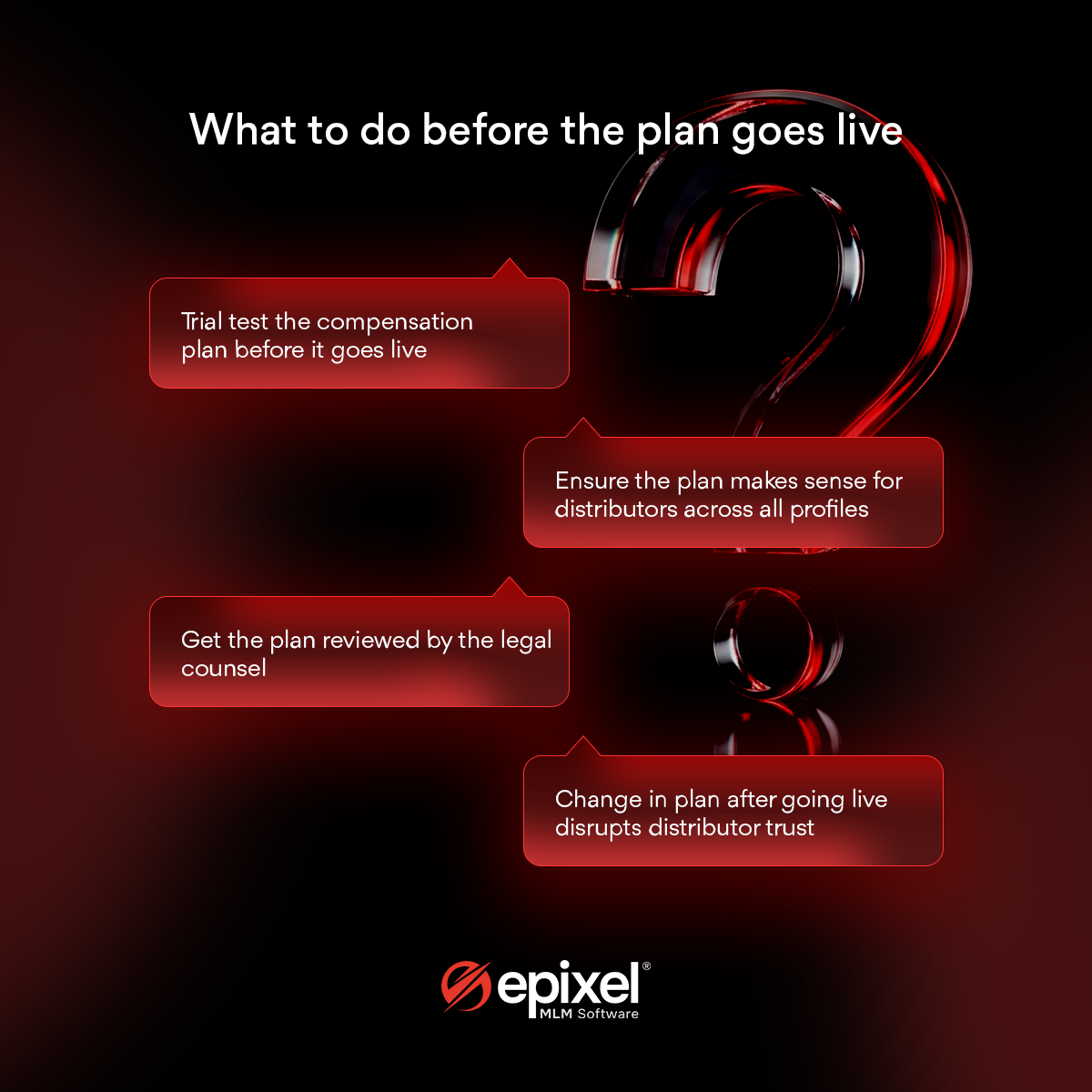
Before your plan goes live, trial test it with a selected number of distributors. This is performed to assess how the plan works in a given commission engine and the accuracy of calculations.
Conduct small group discussions with distributors across different levels and profiles. Ensure that the compensation plan makes sense to them.
Before you rush to make the compensation live and release it to the market, consolidate the plan in a document and get it reviewed by the legal counsel. Changes in the plan after it goes live can disrupt distributor trust and even face scrutiny from regulatory authorities.
Discover how we build resilient businesses with advanced MLM functionalities



The builder's checklist
Before you sign off on a compensation plan, go through a checklist that evaluates the health standing of the compensation plan.
The total payout percentage should be financially sustainable in all types of growth scenarios.
Does each rank have an achievable pathway that rewards genuine product sales? Is the plan thoroughly reviewed by the legal counsel before releasing it to the market?
Is your MLM platform compatible with the compensation plan logic and does the distributor find the income opportunity reasonable and encouraging?
Is your income disclosure process designed to meet FTC standards?
If a compensation plan is built strategically, it becomes a company asset. It supports sustainable growth and ensures that distributors find the compensation plan ideal. That is the result of taking time to build the right plan.















Leave your comment
Fill up and remark your valuable comment.