















English
- English
- Español

- 简体中文

- Français

- Deutsch

- Italiano

- 日本語

- 한국어

- Portuguese, International



Strategic guide to mitigate compliance risks in the US, Europe, and UAE markets

Direct selling companies, irrespective of being a startup or enterprise now launch their operations across multiple country markets right from the outset. Establishing brand presence in multiple markets has matured into a launch strategy from an expansion strategy. MLM companies with a keen focus on growth establish their presence first before building their customer or distributor network.
Regulations and tax policies are different for different markets. Most companies adopt a reactive approach to compliance which increases the risk of failure and sustenance. Companies operating in the US need to comply with FTC regulations and those in the European Union have to operate in compliance with the GDPR architecture. The VAT and Anti-Money Laundering policies create challenges for direct selling companies in the UAE. The white paper details proper steps and procedures to manage claims, data, payouts, customer acquisition, and distributor onboarding for companies operating across these regions.
Compliance management through spreadsheets and disconnected approval processes creates risks that might go out of control if not addressed on time. The regulatory scrutiny across the US, Europe, and UAE has increased sharply since 2022. For companies that have undergone regulatory reviews, the costs incurred were way above the investment needed to build a compliance management system from the outset. Hence, compliance management becomes a prime necessity for direct selling companies planning to grow beyond a single market.
By 2027, multi-region compliance failures are expected to cause operational disruptions for direct selling companies. Leaders who invest today in compliance management systems can ensure risk-free operations year after year.
Direct selling businesses expanding across regions face problems when existing policies have to be adjusted for each regional market. Informal operating procedures and increasing cost due to reactive compliance measures also add to the failure of multi-region compliance.
When a business expands to multiple countries or even spans continents, new leaders come in to manage the local markets. The standard operating policies might need adjustments to fit the regulations of the new markets. Often, local leaders request and process adjustments locally but may not be applied to the global policy architecture of the company. A regional director in Germany might need a changed disclaimer to align with the GDPR policy or a MLM trainer in Florida needs an update to the earning claims language. When the fixes are local and isolated, it becomes difficult for teams to manage efficiently.
Another challenging concern in multi-region compliance which is as much dangerous as fragmented policies are the shadow processes that govern onboarding and payouts. A compliance manual cannot moderate distributor activities that happen over social media and finance teams often approve payouts without KYC verification. Manual onboarding processes accept scanned documents as proof of identity without actually verifying them.
These may not be intended to cause dangers for the brand but are the result of slow and opaque processes. The impact is the same. When regulators ask for substantiation or an individual requests data deletion, or tax authorities demand VAT reconciliations, companies fail to respond within the required timeframe leading to reputational and financial damages.
Penalties and reputational damage were manageable in the past but the situation has changed considerably. FTC enforcements against direct selling companies have increased between 2020 and 2024 than in the past decade. In the European Union, data protection authorities fined violators €2.1 billion in 2023 alone. The scene in UAE was not very different. The UAE’s Financial Intelligence Unit has enforced strict rules on goAML reporting and non compliance now carries criminal charges for corporate officers.
Implementing advanced compliance systems can ward off these risks and cost less than the adverse impact these bring to the brand.
The three regulatory regimes direct selling companies must focus on are those of the US, Europe, and United Arab Emirates. This detailed table outlines the operative compliance focus of these regions, primary regulatory authority governing the policies, and the primary evidence that regulators will ask as the first step to investigation.
| Region | Regulations | Operational focus | First level evidence |
|---|---|---|---|
| United States | FTC Act and earnings-product claim guides | Verified earning claims, mandatory customer refunds, and fair testimonial standards | Claim logs, verification files, and approval details including time and approver data |
| European Union | GDPR (Reg. 2016/679) | Record user consent, data rights request management, and legal authorization register | Record of all user consents, rights request trackers, and data retention schedule |
| United Arab Emirates | VAT laws and AML/KYC Decree | International sales, KYC verification during distributor onboarding, and goAML audit records | Tax invoices, KYC details of every distributor, STR/SAR logs |
The three regulatory regimes have different areas of focus. FTC works toward protecting consumers from fraudulent business practices. GDPR governs the right of individuals through data protection policies and UAE’s VAT and AML policies concentrate on accurate tax collection and anti-money laundering. If a company sets one standard compliance framework that treats all laws equally, it can create compliance weaknesses that let in financial risks.
The Federal Trade Commission mandates that every company operating in the US to refrain from unfair or deceptive practices that can harm consumer interests. Ecommerce companies with subscription models are constantly on the FTC radar because many companies build complex processes around subscription cancellation. This is considered deceptive by the FTC.
Direct selling companies need to concentrate on three major aspects to avoid FTC enforcement: earnings claims, product claims, and fairness in testimonials and endorsements. FTC, in its updated guidance on income representations in 2023, states that average earnings of distributors must be disclosed via transparent statements such as income disclosure statement, disclosures should be specific, clear, and verified.
A practical guide to meeting FTC expectations can also provide actionable recommendations to efficiently incorporate a compliant claims process across your global distributor network.
Every aspect of a distributor-brand relationship should be revealed such as compensation, free product, or special services. For direct selling companies operating in multiple markets with scattered distributor network, compliance becomes hard to manage with distributors promoting locally and using different tools and channels. In effect, every piece of content shared reflects the brand image and attracts FTC scrutiny.
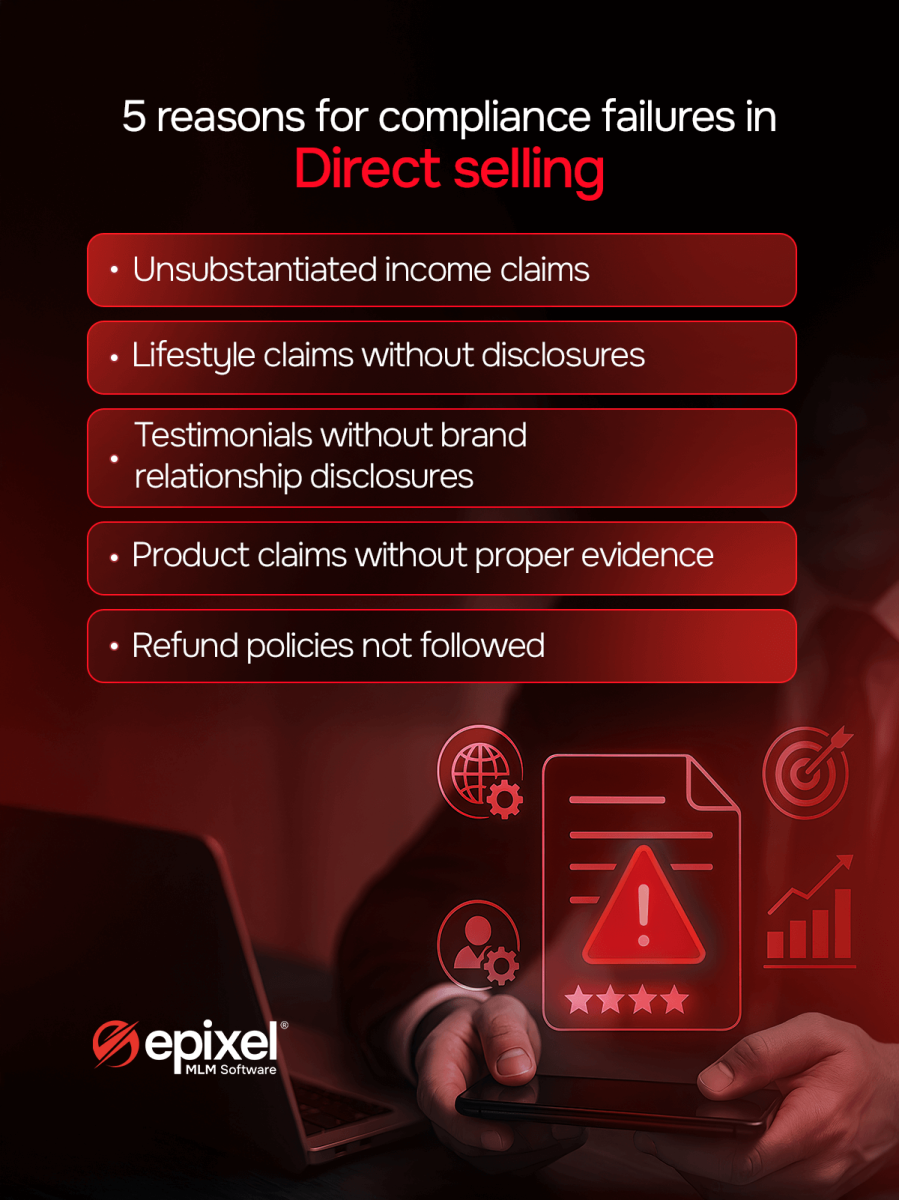
The past enforcement actions and consent orders by FTC between 2020 and 2024 show that most compliance failures in direct selling companies are caused by five common reasons.

Unsubstantiated income claims in distributors’ social media posts.
Showcasing luxurious lifestyle to attract prospects without clear disclosures.
Testimonials that do not disclose the relationship between the endorser and the company.
Product promotion claiming disease cure without any scientific evidence.
Refund policies advertised are not properly followed in practice.
It is clearly evident that these are management failures. Disclosures and policies exist, but the gap is the process that connects the two. When non compliant content is not caught at the right time, scrutiny, reputational damage, and fines follow.
When building an efficient claims system, four mandatory elements have to be considered.
A pre-approved content library with earnings claim statements, product benefit descriptions, and testimonial formats that have been reviewed by the legal team. This must be mandatorily made available to distributor portals upon onboarding.
A moderation process through which distributors seek legal approval for posting their content. Every activity, whether approved or rejected, should be properly recorded.
Verified evidence files linked to data supporting earning or product claims with details of when the data was current.
Training and attestation records to show that all active distributors have undergone mandatory distributor training sessions related to earning claims and endorsements.
Operational insight
Direct selling organizations who maintain an easy-to-access approved content library and moderation process reduce compliance concerns related to claim incidents by an estimated 60-75%, also accelerating distributor content production with compliance.
The General Data Protection Regulation policy was enforced on 25th May 2018 and is one of the most comprehensive data regulation frameworks in the world. Direct selling companies operating in Europe or targeting customers in the region must strictly adhere to the data standards as set by GDPR. Data processing must be lawful and data subjects should have full authority to access, rectify, or erase their data. These requests from the individuals must be honored by organizations at the earliest to avoid scrutiny.
In a relationship-based model like direct selling, managing how distributors process customer data is difficult. Distributors generate personal data from different customer purchase histories, communications between distributors and customers, distributor compensation records, health-related purchase data in wellness sector, and geolocation data from mobile applications. In-person or online data processing should have a Record of Processing Activities (ROPA) which clearly defines how long the data will be used and third-party processing details.
An advanced data security framework that aligns with EU’s GDPR policy can create a differentiating brand identity among distributors and customers to improve trust and compliance.
Consent must not be a complicated process, it should be straightforward. Direct selling companies need to implement consent requirements at two levels. Customer consent is required for marketing, profiling for personalization purposes, and for sharing data with distributors through a CRM. Distributor consent is required for processing performance data for compensation purposes, sharing data with uplines, and any type of data processing outside EU.
Distributor and customer consent must be recorded at individual level with clear policies stated at the time of consent confirmation and the same linked to the consent record. Any minor change to the policy must ensure that the consent remains valid and reconsent is not required.
Article 12 of the GDPR policy states a strict timeframe to acknowledge and resolve a data subject’s request. Both processes should be completed within one month from the receipt of request. An extension of one month is granted only if the request is complex. This timeframe can be challenging for direct selling companies with large distributor networks and disconnected data systems. When a customer requests erasure of their data, it may be stored at various locations such as CRM, distributor’s local device, payment gateway, email marketing platform, and supply chain partner’s system.
Organizations that are capable of honoring this timeframe are the ones with automated data processing systems that can track data across devices and channels, a dashboard that tracks and alerts requests that are overdue, and a comprehensive audit trail system that records every action taken in response to the request.
Operational insight
Companies operating in GDPR-regulated regions must have a dedicated data processing infrastructure with continuous data mapping reviews and a trained data-subject rights team.
In the UAE, companies operating in the direct selling industry must focus on alignment with VAT, KYC, and AML compliance.
In the UAE, 5% VAT is charged on product sales and for direct selling companies this spans three main areas of risk.
The tax rate for each product category sold to customers and distributors, discounts and rebates, and the documentation of B2B vs B2C transactions.
VAT rates for international sales including the zero-rating of exports, the reverse-charge mechanism for imports, and the place-of-supply rules for digital services.
Correct application of VAT in bonuses, commissions, and incentives.
The tax invoices under VAT law have a strict format with compulsory fields such as the supplier’s Tax Registration Number, the customer’s TRN where applicable, a sequential invoice number, and the VAT amount. Companies sometimes fail to issue full tax invoices or use non-sequential numbering systems that create problems during reconciliation. Effective commission management practices ensure that all VAT applicable products and transactions are correctly calculated and applied across all transaction types, distributor levels, and product categories.
The United Arab Emirates Federal Decree-Law No. 20 of 2018 on Anti-Money Laundering and Countering the Financing of Terrorism imposes stricter customer identity verification requirements on non-financial businesses and professions, under which the direct selling industry falls. This means that the distributor onboarding process must include identity verification and a risk-based assessment of every distributor’s profile. An ongoing monitoring system should be in place to monitor unusual transaction patterns.
The goAML system managed by the UAE Financial Intelligence Unit demands immediate reporting of any suspicious transactions through an electronic platform. Any failure in compliance at the STR/SAR level will be liable for criminal prosecution, not just regulatory penalties.
To best avoid regulatory scrutiny, organizations can implement payout risk controls that can detect suspicious transaction patterns and prevent risks in your global payout process.
A practical and complex challenge for direct selling companies in the UAE is the linking of KYC documents with a distributor’s payout records. Commissions, bonuses, and incentive payouts should be traceable to the receiving distributor’s KYC records through an integrated commission management system that links verified identity details, risk assessment report, onboarding data, and other monitoring records. When KYC details and payments happen to be in different systems, this linking becomes impossible and organization fails to establish the integrity of its payout process during an audit.
Direct selling companies operating in multiple regions will have to comply with numerous policies related to data, payouts, and marketing that require close attention and tracking. An efficient compliance system blends people, processes, and policies to ensure everything works together to achieve compliance on a global level.
Policies on paper do not ensure compliance. They give the company the impression that it exists when in reality it does not. Actual compliance is produced by a system that integrates these policies into daily actions of people who moderate content, onboard distributors, approve promotions, and process payouts.
Direct selling companies that have operations across different international markets should keep these three documents up to date.
Claims and promotional language policy
Privacy and consent policy
Payout and KYC SOP
Claims and promotional language policy will govern the marketing activities as to what distributors can say about earnings, product benefits, and testimonials. The privacy and consent policy of companies must explain every step taken in the process of getting data and processing. This along with the consent and data requests handling process should be neatly outlined. KYC and payout process should have clear explanation about the distributor onboarding process and payout verification.
These policies once implemented should be regularly updated and version controlled with a review schedule. Laws that these policies are based, should be referenced in the documents and the name of compliance officers for each should be mentioned. Most importantly, each policy must be connected to actual operations, and every rule in the policy should link to corresponding workflows and systems with evidence that proves it. If this connection is not established, then policies remain on paper and not in practice.
Regulatory authorities in any country will have a common expectation, that is, when they seek information from an organization, they should be able to produce complete and up to date records within the given time window. Procedures of FTC, GDPR, and UAE AML law expect companies to provide evidence within 24 to 48 hours for a recent promotional campaign or payout cycle.
Organization to meet this standard will need the following:
Centralized audit-evidence repository for each promotional event and payout cycle that prevents commission calculation errors and payment discrepancies.
Approved content with evidence documents, legal approval details with ownership and timestamps.
Consent ledgers with details of all data subjects.
Updated KYC documents for all distributors in the payout cycle.
Complete VAT invoice records.
Training completion certificates for relevant distributors.
Exception logs for exceptions made from standard operating procedures with dates and owners who authorized the approvals.
| # | Audit evidence category | Jurisdiction | Owner |
|---|---|---|---|
| 1 | Earnings claim log with substantiation files | US (FTC) | Legal/Compliance |
| 2 | Promotional approval timestamps and approver IDs | US (FTC) | Legal |
| 3 | Distributor training completion certificates | US (FTC) | Training Ops |
| 4 | Testimonial disclosure evidence | US (FTC) | Marketing/Legal |
| 5 | ROPA (Record of Processing Activities) | EU (GDPR) | DPO |
| 6 | Consent ledger with version-linked privacy notices | EU (GDPR) | Data Governance |
| 7 | Data subject rights request log and resolution records | EU (GDPR) | DPO/Support |
| 8 | Lawful-basis register for each processing activity | EU (GDPR) | Legal/DPO |
| 9 | Processor agreement register (DPAs with vendors) | EU (GDPR) | Legal |
| 10 | Sequential VAT invoice series | UAE (VAT) | Finance |
| 11 | Cross-border supply documentation | UAE (VAT) | Finance |
| 12 | KYC file per active distributor (ID, risk rating, date) | UAE (AML) | Compliance/Ops |
| 13 | Payout logs cross-referenced to KYC file IDs | UAE (AML) | Finance/Compliance |
| 14 | STR/SAR submission log (goAML) | UAE (AML/FIU) | MLRO |
| 15 | AML monitoring exception log with escalation records | UAE (AML) | Compliance |
Global compliance governance needs a strong charter and a responsible team to operate efficiently. Governance charter should list the members who make up the compliance council, the authority they have, and how decisions and problems are handled. Every major compliance policy should have a specific owner. The compliance council is a team comprising of members from legal, finance, operations, technology, and distributor teams.
The function of the compliance council is to manage every change made to policies and processes. When business operations change, the council is entitled to measure the compliance impact and report it to the leadership. If distributors violate a policy or unintentionally do something outside of the policy limits, the council must correct or adjust controls to ensure that the company’s compliance system stays up to date and properly documented.
Identify compliance gaps and build a regulator-ready compliance architecture with our free multi-region compliance decision template.
Global compliance is a complex process that needs proper planning and a phased approach to implementation. This 90-day approach will help businesses implement a governed compliance system that is centralized and continuously monitored.
| Phase | Days 1–30 | Days 31–60 | Days 61–90 |
|---|---|---|---|
| Policy and documentation | Analyze your current policies for gaps against FTC/GDPR/UAE rules. Create RACI chart and assign policy owners. | Draft three core policy templates. Submit it for legal review and establish version control. | Finalized policies should be implemented in multilingual versions for EU and UAE. Distributors should be briefed with the summaries of policies. |
| Workflow and technology | Map current approval and onboarding workflows and identify tool gaps. | Deploy claims approval engine and activate consent ledger. Integrate KYC onboarding process with a designated onboarding team. | Automate all three workflows completely. Activate exceptions log reporting. |
| Training and attestation | Identify training gaps by role and region. Create micro courses as needed and monitor completion. | Test 30-min claims training with top leaders. Set up a 45-min GDPR workshop for support. | Full rollout across all distributors and staff. Make completion logs live. |
| Evidence and audit readiness | Inventory existing records and identify evidence gaps. Assign custodians for maintaining evidence without fail. | Launch an audit-evidence pack for current promotions cycle and conduct a 24-hour drill. | Set up a practice session every quarter to check for compliance and audit-readiness and automate the export of all compliance records. |
| Governance | Identify a responsible team with experienced members to form the Compliance Council. Draft the charter. | Set up a stand-up meeting with the compliance council. Define the metrics to be monitored on the KPI dashboard. | Final approval of the governance charter. Schedule a first quarter review. Plan and rehearse external audits. |
When the implementation is complete and the compliance system becomes operational, compliance readiness has to be constantly monitored. These KPIs signal the compliance health, hence must be monitored every quarter by the compliance council with target KPIs set in the governance charter.
A Regulatory Readiness Index framework can also help MLM organizations to convert compliance policies related to their income claims, data protection, refund processes, and subscription management into measurable scores to monitor any variations in their compliance health.
| KPI | Target | Measurement Method |
|---|---|---|
| Percentage of promotional content approved through a formal process | 100% | Approval engine log |
| Average time taken to respond to a data subject’s request | <15 days | Rights request tracker |
| Percentage of active distributors who successfully completed KYC verification | 100% | KYC–payout reconciliation report |
| VAT audit readiness: Invoice series completeness | 100% | Finance reconciliation log |
| Training completion rate (Claims + GDPR + AML) | 95%+ | LMS completion report |
| 24-hour evidence-production drill pass rate | 100% (Quarterly) | Drill log |
| Number of regulatory escalations per quarter | 0 (trend to zero) | Compliance incident log |
The extensive analysis done in this white paper points out to one important fact. Compliance has become a high-level priority that affects distributor-brand relationship, market access, and business value. The three regions examined in this white paper may have different regulatory policies but shares a common demand from companies operating in those regions: a well-maintained compliance governance system that will be able to demonstrate compliance, any time, on demand.
Leadership teams in the direct selling industry who are all set to implement the system, here are five priority recommendations.
Analyze existing gaps in your system with the evidence checklist provided within 30 days and assign an owner to each gap category.
Team up experienced members from your legal, finance, operations, and distributor teams to form the compliance council. Give it a finalized charter and a review period that must be followed. This has to be done before the end of the current quarter.
Implement an automated claims approval process for the US market that moderates content produced by every distributor.
Call for a GDPR mapping practice for your EU operations with compulsory ROPA.
Integrate an automated KYC verification process in your onboarding system with commission engine in the UAE market.
Compliance for direct selling companies is not just a process. It is a critical factor that determines the longevity of companies in each market. With different markets having different regulations and many new ones emerging, direct selling companies must understand the relevance of compliance and act quickly to implement and manage a global compliance system that is regulator ready.
Epixel MLM Software anchored 450+ network marketing companies to success through their business process automation in more than 88 countries. Let Epixel MLM Platform revolutionize your MLM business with 100+ proven features intelligently tuned for small, medium, and large enterprises.
Try our Ultra-modern
Direct Sales Mobile App!!!
Take your business with you. Anytime. Anywhere.


Epixel Enterprises LLC.
300 Delaware Ave STE 210 286,
Wilmington, DE 19801
United States Of America
Solutions
Products
Resources
Get in touch
Epixel Enterprises LLC.
300 Delaware Ave STE 210 286,
Wilmington, DE 19801
United States Of America
 United States+1 650 491 9744



 Canada+1 437 2208998
 Mexico+52 13322545528
 Hong Kong+852 5616 7921