


















 Epixel Perspectives and Data Matters
An increasing number of direct selling companies are on an unrealistic run to expand internationally thinking that it will give them the ground to present themselves as successful among customers and distributors. And in this tedious effort, they lose customers, network, and growth, in existing markets too.
This article takes you up the global expansion ladder right from the basics. It will walk you through Sprawl impact metrics to show you the effects of overexpansion on your business. International expansion has too many hidden complications and concepts like hierarchical modeling will help you overcome them. So, let’s structure a solid international expansion plan not with sprawl but with focus.
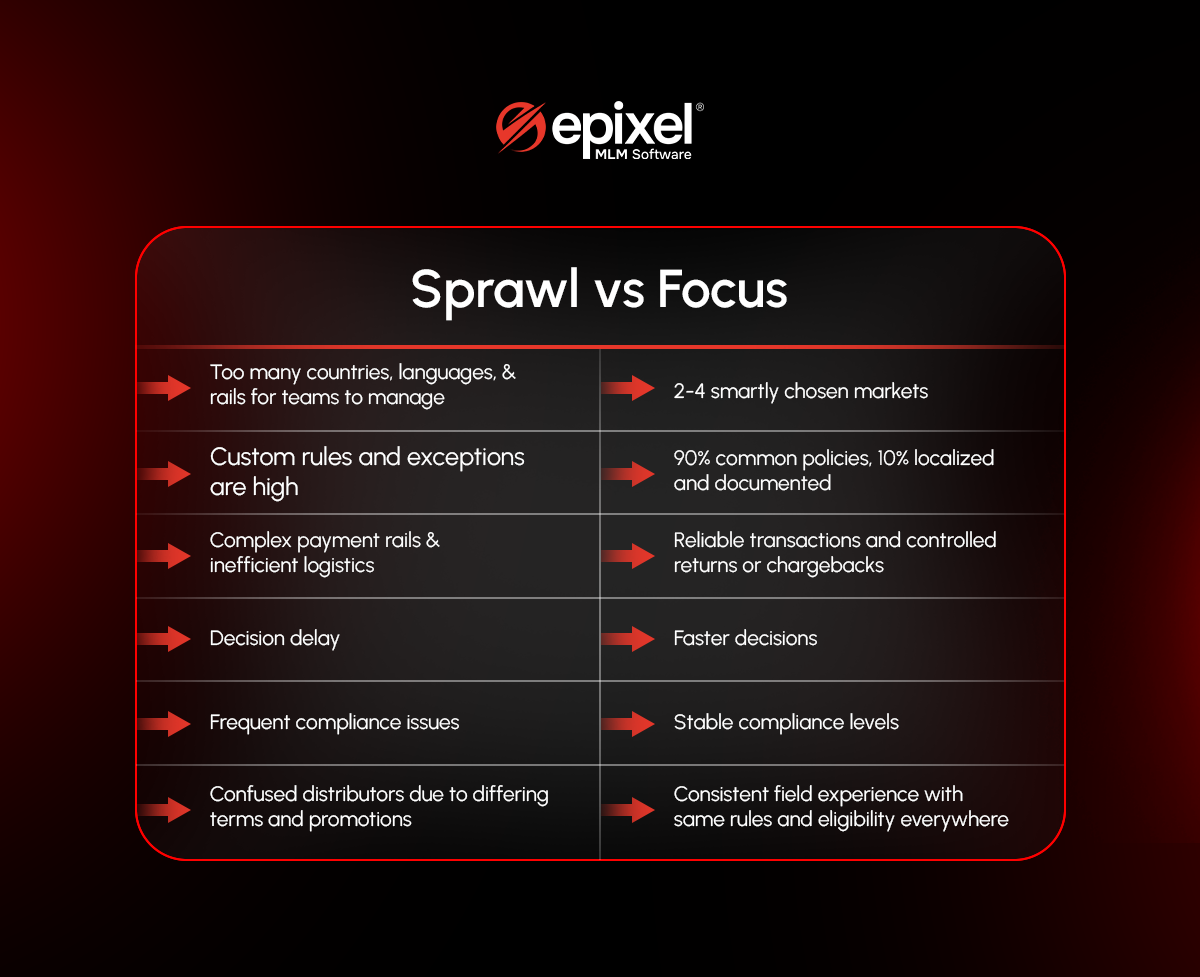
Difference between sprawl and focus in international expansion
Expanding into too many countries with new languages, payment rails, and compensation exceptions all of a sudden. This sprawl crumples your business and your team will run into chaos when they are burdened with more than they could handle.
But with focus you identify and expand into small markets that promise growth and sustainability. So, leadership decisions should not debate on local vs global but should keep expansion as a route to consistent growth where both the business and its network prosper.
Four cross-country growth patterns to plan your expansion
“Which market to choose” and “how to” are not easy questions to answer. Even when you already have researched and shortlisted the markets, there are hidden complications that you might encounter. Hence, it is always best to group the shortlisted markets into four.
Beachhead twins
These are basically twin markets that mirror your home country in the aspects of product expectations, legal structure, payment systems, and logistics. Since you already have experience handling the type, it will be easier for you to enter and establish here. Keep everything 90% the same as your home market with extremely necessary localizations. Especially the compensation plan should remain without any change except for payment methods in case if regulations in the new market demand.
Success in these markets is measured in comparison to your home market.
- Contribution margins within six months should be within 2%.
- Return rates should be within the designated limits.
- Cash conversion cycles should be the same.
Community-powered markets
The next priority markets are the cross-country markets where your customers are already present. These brand communities can help uplift your brand in the new market so you do not have to work out marketing from the basics. All you need to do is activate your existing communities in the new market with special offers and bundles. In these countries, you can begin with two or three select cities and launch the brand through local ambassador programs, translated onboarding, and community-centric events. Your nearest established hubs can support logistics so that you don’t right away need a logistics infrastructure locally.
Performance in these markets will be clear within four months and repeat purchase rates and multi-category orders should increase proportionally to your existing customer segments. Fraud and chargeback rates should be under control to reduce growth-related risks.
Tech-savvy markets
Customers and distributors in these markets will be reliant on technology and online platforms for marketing and purchasing. E-wallet and ecommerce usage will be high. Companies planning to operate in the technically dependent markets should localize payment methods, logistics, and customer support system. Consider launching one hero product and one complementary product and events should be based strictly on value in the initial days.
The success of your brand in the tech-savvy market should be measured in KPIs below
- Strong compliance rates
- Rewards for real retail sales
- Online customer acquisition costs
- Lifetime value of customers who joined the brand online
Complex markets
In the complex markets, you will see high potential for growth, but risks and challenges for operations are also high. These countries will have complex customs, compliance, and legal regulations. If you have a complex market on your expansion list, then it is best to consider it as a research and development plan with fewer products and resources with third-party fulfillment and strict onboarding process.
The market can only be considered under your “Growth Markets List” once it starts contributing to your margin consistently. Else, it should be paused or discontinued.
Analyzing country-level unit economics
You will need to assess each social, cultural, legal, and economic unit in the new country that influences the performance of your business. This analysis is important because you cannot justify weak unit economics. So, when planning, plan it right, from the basics to a strong start.
Demand and revenue side of expansion
The demand and revenue a market generates depends on customers and local buying patterns and is assessed by estimating AOV and order frequency. Average Order Value should be estimated in local currency and converted into your reporting currency with a risk-aware FX rate so that even when there are currency rate fluctuations it will not affect your estimate.
The frequency of customer orders, especially the first three orders, determines their CLTV. So, you must calculate the time it takes a customer to place their second order and the percentage of customers who reorder within their first 90 days. Other purchase behaviors like bundle and add-on purchases and performance of your starter pack should also be listed in.
The channel from which demand and revenue are high is the one right for marketing use. You should know if the business comes more from distributors or from direct customer purchases, from events or content, samples or discounts. This is the hint that makes predictions and marketing plans easier.
Expenses involved in international expansion
The price of the product in the new market should be announced only after including landing costs, FX and transaction fees, support resources, returns and chargebacks, compliance expenses, and distributor commissions.
International payment charges are additional and may include gateway fees for cards and ewallets, and chargebacks. Companies will also have to shoulder costs for additional resources needed to facilitate compliance, support ticketing, and distributor training. Product returns cause reverse logistics expenses and write-offs.
Keeping every international market compliant is not an easy job. A separate team, one for moderation and one for policy management and legal support is required. The compensation plan for your global MLM network should be the same and payout methods and commission caps should be adjusted according to the local regulations.
Market contribution and cash efficiency
Market contribution itself will show if it is profitable or not. The formula for the calculation of contribution margin is to subtract all expenses like landing cost, payments, support, returns, and distributor commissions from total revenue.
Another method is to calculate the cash conversion to see the speed of the market to turn sales into cash. This depends on the time taken to collect cash from customers after a sale (DSO), settlement delays from payment gateways, and payout cycle frequency.
Market contribution also depends on the working capital you need to operate in that market. Like, how much inventory you must hold to meet the expected demand and the cash reserve needed to manage FX fluctuations.
If a market cannot produce a realistic margin contribution and cash conversion, then treat it as an R&D strategy and not as a revenue market. In that case, do not expect profit, do not overfund it, test it periodically until it is safe for a full-fledged expansion.
Setting the “Expected-to ROI”
When expanding to newer markets, that too internationally, it is always better to set practical expectations on your ROI. An entirely new market might or might not generate up to your expectations. So, it is best to keep the reserves and expect a practical margin with a reasonable ROI range.
Expected-to ROI = (Expected Contribution in dollars × Survival curve) − (Run-rate OpEx + One-time setup)
(One-time setup + Working capital step-up)
Expected contribution is revenue minus the variable costs.
Survival curve is the number of customer/distributor segments you are planning to retain into the second year. Estimate this using your existing markets similar to this one.
Run-rate OpEx is the operational expenses you are paying for local managers, agencies, compliance, translations, privacy tools, and logistics services.
One-time setup is the localization, payment gateway onboarding, tax IDs, product registrations, and legal checks.
Step-up capex is the extra inventory, warehouse setup, returns station, or POS materials you will need.
Placing unrealistic hopes fails an expansion plan more than competition. So, always analyze these two scenarios before entering a new country:
- A base case in which you set your realistic expectations.
- A downside case which counts your what-ifs like “what if sales are 20% lower and costs are 20% higher”.
Structuring your expansion with hierarchical thinking
After you successfully establish your business in the new markets, the first few months cannot bring promising returns or hints at your failures. It is too early to make a decision with the initial data from the new markets. It might show a sharp increase or sudden drop, but hold on, it’s still not time to draw conclusions.
Hierarchical thinking can get you across these early results to smarter conclusions. Always ensure that you do not analyze the new market as a separate unit. Compare it with other similar markets so that you have a realistic measure to compare.
Don’t be surprised by the sudden highs and lows. You should pull these data toward the pooled average from similar mature markets. Do not apply frequent changes to policies. Wait until there is a steady pattern in growth or fall, change policy if needed.
Your analytics team should finalize reports on the newer markets with ranges and intervals, not a single number or guesses. The analysis should be averaged using data from similar performing international markets.
Seeking the hidden complexities

When your ambition to emerge as an international business cloud the realities, rule exceptions and process inefficiencies slowly increase. It can slow down and cause errors which will directly impact your profits. You won’t realize until one day it stands before you as a serious problem too late to solve.
The smell tests below can help you identify these warning signs to set up controls before it is too late.
Compensation exceptions
Rule exceptions are common in most markets but in new markets, it might get complex. Because setting the rule exceptions for distributor requests or single country preferences can damage your brand reputation on a global level. Your compensation plan should be a single structure no matter how many global markets you operate. In case, certain regions need mandatory modifications to fit the local market, apply temporary modifications and invoke them once the goal is achieved. Permanent rule exceptions can grow into unnoticed complexities that affect your overall compensation efficiency.
Pay cycle frequency
The frequency at which a brand pays its distributor affect cash health because many a time returns and chargebacks arrive later than the payout putting the company in loss. These risks should be contained through setting holdbacks and buffers in the payment process to adjust the time duration of returns and cashbacks.
Reverse logistics
Customer returns, exchanges, and in-transit defects increase logistics expenses for the company. Difficult returns process where customers have to send emails and fill out forms to return a product can cause frustration. Out of this frustration, complaints and compliance risks will rise. Prepaid return labels, partnership with local logistics services, and implementing grace periods for returns and exchanges can bring these issues to a close.
Claims and content
Product and income claims issues can increase with a distributor network that is spread globally. More than in-person interactions, social interactions are caught up in this and spread faster, putting the brand at risk of international non compliance. Bringing content-related issues under strict moderation will need a centralized “green-copy” asset library approved for all markets and secured with brand watermarks. Mandatory training sessions both online and offline that include local compliance can make distributors aware of the seriousness of posting ethical and compliant content.
Data and privacy
Different countries have different privacy guidelines. GDPR is to Europe as CCPA is to California, US. Privacy laws and data protection policies should be tailored for each market depending on the local regulations. Companies must know where customer data goes and what it is used for in each market. Unnecessary accrual of PII should be restricted and record the reasons for collecting and retaining data individually for each market.
Support hours and languages
Direct selling companies often set up their customer support hours to their home zone. But with plans to grow globally, this would negatively impact your customer confidence. When you see an increase in after-hour ticket logs, know that it is a warning. Support teams in different time zones or an AI-powered chatbot for global support to handle multiple languages and time zones can reduce support tickets. You should also tell your customers how fast they can expect responses and resolutions.
Go/Defer/No-Go scorecard for quick expansion decisions
Direct selling leaders can reconfirm their international expansion decisions with a Go/Defer/No-Go scorecard. This is more like a one-page tool that leadership can use to evaluate the international markets in their expansion list for market readiness, unit economics, and expected-to-ROI. It will help companies and the leadership prioritize markets that promise real growth and classify markets under Go, Defer, and No-Go status. The scorecard also has a 90-day expansion plan with reversibility considerations to ensure that every market you enter is strategic, measurable, and manageable.
Evaluate new markets and make smarter expansion decisions with our free Go/Defer/No-Go scorecard
Sequencing your international expansion
Design your international expansion as a product roadmap in three waves with quarterly reviews.
Wave 1
Focus on 2-4 beachheads that are similar to your home market and allow you to reuse policies, compensation plans, marketing content, and customer experience strategies.
Wave 2
Look for slightly different opportunities like a mix of one community-driven market and one tech-savvy market. But limit the expansion to a few cities and a small set of products to make the learning process easier.
Wave 3
Consider one complex market and treat it as a research and development strategy with investment decisions based purely on contribution and not assumptions.
The leadership team should publish a portfolio every quarter reporting the progress and regress in the new markets. Countries that do not contribute to growth or margin should be removed, and operations stopped immediately.
Getting compensation, compliance, payments, and policies right
The four aspects of international expansion are compensation, compliance, payments, and policies. The strength of customer relationships in foreign markets depends on these factors. Hence, setting the policies right and payments straight is important to keep your growth stable in the new markets.
One standard compensation plan
Qualification criteria and commission structures should be the same for all global markets. In markets with payment issues, adjust payout frequency according to return and chargeback periods. Any exception you make should be recorded with the name of the owner, start date, and exception period.
Payments and FX management
Foreign exchange rates and payment fees can keep wavering from time to time and market to market. Companies have to keep these fluctuations in mind and set their payment methods and plans accordingly. Before expanding to a new country, your team and your system must understand local tax rules like VAT, GST, etc. The pricing of your products must be inclusive of these expenses before launch.
Optimize compliance to enhance customer experience
Customers take time to trust new brands. They are doubtful about product quality, support, and exposing their personal information. A brand that prioritizes compliance is sure to offer a confident customer experience. In order to become a customer-friendly brand, you should only acquire information that you need. Create a training-oriented onboarding process through which distributors are educated about product and income claims they are allowed to make. Offer approved content templates for social media marketing with enclosed disclosures to keep your brand identity safe.
Discover how we build resilient businesses with advanced MLM functionalities



A 90-day plan to global expansion
As soon as you enter a new market, take time to analyze and understand how your growth sprouts, from where, and how quickly it develops. It takes at least 90 days before you are confident to make a full-fledged expansion.
Days 0-30
In the first month, study the market, finalize the expansion scorecard, get risk approvals from finance team, set compensation rules and product list. Distributor onboarding should start with basic training on compliance and local policies. Offer them pre-approved content and templates to kick start marketing. Start with one or two cities initially and decide when to stop or advance.
Days 31-60
The second month is your time to test scenarios. Monitor how distributors and customers onboard digitally or physically. Compare in-person and virtual events to see which brings more orders. Keep a review every week to analyze contribution and cash flow. At the end of the week, publish a report which cites the strategies you have tested, improvements, and needed changes.
Days 61-90
Into the third month, you will have enough data to make clear decisions on the market. If the goals you have set are met, you can add cities or products to expand your presence. If not, stop acquiring new customers, fix what is wrong, and test again until you get clear confirmation through the performance data. If the results don’t change, park the market for the time being and record what you have learned in the process.
International expansion is a “slow and steady wins the race” story. But here, you rely on real data, make informed decisions, and proceed only when you are confident. Moving too slowly or too quickly is risky in one way or the other. Your safest path is to focus on markets where real growth lies and nurture it carefully.
















Leave your comment
Fill up and remark your valuable comment.