


















 Epixel Perspectives and Data Matters
Every time you have a new customer, you wish them to stay with you forever. But that is never the case. Some stay long while others quit short. How you wish if you could know how long they would stay!
Customers stay with a brand for various reasons. It could be product quality, emotional connection, service experience, financial convenience, or out of their habit. The reasons for leaving a brand are also tied to the same. Just as the saying goes “first impression is the best impression”, the first purchases a customer makes determine their lifetime value for your brand. Especially if you are running a subscription-based ecommerce business, the first three orders show who your customer really is, their preferences to make your direct selling brand a habit or a one-off.
The first three orders decide LTV
The first three purchases with their frequency and quantity are considered important in a multi-level marketing customer-brand relationship. These predict the lifetime value of each customer.
Purchase habits form fast
When you take a close look at the first two or three orders, you will understand the customers’ purchase habits. If the purchases are consistent, it is easier for you to maintain the habit through offers, recommendations, and reminders.
Products in the cart show customer behavior
Decoding customer behavior helps in creating personalized strategies for the future. Customers are of different types. Some make products a habit and some others love trying out new things. Some prioritize deals while others the quality.
Customers choose an MLM brand for the love of a single product or multiple products. Another noteworthy behavior in customer purchases is whether they buy products that finish faster or products that stay longer.
The CLTV
Customer Lifetime Value (CLTV) can be predicted from the first three orders and depends on the pricing you fix, incentives you offer, and the combos you introduce to the customer. If you try to make customers happy by giving large discounts, they expect the same for their next orders too which leads to higher customer retention costs. So, the primary offers should be balanced with fair pricing and product bundles.
Signals that predict lifetime value
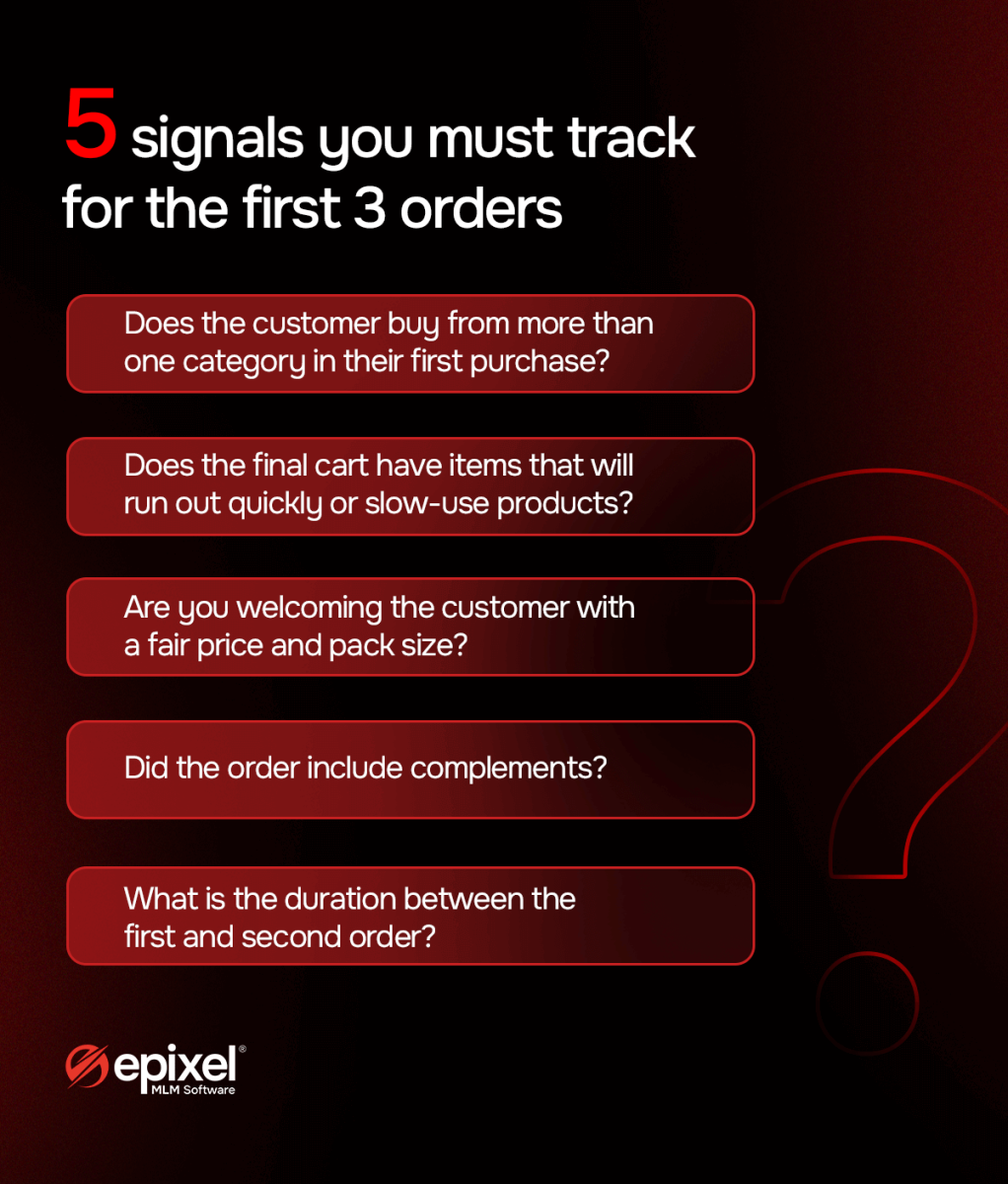
You do not have to track every customer order. Just the first three, but concentrate on these five signals.
- Customers who buy products from more than one product category are expected to stay longer.
- If a customer’s cart has items that will be used up faster, then they are sure to come back for repeat purchases.
- The size and price of the first package matter. If the size is too big, customers will not come back sooner for the next purchase. Costly bundles also hold back customers. Something in between will rightly fit.
- Complementary items included in the initial product bundles increase customer satisfaction.
- The duration between first, second, and third orders matters too. Check if there are returns or support tickets. These show that the customer is happy with your brand and is likely to stay longer.
Forecasting LTV with patterns and predictions
A sequence-to-LTV model analyzes customer’s purchase behavior to predict their lifetime value. Read a customer’s purchase journey more like a story. You will find hidden cues which can accelerate their LTV. A customer who purchases the same product in their first three orders is likely to subscribe and stay whereas customers who constantly switch items in every order will not stay long. There is another group of customers who buy one product, repeats the same and then switches to an attached product, this group is also likely to stick.
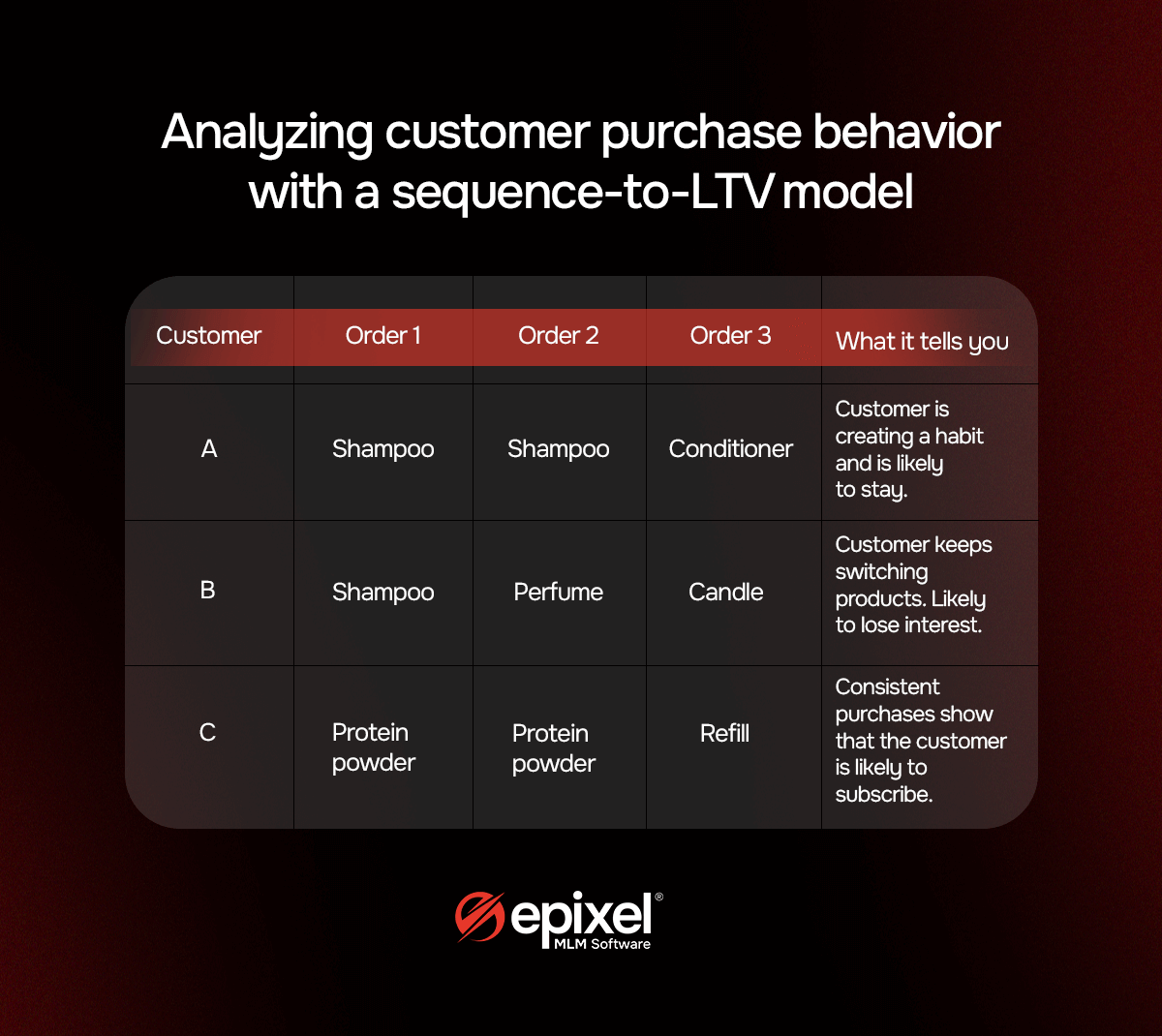
Thus the sequence-to-LTV model analyzes different sequences to predict a customer’s future purchases.
The “why” in prediction through SHAP method
Predictions help companies to plan customer retention strategies. But they often wonder about the “why” behind these predictions because that makes it clearer and easier to formulate fitting strategies.
The SHAP (SHapley Additive exPlanations) method can exactly tell what is contributing to the growth or fall of customer lifetime value. SHAP is like a scorecard which lists the factors that cause the rise and fall of LTV.
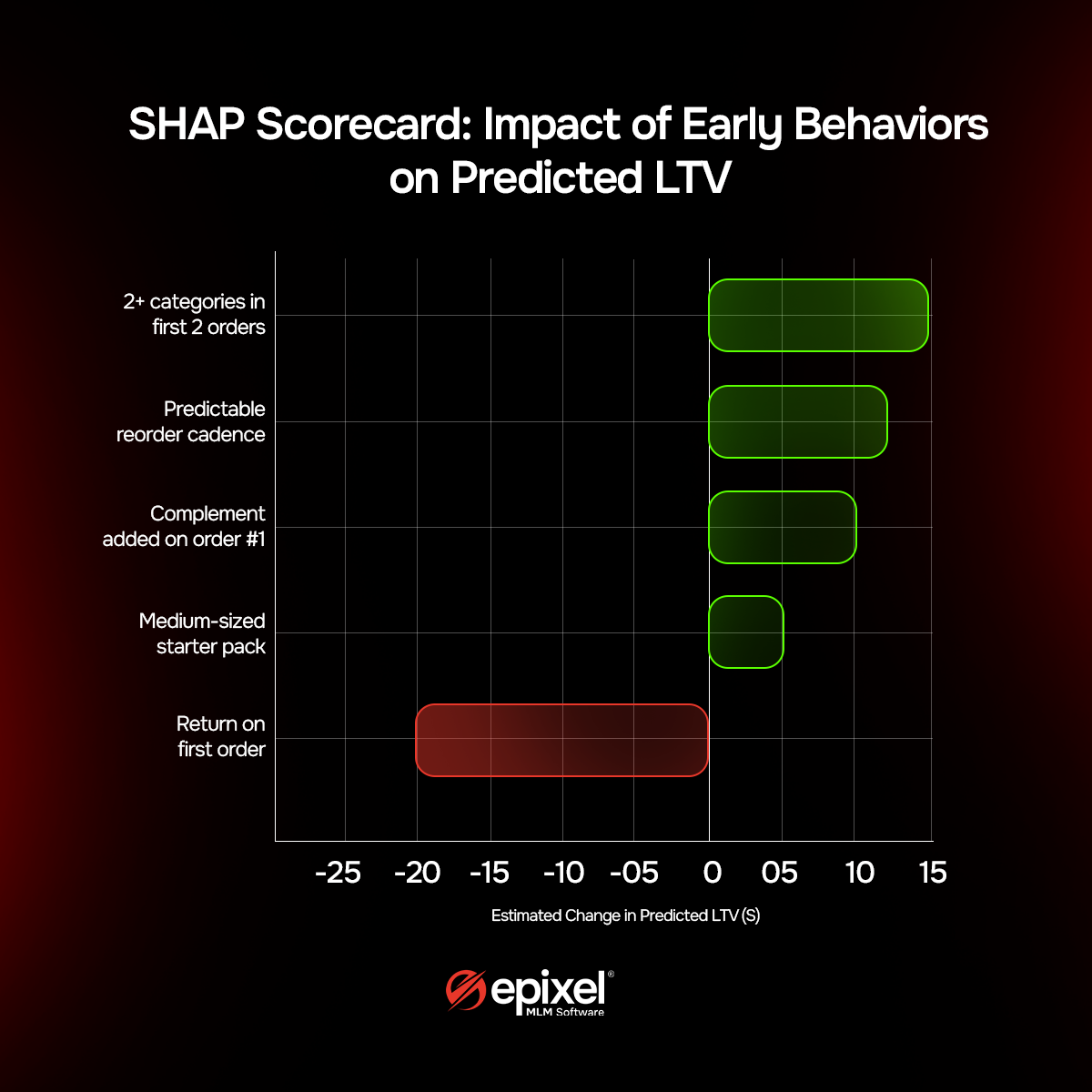
The scorecard represents the positive and negative contributors that affect the predicted lifetime value. This can help companies identify order patterns they should encourage and the ones they should improve.
Strategic first-order designs to improve LTV
You can design a starter kit for the first three customer orders without losing too much on discounts. Here’s how:
Create the right combo for the first order
If a customer is buying a cleanser, pair it with a moisturizer to improve their experience. The size of the product is important, something the customer will finish within a month.
Remind the reorder
When the timing for the next order approaches, the customer should receive a reminder to place the second order. The reordering process should be simple wherein the customer can place the order with a single click. Introduce a second complement that improves the results of the previous products.
Expand your relationship
By the time the customer reaches their third order, a connection has been established. Build on this connection with an upgrade or a product from a related category that does not increase their spends but adds value.
Reflect their brand journey
Show them where they stand through app or email. Rank them as new, privileged, or premium customers to make them feel the importance of their contributions. Consider this as the first step to building trust and loyalty for long-term retention.
Starter Bundle Optimizer tool
Designing a starter bundle for your first customer orders is a real task. So much planning and strategizing goes into creating the perfect welcome bundle. Build a Starter Bundle Optimizer tool to design customer orders that bring repeat purchases and higher lifetime value. The tool once built can be used internally before introducing it to the field.
You have to select a few basic inputs initially using sliders or toggles.
- Choose a hero product that customers will finish in a short span of time.
- Select a maximum of two complement products.
- Choose bundle price and size.
- Set a repurchase period between 30-45 days.
- Set a goal for order #2 as to whether the customer should purchase from a single or multiple categories.
- Choose an incentive to pair such as free shipping, reward points, or small discounts.
When these inputs are given to the tool, it shows the following outputs.
- The tool analyzes past purchase patterns to tell you the number of repeat purchases a customer will make.
- It shows the lifetime value that could be achieved or lost with the current starter bundle.
- It predicts the impact on your profit margin caused by your starter bundle and offers.
- Risk flags indicate potential issues like improper bundle sizes, products with high return rate present in your starter bundle, or offers that could impact your profits.
Built-in strategies in the Starter Bundle Optimizer
- Habit Builder focuses on hero products which will replenish within 30-45 days.
- Two-category path encourages customers to explore a different category in their second order.
- Eco refill path begins with a starter bottle and upgrades to refill routine products by order #3.
Design the perfect starter bundle with our First-Three-Orders-Decision Template
How to introduce the tool to your teams?
The tool should be tested internally first with different bundle scenarios before implementing them. When LTV, margins, and risks are on the safer side teams can implement the bundles.
Apply the 3x30 rule
Increasing customer lifetime value is a team effort. Teams should take actions that would increase CLTV especially through the first 3 orders.
The 3x30 rule calls for creating three key experiences within the first 30 days. The customer must use a hero product and reorder it within 30 days and move onto another category in their third order.
The rule makes 30 days a mandatory period because that is when the habits form. During this period customers regularly use the product and see its impact. The benefit they get from the first purchase leads to pairing new products and the process repeats. These customers are not ordering for discounts but because the products have entered their routine. Such customers build strong connections with the brand to increase LTV.
The rule brings all teams under one concrete goal which is to make every customer feel their first month valuable and easy.
Bringing teams together to improve CLTV
Each team has a special role to play in improving CLTV with a distinct set of responsibilities. This makes them realize their contributions in influencing customer behavior and reducing attrition.
Growth and product category management team
They decide the hero products and which products to pair with them as complementary offers. They also design starter bundles with the right size and price.
Lifecycle and CRM team
These are the teams responsible for communicating with the customers through the first three orders. They send personalized messages through emails, app notifications, or text to recommend new products or remind them to reorder the products before it runs out. They test when and how to approach customers with reminders or recommendations for the next purchase.
Field enablement team
They train distributors and leaders on how to start, strengthen, and expand customer orders through simple scripts. Visuals, FAQs, and training materials are also used to help distributors guide customers through their first three orders.
Finance team
They set the price and profit margin when designing starter bundles. They set limitations on offers and discounts that can harm the finances and expedite customer retention costs.
Data and analytics team
They manage the sequence-to-LTV model and update SHAP reports on a monthly basis. They also manage the Starter Bundle Optimizer tool.
Customer experience and support team
They track and solve support tickets and identify issues causing friction. They send these insights to the product and training teams so that customers do not face similar issues in the future.
A promising CLTV model in 90 days
Days 0-30
Where are you going to start from?
Build a dashboard to track the first three orders of all customers with our five important signals. Always review your starter bundles every month and remove products that are no longer relevant or are negatively impacting CLTV. Create your first test bundle with a hero product and one complementary product in medium size.
Days 31-60
What will you test?
Test your first bundle and analyze data surrounding it. Introduce this in one market first and compare customers who buy this bundle versus those who buy individual products. Add reminders with personalized messages for taking customers to their second order. When the customer numbers are enough for experiments, try different complements and hero products to create new bundles. Reviewing the performance of these bundles weekly and tracking metrics like second orders, attach rates, return rates, and early LTV performance can take you on the right route.
Days 61-90
What is your decision?
Decide the bundle that performed best to be your hero bundle. Launch Starter Bundle Optimizer tool for your team to test more ideas and combinations before launch. Implement the winning bundle to all customer segments and markets. Share details of bundle performance and the LTV improvements with your board members.
Metrics to measure and when
The first 60-90 days are important in your customer-brand relationship. Keep a close watch on these crucial metrics to strengthen your CLTV.
- Two-category rate by order #2: Track how many customers move to choosing two categories by order #2.
- Complement attach rate by order #1: Calculate the number of first orders that include a complementary item.
- Use-through index: Measure how many products that run out quickly are there in the customer’s cart.
- Order #2 reorder duration: Count the average number of days between a customer’s first and second order.
- Order #3 conversion rate: Take the percentage of customers who placed the third order within 75-90 days.
- Negative experience indicators: Closely monitor the increase in the number of support tickets, negative reviews, and return rates.
- Early cohort LTV: Measure the total revenue from a group of new customers.
Safe practices and experiments you can try to protect CLTV
Every company wishes that the strategies they implement bring results faster. But steps taken in a hurry can expose businesses to risks and complications. So, each step you take in improving your CLTV should be safe and proven.
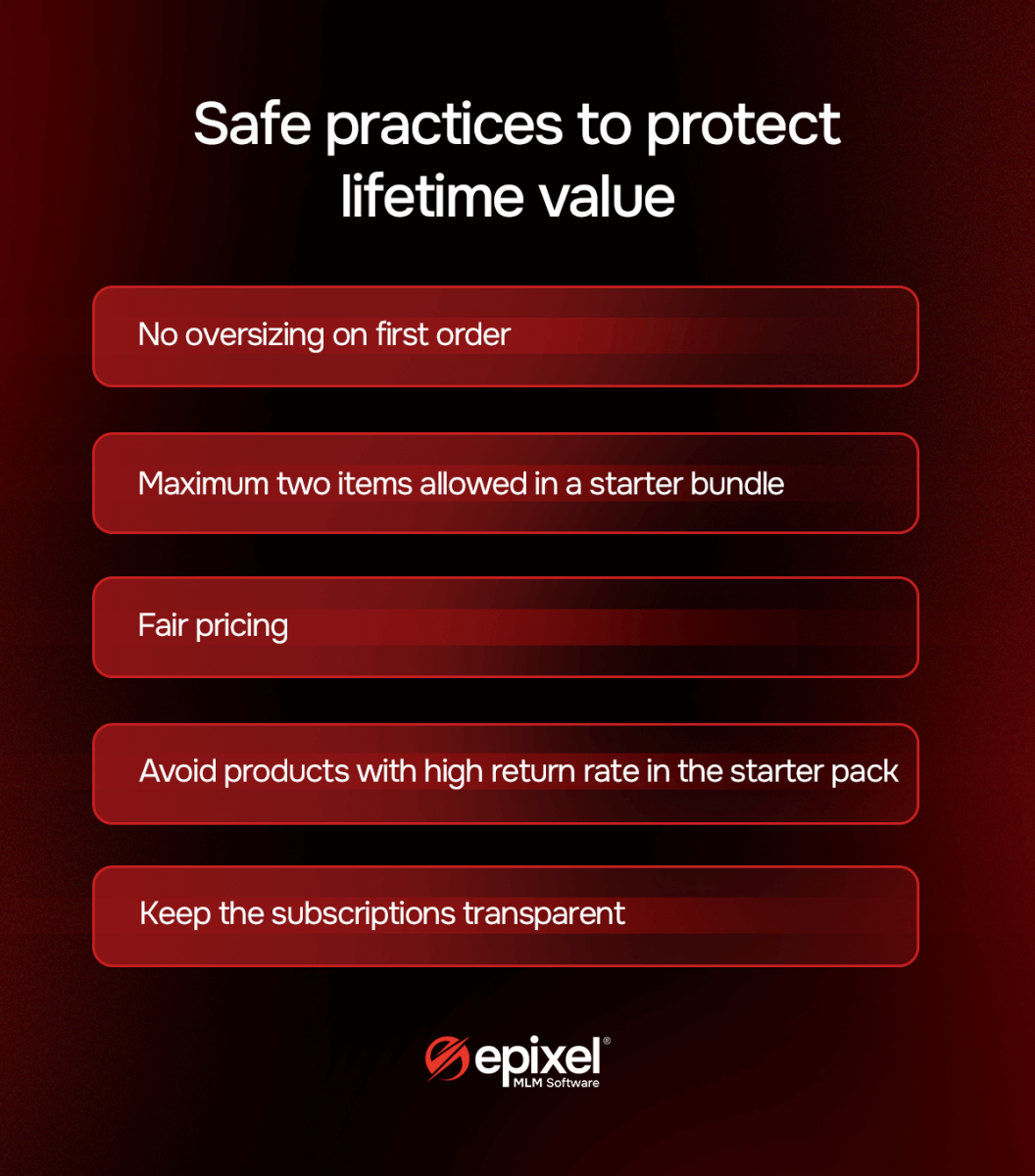
Safeguards
- Do not offer large packs because they delay reorders and lower your CLTV.
- Too many complementary products can overwhelm customers so limit it to two.
- The pricing of starter bundles should be fair. Too much discounts can increase your customer retention costs.
- Never ever include products with high return rates in your starter bundles.
- For subscriptions, keep the process easy and transparent.
Low-regret experiments
- Compare customers purchasing your starter bundles and DIY packages. Your starter bundle is a success if attach rates rise by 8-12 points and reorders happen 3-5 days earlier with zero returns.
- Let the team test the complementary product that works best with the decided hero item. Rotating two or three combinations can show which brings more repeat purchases. The winning combo gives you a 5% higher order #2 conversion rate and lesser customer support tickets.
- Compare combos with different pack sizes like small, medium, and large but keep the per-pack-price consistent. The results normally point to medium being the most favorable one because small packs run out quickly and large ones cause delay in reorders.
- Test communication timing as to whether generic weekly emails influence customer purchases or on-time personalized reminders. It is highly advisable that reminders around the use-through period inspire repeat orders than pressurizing emails.
- By order #3, customers have established a routine with your product. Experiment with a new related category product for their third order. This cross-sell experiment can increase AOV without affecting the hero product’s reorder rate. This can successfully bring an increase of 5-7 points toward order #3 conversion.
Discover how we build resilient businesses with advanced MLM functionalities



Conclusion
Customers’ decision to stay or leave the brand unfolds in the first three orders. This is the exact time a brand has to sketch an impressive experience that will make them stay long and loyal. Even when we formulate a hundred strategies and tools to build customer satisfaction, relationship forms the foundation. It is true that the strategies and tools build the relationship but there is something more important than these mechanical methods. A genuine human connection. When customers feel understood and valued, loyalty grows on its own.















Leave your comment
Fill up and remark your valuable comment.