


















 Epixel Research: Fairness and Compliance
Compliance is always a concern, a fear, a challenge fought tooth and nail by MLM companies. Multi-level marketing is overshadowed by a web of regulations and perceptions that conceal the innate potential of the model. The struggle is tougher for MLM and network marketing companies operating across international markets, which is the reason why many organizations rely on a multi-region MLM compliance template to organize and manage their regulatory requirements with easy to access audit-ready documentation. Policies vary, regulations tighten, and companies suffocate to sustain in the middle of increasing complexities.
Staying clear of this regulatory web needs proper planning and execution of processes and practices. It should start right from onboarding a new team member, launching a new product, or implementing a new customer strategy.
To err is to slow down your growth
Errors and oversights in compliance management can hurt business growth very quickly. Hasty decisions without thinking twice can create negative impact that lags the growth for a lifetime.
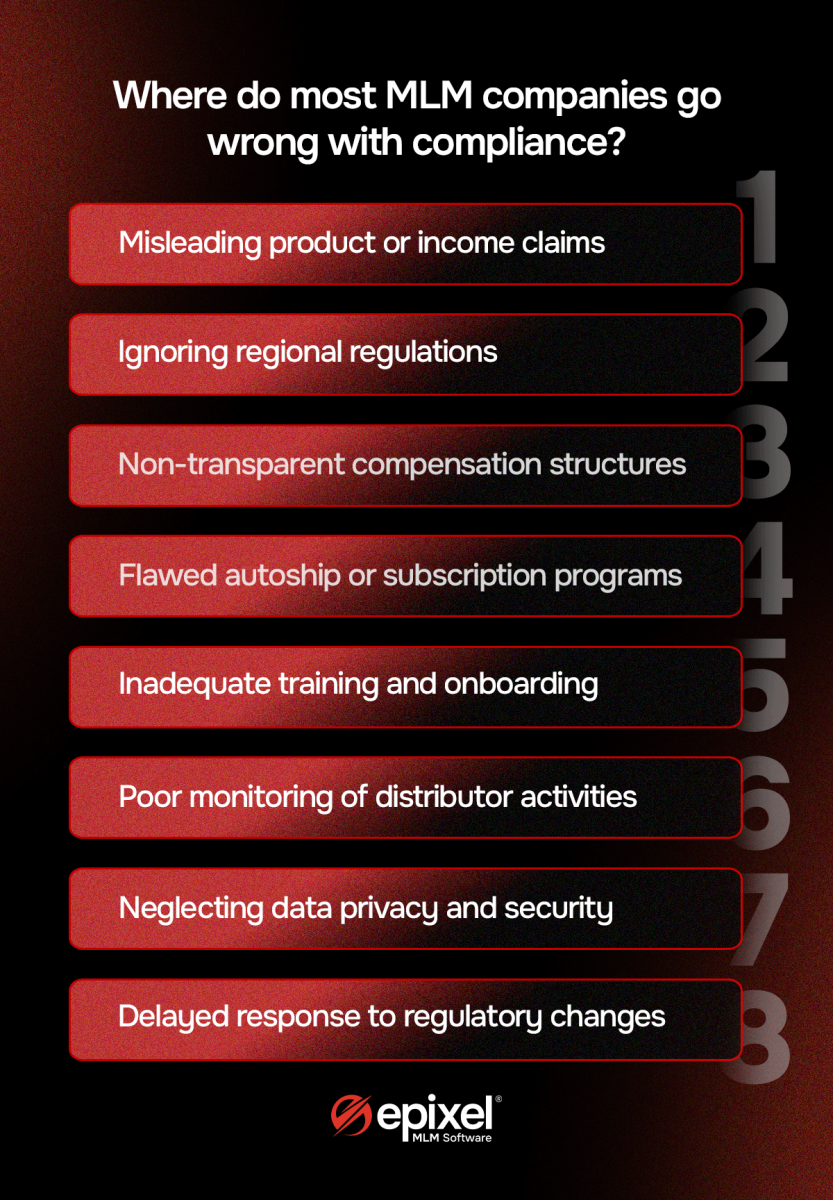
To avoid these errors, companies must enforce stricter strategies with a systematic process.
Regulatory Readiness Index to ensure compliance and growth
MLM companies can take advantage of the Regulatory Readiness Index (RRI) to maintain a compliance process without flaws. The RRI gives leadership teams a single score with a scorecard to see your current status in the compliance domain. It scans for readiness across four high-exposure areas such as income or product claims, returns or refunds, data protection, and autoship or subscription policies.
What is Regulatory Readiness Index (RRI)?
Regulatory Readiness Index is a leadership tool that converts compliance policies into a measurable score that shows the readiness of a direct selling company to launch promotions, products, and subscriptions with compliance in place.
Through this article we will develop a practical approach to managing compliance with low risk and high impact. This includes:
- A policy-to-metric map to decode your compliance principles into measurable signals.
- A weighted composite index (0–100) that you can show to your board each month.
- A benchmark chart to compare markets, products, or teams and highlight areas with compliance risks.
- A downloadable checklist to help close compliance gaps immediately with a focus based on level of impact.
The Regulatory Readiness Index helps MLM companies understand where they stand in terms of compliance before launching a promo, product, or incentive. It supports making the right investment decisions in compliance as to where additional spending is to be made for reducing risks with the least effort. It identifies compliance policies that must be standardized across all markets and the ones that need to be localized.
Why is RRI critical for direct selling businesses today?
Direct selling companies operate on four major grounds: customer protection, marketing standards, payments, and privacy. These are the non-negotiable aspects of the business, and the regulations that govern them are equally strict. In fact, it is tighter than it was a few years ago. Today, every return policy is scrutinized, income and product claims monitoring have become stringent, and data handling requires full consent and limited retention. Autoship and subscription programs now demand extreme flexibility on returns and cancellations.
The Regulatory Readiness Index cuts down on expensive rework caused by weak disclosure, confusing enrollment processes, or poor refund practices. It assists you in planning your marketing activities by helping you identify the compliance-ready ones first and guides you to fix the less compliant ones.
RRI generates a centralized readiness score with a shared scorecard and heatmap so that every team (legal, finance, sales, or product) sees the same risks and acts toward resolving it collectively. The greatest value delivered by RRI is the trust it creates with distributors, leaders, and regulators. It brings clarity and fairness to your compliance policies with transparent enforcement strategies.
Regulatory focus areas of RRI
The Regulatory Readiness Index focuses on four main aspects of a direct selling business. Each aspect is broken down into sub aspects, which are then scored for granular compliance inspection.
Product and income claims
Clarity and balance: RRI measures the clarity of claims made by analyzing if reasonable disclaimers are attached to it. For example, claims like “guaranteed weight loss in 3 days” should be followed by a realistic disclaimer which states “results may vary” or “with regular use and balanced diet”.
Evidence: It checks whether brand claims have concrete evidence, like customer testimonials or reliable product data.
Distributor claims control: Measures how easily distributors can find approved claims and ensure what is permitted and what is not.
Returns and refunds
Policy simplicity: Scans policies for clarity and ease of access for customers before they make a purchase.
Operational follow-ups: This measures if the company is abiding by its refund promises and tracking and fixing root causes of frequent product returns.
Fairness to distributors and customers: Focuses on ethical practices followed to reduce inventory loading and encourage genuine customer orders.
Data and consent protection
Consents and preferences: Ensures every consent given and preference set by a customer is respected with flexibility to change preferences.
Data handling and retention: Evaluates if only essential data is collected and deleted on a defined schedule.
Security and vendor oversight: Ensures company protects data even if handled by third-party vendors with agreements that define privacy standards.
Autoships and subscriptions
Enrollment and disclosures: Checks whether customers are well-informed about the policies and are voluntarily enrolled for the autoship or subscription programs.
Cancellation and refunds: Reviews whether customers can easily cancel or modify subscriptions without complicated terms and conditions.
Customer value and experience: Evaluates programs for customer satisfaction scores for preference handling and subscription flexibility.
RRI is not a policy maker or a legal opinion. It is meant for leaders to implement full compliance in all processes to keep the brand safe and trusted.
Understanding the RRI scorecard
The scorecard displays the score for all four domains on a scale of 0-25 with a total sum calculated out of 100. If you want an easy-to-communicate score, use the equal weighting scoring method for each domain. This considers each domain equally important and scores it out of 25. But if you think one domain poses more risk, then give it more score weight.
Suggested domain weights (optional)
| Domain | Weight | Rationale |
|---|---|---|
| Claims | 30 | False or misleading claims can cause legal action and damage reputation |
| Returns | 25 | Refund and return issues damage customer trust |
| Data Protection | 25 | Mishandling personal data leads to huge fines and brand harm |
| Auto-Ship | 20 | Subscription renewals often cause compliance complaints if not managed properly |
Scoring each sub domain (0–5)
| Score | Description |
|---|---|
| 0 | No policy or policy violated frequently with unclear ownership. |
| 1 | Policy exists but is hard to find, weak training, and frequent exceptions. |
| 2 | Policy visible, basic training, inconsistent follow-through, and absence of tools. |
| 3 | Policy clear and enforced. training in place, basic dashboards exist. |
| 4 | Mature policy, automation supports compliance, exceptions are rare and corrected. |
| 5 | Best-in-class. Effective policy, tooling, and reporting across markets and distributor segments with regular audits. |
Totaling the score
Step 1: Add all sub domain scores within a domain.
Step 2: Normalize to that domain’s total (25 or its weighted equivalent).
Step 3: Sum up the domain scores to get the Regulatory Readiness Index score.
Interpreting the scores
| Range | Status | Action guidance |
|---|---|---|
| 80–100 | Ready | Launch campaigns confidently, track the KPIs, and improve continuously. |
| 65–79 | Watch | Limit the scope of the campaign, add pre-launch reviews, and close key gaps within 30–60 days. |
| <65 | Action | Delay growth plans until remediation and assign ownership responsibilities. |
What does a great score look like
When you know how the real impact looks like, you can confidently publish the scores internally to celebrate your regulatory readiness.
- RRI ≥ 80 for three consecutive months shows that your teams can freely operate with the current policies without restrictions or fear of damage.
- 90% of marketing materials come from the approved content library and only <5% distributor posts require edits or takedowns.
- Total return rate is <2.5% of gross merchandise value (GMV) and no product go beyond 5% return rate for two months in a row even without a remediation plan.
- 100% of all digital forms use simplified consent language approved by regulatory authorities, and all vendors who are handling sensitive data are reviewed periodically.
- 100% of customers receive alerts before billing their subscriptions and cancellations takes ≤2 minutes for median users and ≤5 minutes for 90% of the users.
Using the monthly RRI scorecard
The scorecard gives a monthly snapshot of your organization’s Regulatory Readiness Index. Look at the monthly scorecard below with the sample data for a better understanding of how it actually works.
RRI this month: 74/100
Status: Watch
Movement compared to last month: Claims improved by 2 points and autoship by 1 point.
RRI insight for the month: Product claims have improved and autoship cancellations have been simplified but returns operations have not improved and remain a concern.
| Domain | Score (0–25) | Last Month | Trend | Risks | Decision |
|---|---|---|---|---|---|
| Claims | 18 | 16 | ⬆︎ | Distributors use non-approved visuals. | Ensure only approved visuals are accessible to distributors. |
| Returns | 15 | 15 | ➝ | Two products at >6% return. | Find the root cause and fix. |
| Data Protection | 19 | 19 | ➝ | Vendors are not properly reviewed. | Schedule timed audits. |
| Auto-Ship | 22 | 21 | ⬆︎ | Billing reminders are not received for a few customers. | Set up an automated reminder system. |
Decision block
Launch stance: Shows whether marketing campaigns can progress or should be stopped with color-coded lights.
30-day priorities: Top actions the team must complete to improve the RRI next month.
Owners: Responsible for carrying out the 30-day priorities in various teams.
Download the Regulatory Readiness Index score card to measure the compliance standards of your business processes
Compare the compliance gaps with benchmark chart
The RRI benchmark chart can be built with a simple bar or heatmap chart with business units or markets on the X axis and the four domain scores (claims, returns, data protection, and autoship) as stacked bars or colored cells. The chart is meant to act as a guide to make bottlenecks and weak spots immediately visible, without ranking or shaming teams.
- If the claims bar of a particular market is low compared to the other ones, offer training and support to distributors in that market.
- If returns are high for a product, see if the issue is product quality, packaging, or instructions and fix it.
- If data protection is weak, then review vendors and update forms with proper consent.
- If autoship is performing well across all markets, then allocate teams to domains where risks are present.
Translate policies into measurable metrics
In order to make the RRI score audit-ready, policies in each of the four domains should be converted into two types of metrics.
Leading metrics: Measures the behaviors and processes that should happen every day.
Lagging metrics: Measures the results that show whether those behaviors are working over time.
Claims policies
Marketing communications must use only approved claims, should have disclaimers, and avoid false or misleading claims.
Leading metrics
- Percentage of marketing materials taken from the approved library.
- Number of distributor posts with verified and approved claim snippets.
- Completion rates of training programs on writing clear and simple claims.
Lagging metrics
- Number of complaints caused by incorrect claims.
- Ratio of posts that are compliant to the posts that required edits.
- Number of customer tickets due to claim issues.
Returns and refunds policy
Returns should be simple and transparent, refunds processed promptly, and product-related issues that lead to refunds and returns should be investigated and resolved immediately.
Leading metrics
- Percentage of detailed product pages and checkout process with clear return options.
- Refunds processed within the promised time period.
- Monthly review meetings for product-related concerns that increase returns.
Lagging metrics
- Return rate by individual products.
- Average time taken to process refunds.
- Chargebacks as a percentage of total sales.
Data protection policy
Collecting only required data with clear consent and retention rules. Vendor agreements and reviews for sensitive data handling.
Leading metrics
- Percentage of new forms that use simple and straightforward language.
- Systems with automated retention scheduled correctly.
- Timely completion of vendor audits.
Lagging metrics
- Number of privacy complaints.
- Security breaches or incidents.
- Success rate of customers opting out on request.
Autoship policy
Customers should choose autoship voluntarily with clear pricing and frequency. Reminders on billing should be sent to the customer every time before confirming the order.
Leading metrics
- Percentage of enrollments receiving pre-billing reminders.
- Percentage of cancellations completed online.
- Average time taken to complete a cancellation.
Lagging metrics
- Reasons for cancellation of subscriptions.
- Number of refunds issued due to confusion caused by autoship policies.
- Support tickets raised per 1000 autoship subscriptions.
Downloadable RRI checklist
The checklist can be downloaded and used after adding owners and due dates.
Income and product claims
Returns and refunds
Data protection and consent
Autoship and consent
Governance
Ensure regulatory readiness of your MLM business with the complete Regulatory Readiness Checklist
RRI adoption with a 90-day plan
Days 0-30
The first step is to appoint a single trustable owner who will head the entire process related to RRI. It could be anyone from your compliance, product, or operations team. Each domain should have a scoring guide based on the domain weightage in your business. Now, create a one-page scorecard and benchmark chart for each market and business unit. Try and stick to the targets to achieve the expected RRI score.
Days 31-60
In the second stage, focus on what is easy to fix but gives you the maximum impact. Solve issues related to missing disclaimers, refunds, and cancellations. Add a micro-training module and approved claims library in your distributor app. Introduce a review process for product returns and fix the identified issue immediately. Conduct vendor reviews for those handling sensitive data.
Days 61-90
Document every change you make to your policy but bring policy changes in batches and not frequently. Implement RRI scores as approvals for campaigns and pause campaigns that do not reach the minimum RRI score set by the team. Start localizing the RRI for your next new market. Review your regulatory readiness every quarter with the report presented to the board or executive team with the score trend, fixes, and plans and priorities for the next quarter.
Discover how we build resilient businesses with advanced MLM functionalities



Common mistakes during RRI adoption
Many companies dream to achieve the maximum results at the first stage itself. But trying to create the “perfect” scoring system is not a good choice because this can delay the process and run into more complications. It is best to start simple with a 0-5 rubric for each sub dimension. You can always watch the results and improve later.
During the pandemic period, global retail sales recorded modest growth, with increases of 2.2% in 2020 and 2.0% in 2021. After that, sales began to fall. By 2024, the total had dropped from $170,023 million to $163,863 million, a 3.6% decrease and a CAGR of 1.2% over the three-year period. In 2024 sales of $163,863 million remain $675 million (0.4%) above the pre-pandemic level of $163,188 million in 2019. The independent direct seller numbers remained nearly unchanged in 2024, with 104.3 million representatives and a small 0.1% rise. However, the 2024 figure is still 4.2% lower than the 109.0 million representatives in 2019 before the pandemic.
Organizational policies exist but are not accessible to the distributors. This happens often with MLM companies who have poor onboarding and training processes. Always include the policies or create a centralized library and integrate it into your distributor app or portal. Content templates with disclaimers already in place can help in speeding up your campaign moderation process.
Policies are rolled out, and audits run, but this is not a one-time process because vendors, distributors, and processes change over time. Readiness drains off and your brand stands again in the court of non-compliance. Regular reviews with monthly RRI scorecards and quarterly audits can flag issues on time so that your team can fix it before it builds up.
Each market is different. One global policy cannot be applied to all markets. Local differences should be considered while drafting policies with consent forms and refund policies matching each market.
Compliance is never a growth breaker. It is more like a speed breaker that keeps a check on risks to ensure that your business grows safely and sustainably. It doesn’t slow down your business; rather it gives you the trust and confidence to leap forward with assurance. So, always keep a check on every aspect whenever you design a new growth path to safely reach the targets you have set.














Leave your comment
Fill up and remark your valuable comment.