



















Discounts are a pleasing incentive for customers and distributors. But do all discounts please everyone? There are customers who love lower prices and there are some others who care about status and exclusivity. When companies design discounts, it can never be a single standard offer for all. Each customer or distributor segment must be given recognition based on their performance and lifetime value, so they feel valued and their connection with the brand strengthens.
Modern customer and product analytics models such as hierarchical Bayesian demand models, we can understand what distributors and customers consider a priority, whether it is pricing, value, status, or convenience. We get clarity on each persona and their preferences on pricing and discounts. By analyzing each persona and their preferences, we can design better pricing structures, optimize existing ones, and in the long run a strong network of satisfied customers who will stay with the brand for the long term.
Looking into the numbers, persona-based pricing can improve average order value by 8-12% and cut down discount leakage by 15% along with an increase in profits. Through this article, we will be analyzing each segment but not limited to demographics but their behavior and the value they will bring. Bayes model for pricing analytics will make us understand the sensitivity levels of each persona to discounts and value add-ons. With this, we can create different offers for everyone like discounts for segments who are price-sensitive, bundles for personas who prioritize value, exclusive offers for those who choose status, and services for segments who choose convenience.
Persona-based pricing: The advantage your competitors can’t copy
Markets are flooded with similar products, offers, and prices. Customers choose one that suits their budget and needs, affordable quality without compromise. Companies experiment with upcoming technologies and tools to deliver a one-of-its-kind experience, but a brand’s intelligence in setting up the prices is far beyond what these could bring. Because pricing by persona is something that your competitors cannot replicate.
Macro pressures that impact the pricing
NYC Local Law 144 has made bias audits compulsory for companies that use Automated Employment Decision Tools (AEDTs). These audits are to be performed by a third party every year and results published on the company website. This is applicable for all companies with gig, incentive, and commission systems. Europe also controls and monitors AI use through its AI Act. The Act imposes strict monitoring through bias audits in high-risk AI systems that involve compensation handling. Non compliance with these laws will cost companies an approximate six percent of global revenue along with public listing that damages brand reputation.
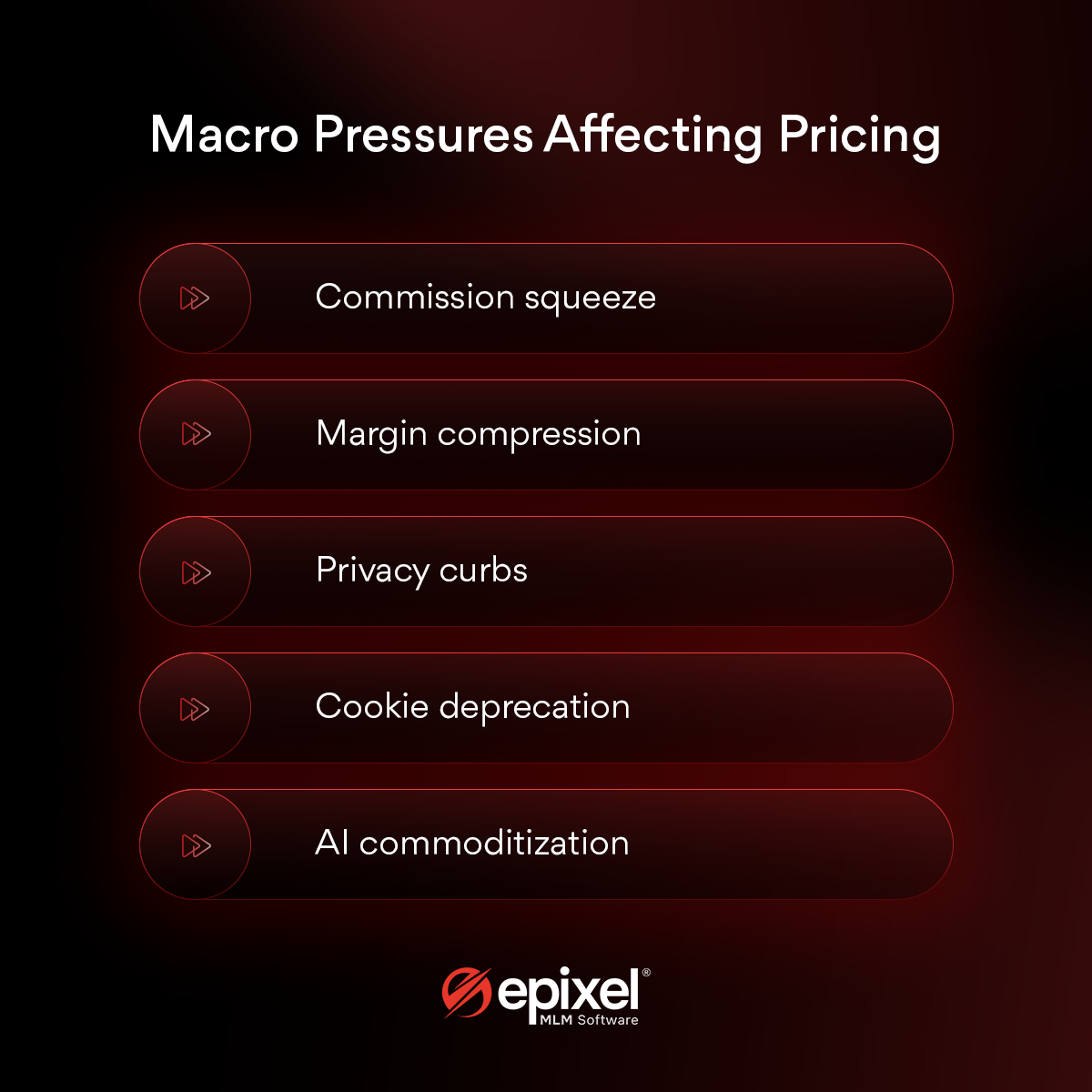
Even when brands are all set to give its customers and distributors a privileged pricing experience, there are factors that hinder the process. Distributors expect higher commissions and brands cannot compromise on that. This makes the margin for discounts smaller.
Privacy regulations, if not for all, in some countries have tightened adding to the difficulties of brands in targeting the right audience. Third-party cookies too are gradually disappearing, which makes broad retargeting strategies more expensive, less precise, and less scalable.
AI-driven tools such as predictive lead scoring and automated targeting are adopted by almost every business now and hence it is no more a competitive differentiator. The definition of competition itself has now changed from who has the best algorithms to who can design smarter pricing strategies.
A real-world impact of smarter pricing
The health and wellness industry is among the top competition facing industries in direct selling. One prominent MLM company in 2025 applied persona-based pricing in one of its holiday campaigns. The company implemented the pricing model in a controlled group with 15% discount for everyone and a test group with different offers for different personas, basically to compare the results.
When the results were analyzed, there was an 11% improvement in net revenue and a reduction of 24.5% on promotion costs. The Net Promoter Score (NPS) of distributors also increased by 8 points, adding happier and loyal distributors to their network.
The profits increased because high income distributors and prestige builders received skin care bundle upgrades which were cheap to provide but have high perceived value and the price-sensitive segments received good discounts. Everyone in the network felt rewarded and the profits were protected.
Economic personas as the new segmentation model
Segmenting customers and distributors based on age, location, and gender does not fit the marketing scene because it does not explain how people respond to price. Two customers who are of the same age and income can react completely differently to the same offer. Economic personas segment people based on the level of motivation and behavior. When brands know how a customer or distributor feels about an incentive, an add-on, or a bundle, it becomes easier to fix the right offers and prices for them.
Now, in the direct selling context, let’s classify the larger base of customers and distributors into four main categories:
- Prestige builder who prioritizes status and privileges.
- Mission-driven advocate who cares about brand values, ethics, and impact.
- Side-hustler saver who focuses on savings and profitability.
- Time-starved pro who are busy professionals, prioritize convenience over price.
| Persona | Priorities | Price sensitivity | Ideal offers |
|---|---|---|---|
| Prestige builder | Status and privileges | Low (DP ≈ 0.83) | Limited edition offers or early access to promotions |
| Mission-driven advocate | Ethics, values, and brand impact | Moderate (DP ≈ 1.05) | Promotions that support charity, sustainability, or a cause |
| Side-hustler saver | Savings and profits | High (DP ≈ 1.22) | Flat rate or percentage discounts |
| Time-starved pro | Convenience and easy order experience | Low-to-moderate (DP ≈ 0.90) | Auto-ship subscriptions and priority services |
DP refers to Demand Parity ratio. It depicts the sensitivity of each persona to price changes. Personas with lower DP rates are less sensitive to changes and higher rates show more price sensitivity.
Direct selling companies can extract the data needed to build their own personas from order history, payout logs, social shares, polls and surveys, and support queries. This brings all data required to build personas into one centralized system or the company’s CDP.
Measuring price elasticity with Hierarchical Bayesian models
Even when you have an absolute understanding of distributors’ and customers’ preferences and priorities, it is valuable only if it can be measured reliably and applied in real business decisions. Modeling approaches like Hierarchical Bayesian models make it possible to measure persona-level price sensitivity and decode insights to make smarter pricing decisions.
Decision support for the board
Board members can rest assured that no technical expertise or data science knowledge is needed to understand price elasticity by persona. Hierarchical model considers smaller and larger segments to create reliable estimates. Bayesian models do not provide a single score but probability ranges to help leaders understand the impact, outcome, risks, and uncertainties with the experimented pricing.
The Hierarchical Bayesian model delivers the result through a clear elasticity curve for each persona that shows how demand is influenced by changes in pricing. For decision making, the model also gives confidence ranges that take into consideration the risks before finalizing a pricing strategy.
Pricing strategies developed with the help of Bayesian models are more like business forecasts with known upsides and downsides.
Data requirements for modeling
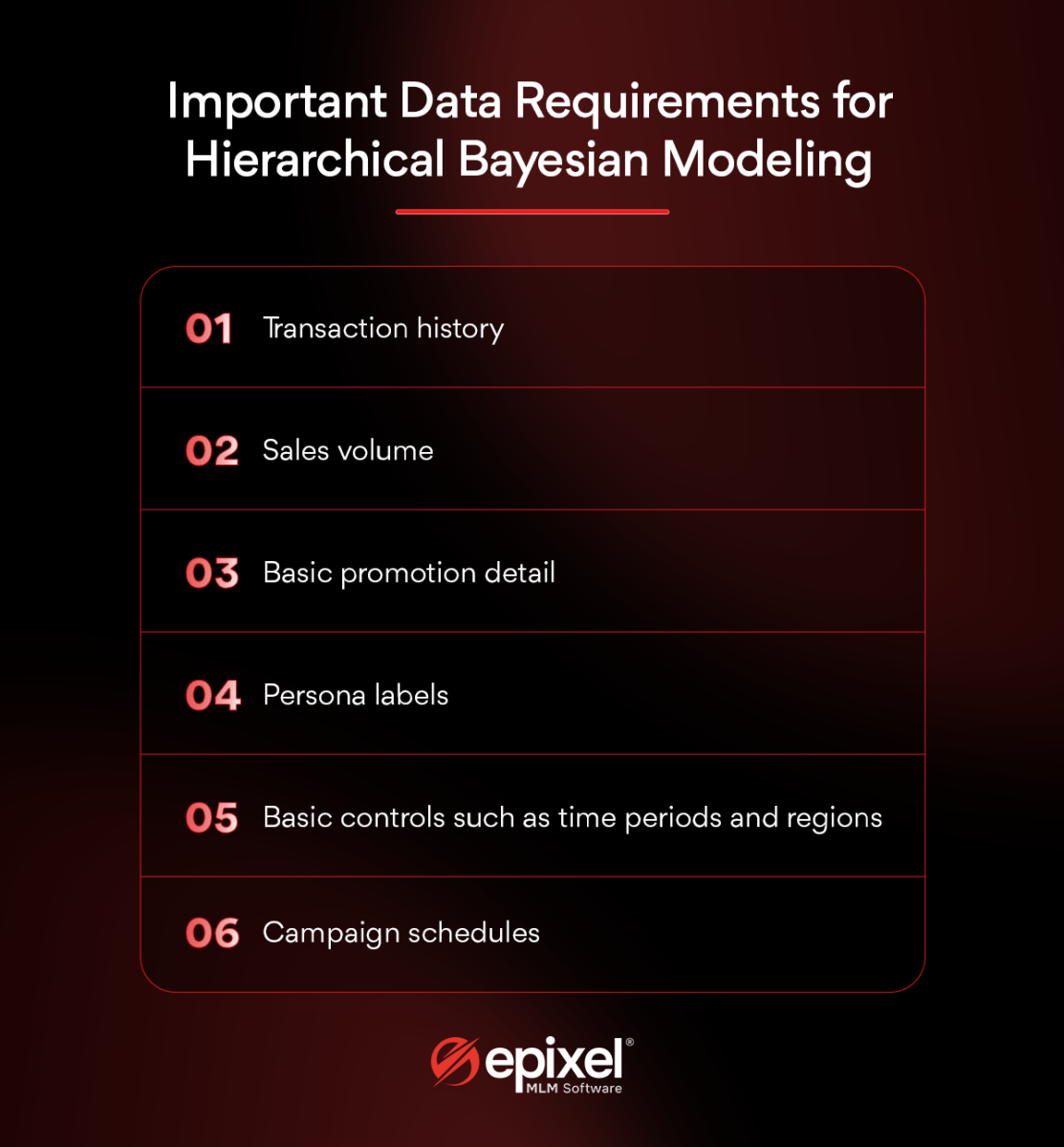
In order to create persona-based pricing strategies, direct selling companies do not need complex data systems. The required data already exists in direct selling organizations in the form of transaction history, sales volume, basic promotion details, persona labels, and basic controls such as time periods and regions, and campaign schedules.
Analyzing the past data shows seasonal trends, and control variables ensure the impact of pricing changes are measured correctly. This makes insights from past data analysis easier to apply in practice.
Data processing in Hierarchical Bayesian models
After data collection, it is structured and cleaned for processing using the Hierarchical Bayesian model. This data is then fed into Bayesian modeling tools such as Stan or PyMC without any prior assumptions. The model then produces probability-based elasticity curves that are easily translated into dashboards and BI systems used by leadership teams. The models can easily process large datasets with accurate results.
Even if companies choose to do statistical modeling through an external source, they must keep persona-level elasticity curves and credible intervals accessible internally.
Interpreting the pricing elasticity curve
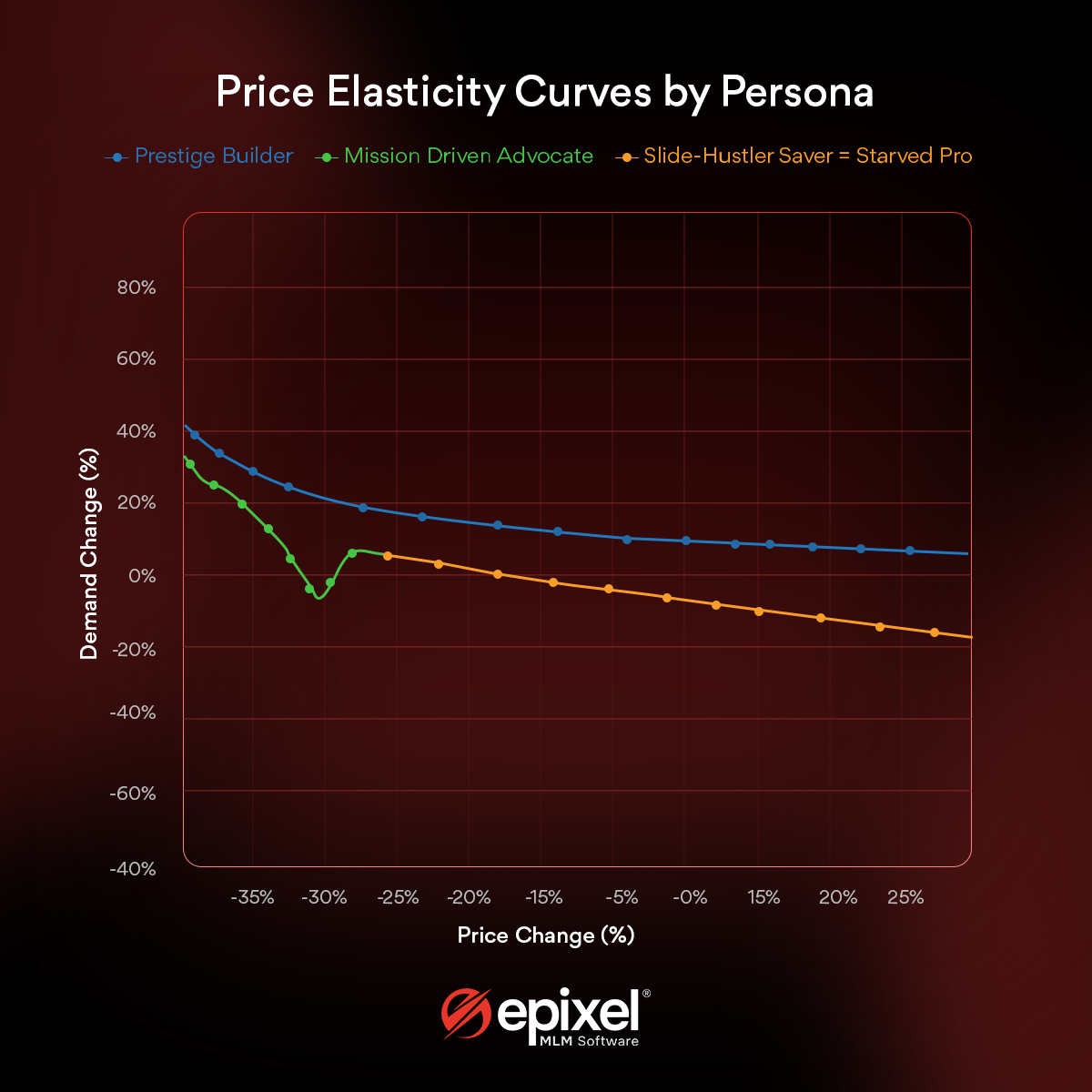
The elasticity curves represent a specific persona and its response to demand when prices increase and decrease. The price changes are listed on the horizontal axis and the vertical axis shows the demand responses for each price change. Brands can see which segments react strongly to price, and which barely respond at all.
The shape of the curve directly hints at the influence of price change on each persona. A flat curve means that discounts don’t increase demand so cutting prices will waste margin and a steep curve shows the segment is highly sensitive to price change. Even small discounts can increase sales volume and price hikes quickly reduce sales. Some curves show a tipping point pattern in which price reductions have little impact until a specific limit and then the demand increases sharply. Curves that show limited responsiveness are the ones where small discounts create only slight result variations. Here demand quickly levels off because convenience matters more than price.
The pricing strategy to be applied in these cases is simple. Do not apply discounts evenly, launch discounts where demand is most responsive, that is, where you see steep slopes. Apply offers related to early access, convenience, add-ons, and exclusivity where price sensitivity is low, that is, where you see flat slopes.
Compare pricing and demand for each segment with a persona-based elasticity curve template.
Deciding the right pricing strategy
Choosing between a price cut or a value add-on should be based not on assumptions but on insights from persona-level analysis. This will protect margins and drive demand for each strategy adopted across various segments.
| Persona | Elasticity Slope | Tactical Move | KPI to Watch |
|---|---|---|---|
| Prestige builder | –0.4 | Limited-edition offers without price reductions | AOV, Instagram user-generated content |
| Mission-driven | –1.1 | Charity-based offers like donate-$1-per-order | Cause conversion rate |
| Side-hustler saver | –2.4 | Flash-sale discounts | GMV, stock-out risk |
| Time-starved pro | –0.9 | Free faster shipping | Subscription lifetime value |
When the right pricing strategy is applied across each segment, profits and sales increase simultaneously alongside brand-customer-distributor relationships. This difficult-to-copy competitive strategy becomes an advantage for brands in the market. Persona-based pricing is a tactical move and with the right KPI tracking brands can optimize growth and profits.
Implementing persona-level pricing in your MLM platform
Once you are done with experimenting with the results and the impact, you must implement the strategy with the right technology. Because when the business, network, and customer base expand, the strategy also has to scale with the growth. The designed pricing strategy must be embedded into the MLM platform, workflows, and teams for it to make the real impact.
Tech stack checklist
- Customer and distributor identities should be centralized across CRM, ecommerce, and commission system.
- Real-time offer generation through endpoint APIs that process persona type, product, and context to recommend a personalized offer.
- Feature flags help team to switch between offers and add-ons and run A/B tests without having to alter the core platform code.
- Git and MLflow track the details of price changes on recorded version logs.
Risks and governance
The proper formation of personas is important in determining pricing elasticity because there are chances to create a targeted group from vulnerable communities just because they are price sensitive, even though unintentionally. Fairness guardrails ensure that your personalized pricing strategy does not become unfair or discriminatory.
Product-level discount caps must be in place to stop discounting the prices of flagship products because this can affect brand value. Once a pricing campaign is launched, the inventory has to be in sync to ensure that there are no middle-of-the-campaign chaoses related to supply chain operations.
Change management
Any minor change to any of your organizational policies has to be conveyed to distributors. Especially fixing different prices and offers to different segments might create confusion and resentment among distributors. Commission strategy and pricing strategy must go hand in hand to avoid feeling threatened. In fact, pricing strategy should help distributors sell more and earn more, so they feel the system as a support not as a competition.
Design a personalized pricing strategy in 90 days
The effectiveness of a persona-based pricing plan increases with a clear and practical plan. The 90-day plan starts from the basics of building the pricing strategy to full rollout and implementation.
| Week | Goal and impact |
|---|---|
| 1 | The setup week will create basic rules and personas that govern the pricing decisions. This ensures everyone works on the same definition. |
| 2-4 | The next level collects needed data and ensures its quality for further processing. A 24-month data set will help understand buying patterns and pricing behavior. |
| 5-6 | The hierarchical Bayesian model is trained with the collected data to analyze the responses of different personas to pricing changes. |
| 7 | Present it to the board or leadership team to analyze and interpret curves. Budget and KPI approvals are finalized. |
| 8-10 | Feature flags and automated offer system are developed and connected to the platform and tested. |
| 11 | Run A/B tests to compare different scenarios and the possible increase in sales and performance. |
| 12 | Full rollout across all markets and segments with live dashboards tracking the pricing performance. |
Price elasticity adds business value that goes beyond growth and revenue
Pricing strategy by persona is not meant only to accelerate growth and revenue. The basis of the strategy is to add value to customer experience, distributor earnings, and brand perception. Other than that, there are quite a few advantages the strategy brings along.
Attracts talents
Distributors who are data-driven are impressed by brands that offer personalized promotions and pricing. They see more room for growth and are easily attracted to the opportunity.
Improves brand authority
When a brand is ready to share high-level pricing and elasticity insights with stakeholders, investors, and partners, it makes them a thought leader in the industry. Brands who showcase distinct perspective growth quickly grab investor confidence.
Improves regulatory readiness
Through the application of models such as Hierarchical Bayesian, each pricing logic and change is clearly recorded. Details of every pricing change are readily available for regulators and auditors to verify.
Enhances investor relations
Private equity and institutional investors value businesses that base their strategies on data. MLM companies who consider price elasticity as a metric improve management quality and increase company valuation.
Discover how we build resilient businesses with advanced MLM functionalities



Conclusion
In the coming years, mass discounts or price cuts will not fetch customers or brand name. Understanding customers and their preference to discounts or value will be the defining factor of brand-customer relationships.
Persona-level elasticity curves give leadership team a new kind of control and the ability to align pricing with behavior, value perception, and long-term growth. When data replaces discounting and precision replaces pressure, pricing becomes a durable competitive advantage not a temporary growth trick.















Leave your comment
Fill up and remark your valuable comment.