

















A distributor purchasing products at wholesale price and selling them at retail price is a very common business practice in MLM. But this single line doesn't define the whole story. Retail profit is vital when it comes to the business aspects of the direct selling industry. Thorough knowledge of the management of retail profits is helpful for MLM company leaders, managers, and distributors to meet market demands and achieve success. Retail profit is not a secondary element for these people to build systems, guide field performance, and to create income structures that will remain sustainable in the MLM business.
Top challenges in retail profit
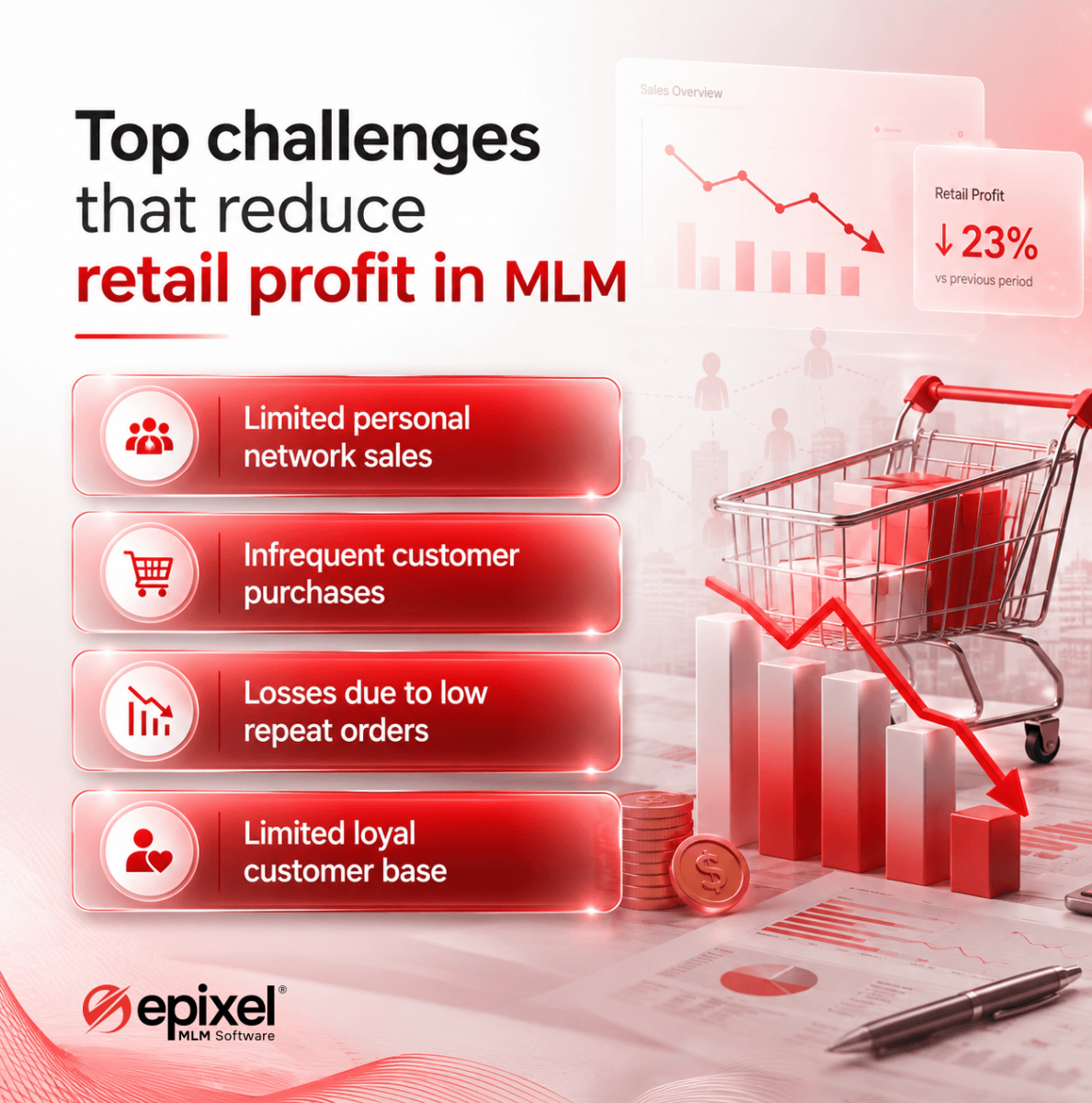
Retail profit is much more than just numbers that show the difference between retail price and the distributor's purchase cost. With the right strategies, one can take retail sales and profit beyond the traditional methods of marketing. It should be able to give a clear picture of who is buying the product, the reason, and whether they genuinely value the product. Because distributors can expand their sales network through their close connections and personal purchases. But the real callenge is that it may not result in genuine retail profit.
Friends and family members can help through occasional purchases. But they don't lead to a sustainable business. This is where the presence of loyal customers became important in generating genuine retail profit. These are people who buy products because they really want to use them. They think the products are worth the price. These approaches will make sure they make repeat purchases and solely stick to the brand. So, like that, genuine customer sales will happen, and it will lead to sustainable revenue.
Why margin numbers alone do not tell the full story
The existence of a retail margin on paper does not imply that distributors can easily earn profit. For example, many direct selling companies believe that distributors can earn a 30–40% retail margin. And that margin is supposed to be a great income opportunity. But at the same time, the actual sales may show that retail sales are at a lower level than expected.
Many items in the market are available through online stores and subscription services these days. So, unless the products seem unique and in high demand, they cannot be expected to sell at the suggested retail price (SRP). In this context, when customers find the same products at lower prices, they are more likely to buy those items. And this will push the distributors either to keep the prices high and lose customers or offer discounts and reduce profit. So, at its core, it is important to hold the concept of people buying a product because they consider it valuable and not because of the urge to participate in an income opportunity.
These are real customer sales. And retail profit from these sales is not determined by the margin offered in a compensation plan. It depends on the profit that distributors can earn from real customer sales. So, when customers refuse to buy a product at the listed price, one cannot achieve the retail margin. Because of this, most of the successful MLM companies focus on genuine customer demand and realized retail margin rather than theoretical profit percentages. Realized retail margin is the actual income generated by a company through the sales of its products to real retail customers. It is calculated by dividing the revenue from retail sales by the total retail sales volume. It excludes products purchased by distributors for their own use. As a result, it shows the true profitability of the company's retail business.
| Retail health metrics every MLM executive should track | Metric | Waring zone | Acceptable range | Best-in-class | Why it matters |
|---|---|---|---|---|
| Revenue from retail customers (non-distributors) | Below 30% | 30–55% | Above 55% | Primary regulatory defensibility indicator |
| Distributors compared to retail customers | More than 3 distributors for every customer | Around 2:1 to 1:1 | More customers than distributors | Helps indicate whether there is genuine customer demand. |
| Retail customer reorder rate (90-day) | Below 25% | 25–45% | Above 45% | Repeat purchases mean customers value the products. |
| Average time a retail customer stays active | Less than 3 months | 3–8 months | More than 8 months | Long-term customers are a sign of real product demand. |
| Realized retail margin (actual vs. theoretical) | Below 50% of SRP spread | 50–75% of SRP spread | Above 75% of SRP spread | Shows if the pricing makes retail selling practical. |
| Retail sales as part of rank qualification volume | Less than 20% | 20%–40% | More than 40% | Shows whether promotions are based on customer sales instead of personal purchases. |
| New retail customers added each month | Declining for 3 or more months | Stable to 5% growth | Consistent growth of 5%–15% | Measures how well distributors are attracting new customers. |
| Retail profit as a share of distributor income | Less than 10% | 10%–25% | More than 25% | Shows how much distributor income comes from product sales instead of network commissions. |
| Selling price compared with similar products in the market | More than 1.5× higher | 1.2×–1.5× higher | Same price or up to 20% higher | Helps determine whether customers are likely to buy the products at retail prices. |
The difference between "can earn" and "actually earn"
Retail success is not defined by a compensation plan alone. It can give numerous opportunities for distributors to earn retail profit. But when it comes to distributors, they may be so fascinated by other activities that will bring more attention from the company. It may include the endless yards of rank achievements, tags of bonus winners and top earners, team growth, etc. So, they will not consider retail selling as a better business growth strategy and keep running behind network expansion.
This is where companies need to take different approaches to retail activity. Because beyond recruitment and team growth, the company culture should be more enthusiastic to offer attractive retail profits to distributors through its compensation plan. It should recognize distributors who build strong and loyal customer bases. Also, showcase customer retention achievements, and make customer acquisition an essential business requirement. The companies should also promote distributors who maintain a certain number of active retail customers to higher levels. All these considerations will make the company more focused on customer behavior, and this will build lasting retail businesses.
Three situations where retail profit becomes difficult to achieve
When in doubt about achieving retail profit, the first thing you question should be the structure of your business.
1. Products are priced too high
When the market is full of similar products, people will prioritize those at lower prices. So, retail selling is difficult in such situations. And also, distributors may think that recruiting new distributors is better than finding retail customers willing to pay the higher price. This will make the retail profit look better on paper but still hard to practically achieve.
2. Personal purchase requirements reduce retail focus
Another issue occurs when distributors give more importance to personal purchase requirements than retail selling. Direct selling companies are the major reason for this. As many of the companies require distributors to buy products each month or stay on an autoship program to qualify for commissions, they start paying less attention to retail selling. Instead of focusing on a strong retail customer base, they start earning commissions and reach targets through personal purchases. This will gradually reduce the priority of retail selling.
3. Competition from online shopping
People have different ways to learn about products these days. Endless reviews, influencer recommendations, and similar products to compare are available in the market. So, in such a business environment, it is essential for companies to provide modern digital tools, online selling support, and effective social commerce strategies for distributors to grow the business with modern touch. Otherwise, it would be very difficult for them to compete with ecommerce platforms and numerous online brands.
Retail profit vs. preferred customer commissions
These are two different approaches used by direct selling companies for customer sales. One is the retail profit model in which the distributors will buy the products at a discounted price and sell them at a retail price. And the difference will be kept as profit. This can generate higher earnings per sale. The distributors have to create a strong customer base and properly manage orders for this. When it comes to a preferred customer model, customers can purchase directly from the company. From these purchases, distributors can earn a commission, and this will be less than retail margin.
The earning potential is actually high for the retail model. But at the same time the preferred customer model is more predictable and is able to make stable customer revenue. As a result, the preferred customer model is more widely accepted among most companies. But it can still vary based on the company's products, distributor base, and business strategy.
| Retail profit model comparison and key trade-offs | |||
|---|---|---|---|
| Dimension | Classic markup model | Preferred customer commission model | Drop-ship / Link model |
| How distributors earn | Buy products at a lower price and sell them for a profit | Earn commissions when preferred customers place orders | Earn commissions from sales made through referral links |
| Typical realized margin | 25–45% per transaction | 15–25% commission on repeat customer orders | 20–35% commission on each referred sale |
| Income timing | Immediate (point of sale) | Delayed (company payout cycle) | Delayed (payout cycle) |
| Inventory risk | Distributor buys and stores products | None | None |
| Operational burden | High – Buying, storing, delivering products, and serving customers | Low – Customer engagement and relationship management | Very low – Share referral links while the company handles orders and delivery |
| Best distributor profile | Distributors with strong selling skills and local customer networks | Distributors who focus on building strong customer relationships | Social media users, influencers, and content creators |
| Customer retention potential | Moderate – Depends on the distributor's relationship with customers | High – Repeat orders and subscription programs encourage loyalty | Low to moderate – Customers may have less personal connection with the distributor |
| Regulatory defensibility | Moderate – Higher risk of excess inventory | High – Customers buy directly from the company at the listed price | High – Customers buy directly from the company |
| Growth potential | Limited by time and inventory | High – Income can grow as customers continue to reorder | High – Can grow with a larger online audience |
| Main compliance concern | Pressure to buy inventory or maintain stock | Making sure preferred customers are genuine customers | Making sure referral sales are tracked correctly |
| Best product types | Premium or specialized products with higher profit margins | Everyday products that customers buy regularly | Products that are easy to promote through online content |
| Best stage for a company | Companies with an established distributor sales culture | Companies building their customer base | New or digital-first companies expanding through online channels |
What many field leaders get wrong about retail profit training
Theoretical knowledge alone can’t bring you success in retail sales. A distributor should build strong relationships with people and make them trust the recommendations. Beyond thorough product knowledge, retail sellers need to attract the right customers and have to maintain them for long-term success. Also, it's important to retain existing customers with repeated purchases rather than constantly looking for new customers. So, in short, customer retention and customer lifetime value are essential factors to achieve retail success.
Why software matters for retail profit
Mainly, MLM platforms help to support network growth. They focus on network structure, various rank qualifications, and commission calculations. But this alone cannot bring retail success. The company’s software must help distributors build and manage customer relationships. Through such platforms, distributors should be able to track customer sales, active customers, and the pattern of repeated purchases. Companies should create retail-focused software systems that are more helpful for business growth. It will focus more on the connection between customers and distributors and repeated purchases. Companies that give proper support to retail sales should maintain their systems to improve customer growth and thereby support network expansion.
Discover how we build resilient businesses with advanced MLM functionalities



Retail profit as the foundation of long-term stability
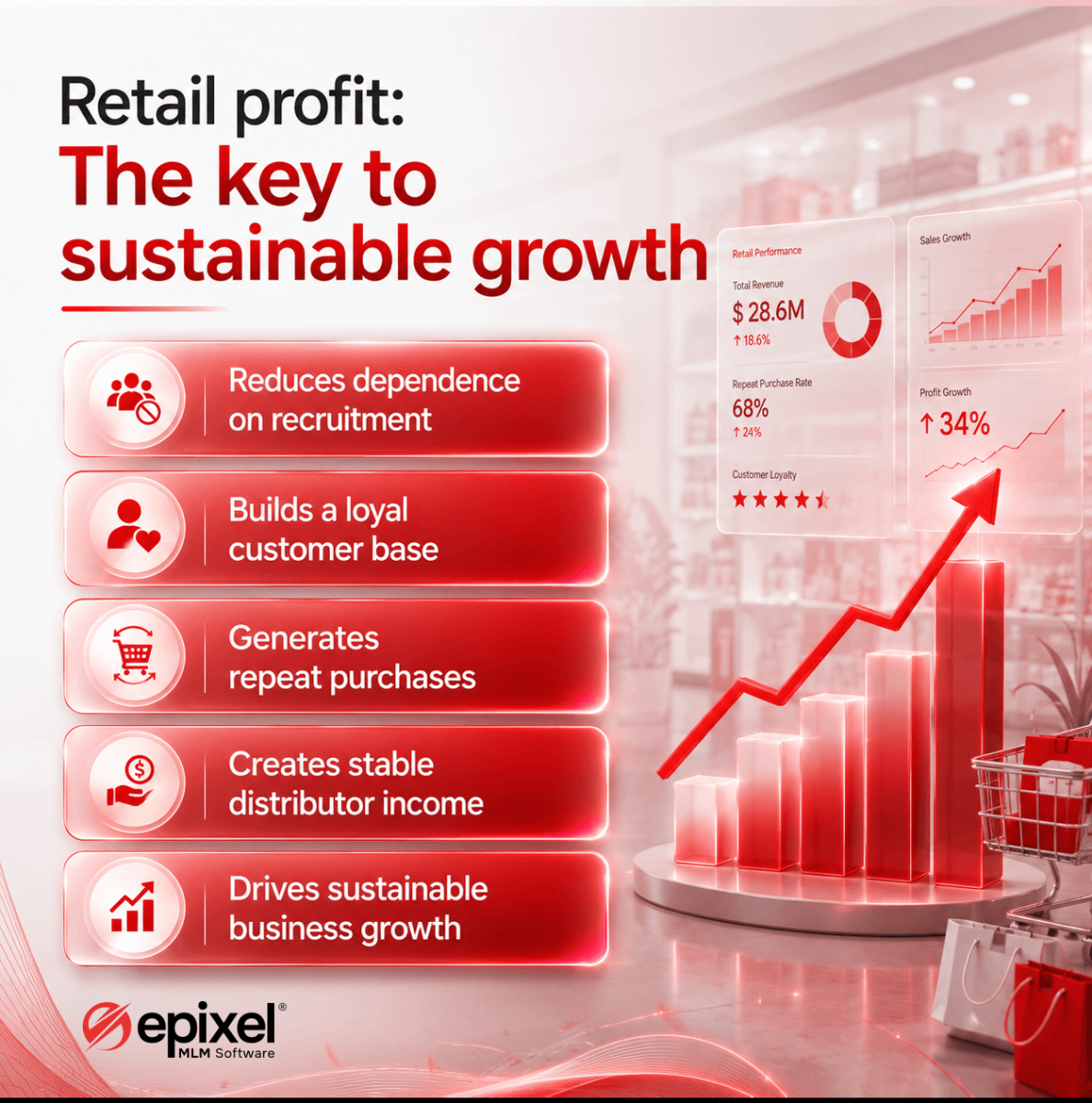
The MLM markets are under constant change and competition. In such an environment, companies cannot only depend on recruitment. The retail customer base of the companies should be strong, and they have to find genuine customers and build strong relationships with them. Through this, even if recruitment activity fluctuates, the distributors should earn from the repeated purchases of the genuine customers. This points out that, beyond product sales, retail profit is a beneficial element to both distributors and the company. Retail sales will lead the company to ultimate growth, which is stable and sustainable in nature. So, basically, investing in retail sales will improve overall growth, customer loyalty, and is a smart business strategy for achieving success.
Conclusion
In the end, it is clear that healthy and sustainable MLM companies need strong retail profit as a strong growth indicator. Also, its definition is not printed on the margins shown in the compensation plans. It is more about the presence of a strong customer base that will bring the multi-level marketing company to new horizons. Companies that prioritize these elements could flourish more in the network marketing industry and are more reliable for customers as well.
















Leave your comment
Fill up and remark your valuable comment.