


















 Epixel Analytics: Growth and Influence Insights
The world is witnessing an unexpected crisis, something that could turn the global economy upside down. It affects all levels of society as much as it does businesses. Ever since the 1973 oil embargo, the current Iran-Middle East conflict has caused another historic global energy disruption. For direct selling companies and MLM leaders, this holds an important lesson to learn. Companies that respond quickly and confidently through the crisis will be stronger and more successful.
To cite a recent example, the direct selling industry grew 5.8% during the pandemic year, 2020, and reached $179.3 billion. This was a time when the traditional retail collapsed. In this era of uncertainty, this article can be your navigator to help protect your field force and business and set the stage for post-crisis growth.
History holds power
The survival history of direct selling industry is very interesting. It has been through the 1973 Arab oil embargo, the 1990-91 Gulf War recession, the dot-com bust, the 2008 financial crisis, and the COVID-19 pandemic. Today's crisis is a bit more difficult for the industry in terms of managing operations.
The US-Israeli military operations against Iran have resulted in the closing of the Strait of Hormuz, through which 20% of global oil and LNG is transported. The price of Brent crude has also gone well above $110 per barrel. Supply chains and customer confidence are broken but for the direct selling industry this will certainly be a strategic inflection point.
Each crisis has reshaped the industry for the better and rewarded the confident ones with a new way to succeed. Today, the question is not whether the current crisis will cause disruption in your business but whether you will be among those who will emerge successfully with larger market share and stronger salesforce.
This article is created with historical performance data, current market data, and practical operational frameworks for C-level executives to build their business as the world watches the crisis anxiously.
The direct selling track record
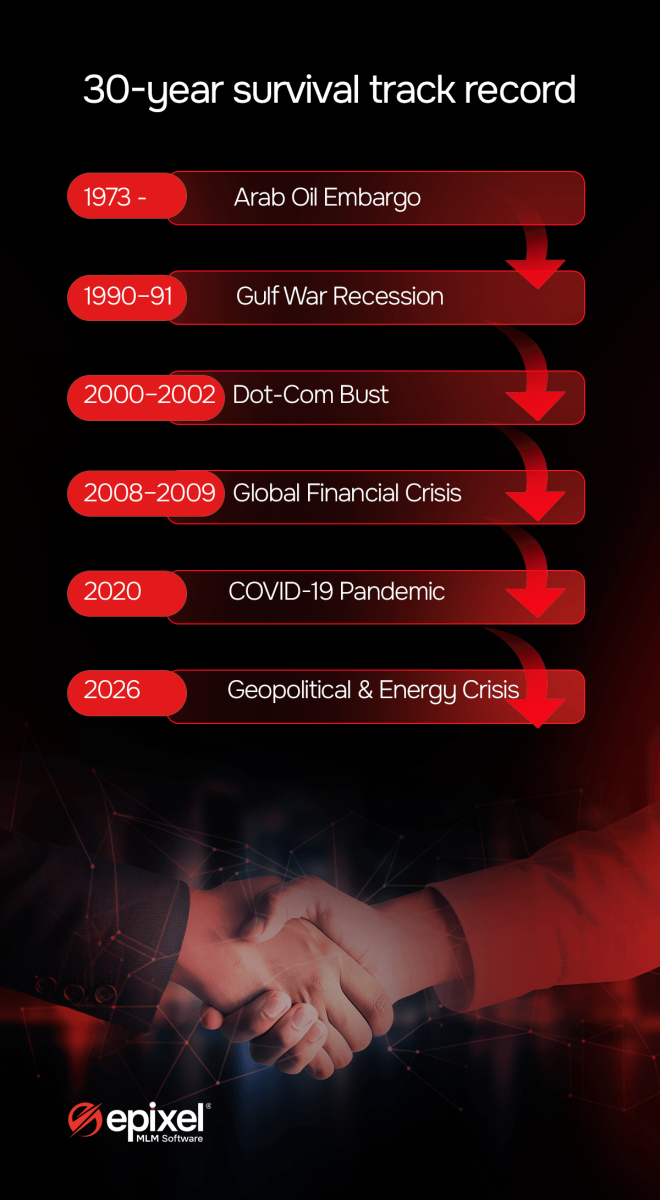
The direct selling industry has successfully adapted to geopolitical, financial, technological, and social disruptions in the past. Let’s examine how it performed and overcame challenges during each of these historical events.
Growth during the pandemic
The COVID-19 pandemic is the most recent crisis the direct selling industry has faced, and comparing industry data before and after the pandemic sheds light on how the industry remained resilient through the disruption.
Global performance
In 2020, the world witnessed the worst global economic contraction since World War II but direct selling showed a 5.8% year-over-year growth with $179.3 billion in global retail sales. The sales declined to $173.4 billion in 2021 but continued to stay active throughout the pandemic period. The global salesforce increased by 4.3% to reach 125.4 million independent representatives in 2020 and over 65 million representatives were engaged in the business as full-time and part-time sellers.
US market performance
The US direct selling industry generated an impressive $42.7 billion in retail sales in 2021, in the middle of the pandemic. Customer base expanded to 44.6 million preferred customers and discount buyers. During the period from 2019 to 2022, the retail sales in the US increased by 15%. The number of direct sellers in 2020 was 7.7 million and the number stayed somewhat steady in the years that followed.
Comparing this to traditional retail in the same setting, US retail employment alone lost nearly 800,000 jobs in 2020. Sales in the clothing stores plunged an 89% and department stores dropped 45% during the initial pandemic months. During this course, direct selling companies were smart enough to adopt digital tools and virtual events to expand their reach and increase sales.
The financial crisis of 2008-2009
During the Great Recession, employees across industries faced layoffs. Direct selling industry became a dependable option for many with flexible income opportunities. Amway experienced 2.3% growth in sales during this period with a recorded $8.4 billion in 2009. The growth rate hit 9.5% in 2010 with $9.2 billion.
The 2007-2008 financial crisis brought in more Americans to the multi-level marketing industry. Research and past events suggest that MLM companies experience increased participation during recession as more individuals look for additional income opportunities. This could be mainly because of the low barrier to entry, flexible timing, income for the effort invested, or the psychological benefit of entrepreneurial opportunity during uncertainty.
Three decades of resilience
If we look at the data from the Direct Selling Association, we can confirm that the industry has shown impressive resilience for over three decades through recession, war, and pandemic. The consistency displayed by the US direct selling industry underlines the fact.
- Over 30 years, the cumulative annual growth rate of the US direct selling industry was 4.03%.
- The cumulative annual salesforce growth was 3.93% during the same period.
- During the period from 2019-2022, the average annual sales growth was 5%.
The direct selling industry has stayed agile across changing business, economic, social, and political pressures. The direct selling model has converted this resilience into an advantage over traditional retail and employment, which face severe disruptions as soon as adversity strikes.
An economic impact assessment of the current 2026 crisis
The International Energy Agency has characterized the Iran-Middle East Conflict as the "greatest global energy and food security challenge in history". Planning growth in this disrupting phase needs a clear understanding of the channels that create economic impact and strategic planning to overcome the disruption.
Impact on energy market
Brent crude prices have seen a hike of 39% after the conflict started and the closure of the Strait of Hormuz has suspended about a fifth of global crude and natural gas supply. Qatar, the country which supplies 20% of global LNG has declared a force majeure on exports and the prices of gasoline in the US have risen by $0.43 per gallon in a week.
Supply chain disruption
The Strait of Hormuz is a major transit point for 20-30% of global fertilizer exports, and Helium shortages are creating concerns for semiconductor manufacturers. Food supply chain including rice and essentials is facing disruptions and the insurance premium for Gulf shipping have increased significantly.
Economic forecasts
If oil prices remain elevated, global inflation could rise by 0.5-1.0 percentage points. The US consumer price inflation could also rise from 2.4% to 3.0% by the end of this year. The expectations on reduced interest rates have also weakened globally and Asian economies would be hit most because 80-90% rely on the Strait of Hormuz for energy imports.
Opportunity amid crisis
The economic impact analysis above may feel threatening, but these create conditions that favor direct selling. People in the fear of losing consistent income with traditional employment resort to flexible entrepreneurial opportunities such as direct selling. In times of economic uncertainty, individuals look for trust-based opportunities, even in personal shopping. Relationship-focused direct selling model stands in favor of this by giving trust-based sales and career building opportunities.
Direct selling companies have already adapted to digital channels for growth and hence geographical barriers are never an impediment for growth. Companies with strong digital infrastructure have the tools to reach customers and support their global distributor networks.
Wellness products constitute 36.2% and cosmetics and personal care products 26.2% of the global direct selling retail sales. The demand for the products in this segment never decreases even when price rises in times of recession because they are considered essential for health and self-care.
A strategic crisis framework for direct selling companies
Derived from our historical and current market analysis is a practical framework for direct selling companies to navigate challenges in these times of war-triggered disruption. This framework is designed to provide resilience to direct selling businesses across four domains.
- Supply chain
- Distributor network
- Customer engagement
- Financial management
Supply chain resilience
Companies implemented innovative resilience strategies to curb the disruptions caused by pandemic, but current crisis tests these strategies and demands additional action.
Strategic actions to undertake:
- Keep backup suppliers in different locations so that if one fails another one can step in. Shift your supply chain points closer to your customers to ensure faster and more reliable deliveries.
- Many companies maintained low stock and restocked only when needed to reduce costs. But during an era of disruption it is advisable to keep a buffer stock so that you don’t run out of stock, especially critical products. Keeping additional inventory is a bit expensive but it is better than losing sales during peak demand periods.
- You will need a complete visibility of your supply chain to ensure there are no disruptions. AI-powered inventory management systems can forecast risks and delays, helping you take the right action to avoid delays and delivery failures.
- Review contracts of your local supply chain providers for force majeure clauses and flexibility policies. Pre-negotiate terms that allow quantity adjustments without affecting your supplier relationships.
Distributor engagement
Emotional and field support for distributors is important during a crisis because your business thrives on their capabilities. Proper communication and engagement through digital channels and supportive incentives can strengthen their confidence.
Communication strategy
Transparent and frequent communication about supply chain status, product availability, and the company’s financial health will keep your distributor base confident and engaged. Provide field leaders with information to be communicated with customers about economy and crisis impact. Mobile-first platforms can help you communicate updated information with distributors through push notifications and messages.
Training and development strategy
Crisis-specific sales training should be given to distributors to handle customer objections related to economic uncertainty. Companies must invest in digital skill development for all distributors to help them conduct business online. Training can be easily managed through mobile-based training apps. Practical approach to training with relevant case studies and success stories can help them overcome the current situation efficiently.
Recruitment optimization
People are concerned about the predictability of income and career growth during a crisis. When offering an opportunity, you must highlight flexibility, additional income possibilities, and entrepreneurial control. Onboarding process must be simplified for easier enrollments along with distributor training and support.
There is a possibility of inactive distributors returning to the business. Recognize their reentry with reactivation incentives. Concentrate on each demographic with a personalized messaging approach because Gen Z, women, and displaced workers from other industries are likely to join direct selling for the timely benefits it offers.
Customer engagement
Customer perceptions, interests, and behavior keep changing, during economic uncertainty, even more. Companies must sense these changes and align their engagement strategies to hold their market share.
Adjusting the value proposition
During the Great Recession, businesses that focused on quality products instead of luxury gained a considerable customer base. Customers prefer value over status during crisis and businesses that can match this demand will stay in the market. Wellness products should be marketed by highlighting the health protection and stress management benefits it offers.
Direct selling companies can point to the safety and convenience benefits of direct-to-consumer delivery. Product packaging strategies should be modified with entry-level or small size packages that can help ease the budget of customers.
Digital experience
It is the fast growing era of ecommerce, so keep that ready. The US retail ecommerce reached $815.4 billion in 2020, a 43% increase from 2019. So, virtual product demonstrations, consultations, and virtual try-ons must be a compulsory strategy for your ecommerce.
Social commerce has become the go-to sales tool for younger generations and tech savvy distributors. Implement social commerce, introduce social selling tools, and make online selling an essential part of your sales training.
Financial management
Managing cash flow and reserves is essential to avoid operational disruptions during a crisis. Cost-effective strategies and strict payout control can help direct selling companies maintain margins and safeguard financial stability.
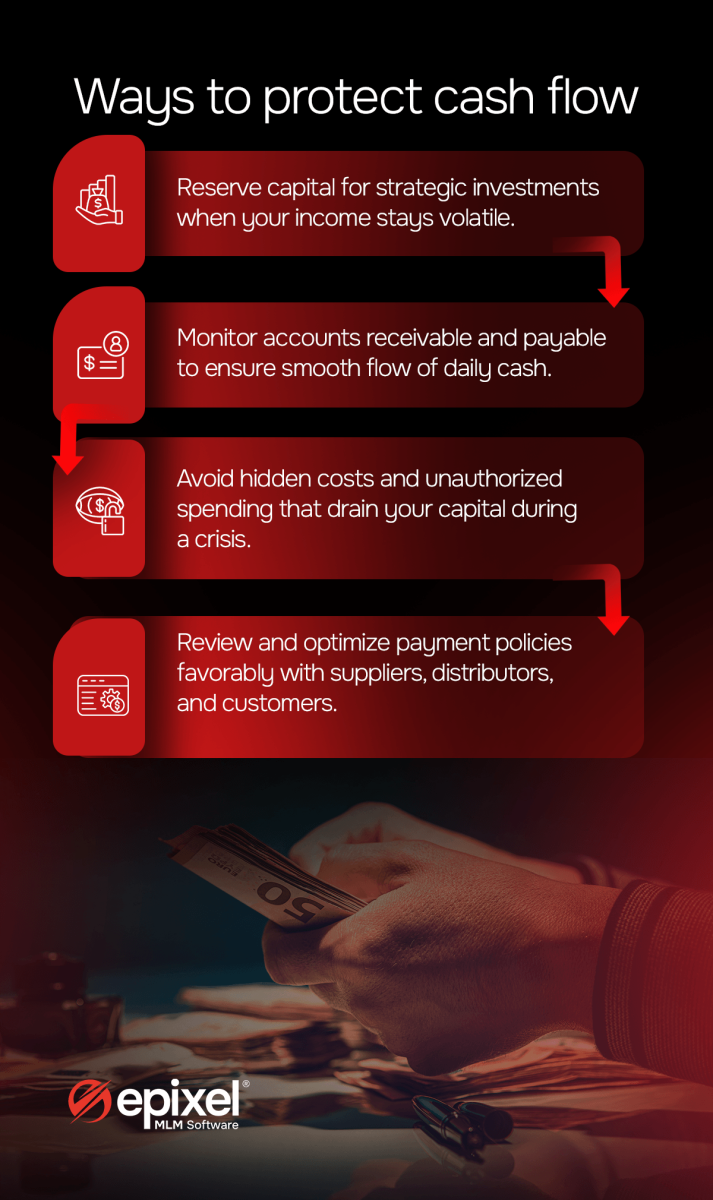
Cost control strategies
Business costs should remain flexible so that you can adjust as needed during tough times. During the Great Recession, smarter companies reduced their fixed costs and relied more on variable costs so that they could break even when revenues dropped.
Direct selling companies must classify their costs as fixed (salaries, rent, etc.) and variable (commissions, marketing costs, etc.) and try to make more costs variable wherever possible. Companies should never stop investing in technology because digital tools and alternatives reduce costs, improve efficiency, and support growth.
Crises can also create opportunities for expansion. Companies can acquire weaker competitors at lower costs, and research shows that companies that do this strategically see long-term returns.
Operational strategies by role
C-level executives, senior sales leaders, and senior distributors, all have an equal role to play in organizational crisis management. Let us allocate a few responsibilities for each role so that they can contribute to maintaining the growth during crisis.
For C-level executives
Actions to take during week 1-2
- Create a crisis management team with representatives from operations, sales, finance, and communications teams.
- Assess supply chain risks in advance by mapping suppliers in the first three tiers for exposure to Middle East disruption.
- Design separate communication plans for board, investors, and field leaders.
- Review your cash position and set up backup credit options if needed.
Actions to take for the first 1-3 months
- Diversify suppliers for all single supplier markets.
- Track finances and adjust it according to forecasts and communicate this transparently with stakeholders.
- Evaluate and implement strategic acquisition initiatives as they emerge.
- Invest in previously planned digital transformation initiatives.
For senior leaders
Immediate actions
- Create and distribute customer clarifications on economic uncertainty to field leaders.
- Increase the frequency of virtual events to stay live and maximize reach.
- Activate reactivation campaigns for inactive distributors who are looking to rejoin.
- Celebrate customer and distributor contributions with behavior-based recognition programs.
Actions for continuous improvement
- Monitor field sentiments through regular feedback and leader surveys.
- Offer sales training to handle customer objections during economic uncertainty.
- Keep track of your competitor strategies. Learn and educate your team from their mistakes and success.
- Identify and share success stories of distributors who emerged from crises and challenges.
For senior distributors and field leaders
Personal business strategies to adopt
- Connect with customers more often to build trust-based relationships that will survive the crisis.
- Add value messaging and health and wellness benefits to your product presentations.
- Learn digital skills if you haven’t already because in direct selling you can do everything from customer acquisition to sales and engagement virtually.
- Speak to your contacts who are facing job uncertainty about the opportunity.
Actions for team leadership
- Make weekly meetings and group calls a compulsory part of your communication agenda.
- Share and discuss market and company condition so team members know that this is a temporary disruption.
- Focus on activity metrics more and results less because consistent effort during crisis is more important.
- Celebrate every small success of your distributor.
Measuring the impact of crisis response
Every crisis management strategy you implement needs to be measured for effectiveness. But the measurement also has to be tailored with metrics that are specific to crisis conditions.
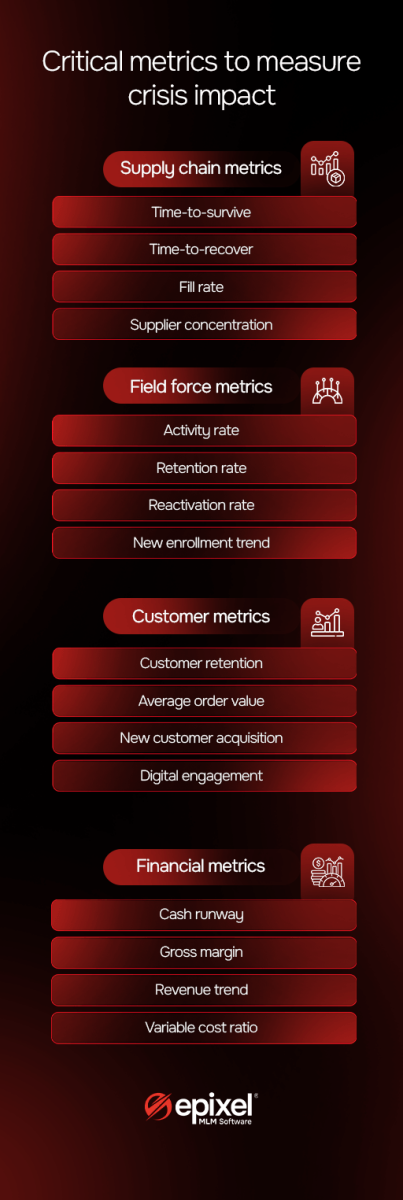
Supply chain metrics
- Time-to-survive: The time taken to resume normal operations.
- Time-to-recover: The time taken to return to pre-crisis performance levels.
- Fill rate: Percentage of customer orders that are delivered completely.
- Supplier concentration: Percentage of spend that depends on a single supplier.
Field force metrics
- Activity rate: Percentage of active distributors placing orders or hosting customer presentations.
- Retention rate: Monthly or quarterly distributor retention rate compared to previous standard retention rate.
- Reactivation rate: Percentage of inactive distributors who reinitiated sales activity.
- New enrollment trend: Number of distributor signups per week against historical average.
Customer metrics
- Customer retention: Repeat purchase rates with existing customers.
- Average Order Value: The size of each customer order.
- New customer acquisition: Number of new customers per week versus baseline.
- Digital engagement: Percentage of sales from online platforms and virtual events.
Financial metrics
- Cash runway: Number of months operational expenses can be covered with existing cash reserves.
- Gross margin: Impact of increased input costs on profitability.
- Revenue trend: Growth rate by weekly or monthly sales against forecasted and previous year revenue.
- Variable cost ratio: Percentage of costs that adjust with changes in revenue.
Download our Crisis Management Dashboard Template to monitor key metrics and make faster decisions.
Setting your business for post-crisis growth
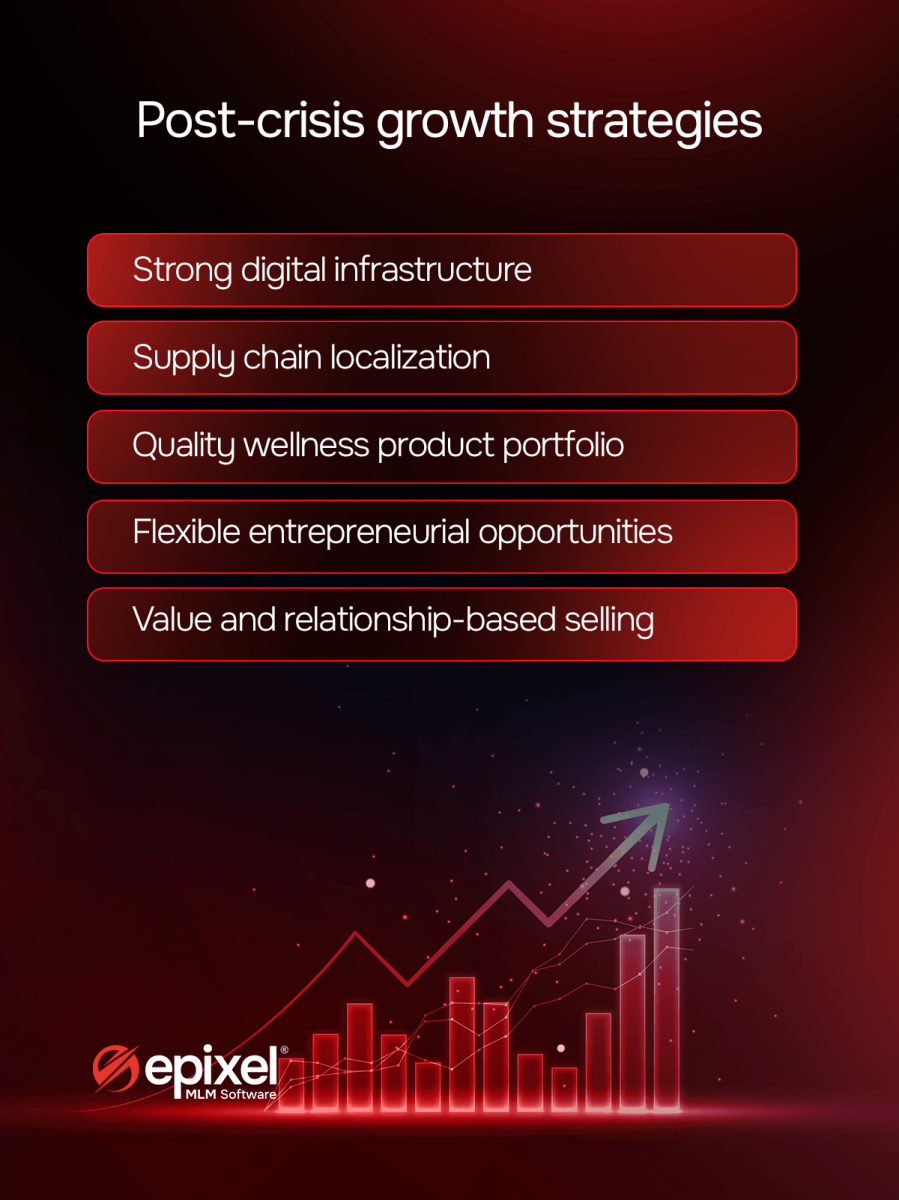
Surviving the crisis is one thing, growing beyond it is another. With strategies applied during the crisis and their effectiveness measured, what actually counts is how well positioned you are for growth after the crisis. Long-term structural changes continue to be a part of your growth agenda.
- Companies are planning to make digital strategies permanent as 90% of businesses are planning to change to virtual sales models and 70% toward remote interactions. These preferences will not change and organizations with good digital infrastructure can flaunt that as a competitive advantage.
- Localization of supply chain will increase with companies experiencing supply chain crises throughout pandemic and current crisis. Companies will resort to near-shoring and multi-sourcing options to smoothen supply chain operations globally.
- Consumer focus and demand on wellness products will turn advantageous for direct selling companies with quality wellness product portfolio.
- The crises in the past have put individuals under constant income and career stress. This will lead to increased preference for entrepreneurial opportunities and gig economy.
- Trust-based sales relationships will stay in demand with authenticity and quality leading the market.
Discover how we build resilient businesses with advanced MLM functionalities



Conclusion
After the evaluation of the direct selling industry against historical crises, we get an important point. The industry not only survives crises but uses them as springboards for growth. Its consistent growth across three decades is itself a testament to this fact. Direct selling organizations must identify the opportunities in times of crises and develop strategies that will help them survive the crises and grow beyond the challenges into the future.
Data sources and references:
Industry data:
- Direct Selling Association (DSA) Growth & Outlook Surveys 2020-2024
- World Federation of Direct Selling Associations (WFDSA) Global STATS Reports 2019-2024
- Direct Selling News Global 100 Rankings
- Nathan Associates (Cadmus Company) industry analysis
Economic and Market Data:
- US Bureau of Labor Statistics
- US Census Bureau Annual Retail Trade Survey
- Deloitte Retail Industry Analysis
- McKinsey & Company Industry Reports
- International Monetary Fund Economic Outlook
Crisis Impact Analysis:
- World Economic Forum Global Risks Report 2026
- Council on Foreign Relations Middle East Analysis
- Chatham House Global Economy Reports
- Center for Strategic and International Studies Energy Analysis
- International Energy Agency
Supply Chain and Operations:
- Boston Consulting Group Resilience Studies
- Jabil Supply Chain Research
- University of North Carolina Executive Development
- McKinsey COVID-19 Crisis Response Reports














Leave your comment
Fill up and remark your valuable comment.