















English
- English
- Español

- 简体中文

- Français

- Deutsch

- Italiano

- 日本語

- 한국어

- Portuguese, International



Overview of US regulations and policies for senior direct selling leaders

Compliance with regulations is important for all businesses operating in the US, for multi-level marketing companies the scrutiny is stricter. This compliance guide was developed with a notion to help MLM companies in the US with a complete overview of the regulatory framework along with operational requirements, risks included, and enforcement expectations.
United States is the largest direct selling market and generates about $40 billion in annual revenue with 6-8 million direct sellers. The disciplined direct selling market in the country is a result of strict regulatory authorities and enforcement standards, and continuous regulatory monitoring.
Regulatory authorities in the US focus on preventing deceptive practices that impact consumer interests. The industry is put under constant surveillance for identifying and eliminating pyramid schemes. Protection of consumers and distributors is also a topmost priority for the regulatory bodies and hence compliance of compensation structures and marketing activities with laws and regulations are deemed extremely necessary.
Federal agencies like FTC and SEC along with state-level governing bodies shoulder the responsibility of maintaining a strict compliance framework. Companies must satisfy the regulatory expectations to operate hassle-free in the region.

Federal Trade Commission has long been regulating MLM companies and the direct selling industry in general for eliminating unethical business practices that may harm consumers. FTC enforcement is based on Section 5 of the FTC Act which prohibits unfair or deceptive business practices.
FTC takes a substance-based approach while scrutinizing companies. The agency evaluates the business model, compensation, and trade practices to understand whether the company is legitimate or running a pyramid scheme. FTC analyzes certain areas of the business like the source of distributor earnings, the balance between recruitment and retail sales, and the real representation of earnings made to prospective participants.
MLM companies must also comply with regulations of respective states in which the company operates. These laws and policies are different for different states and are intended to regulate consumer protection, anti-fraud enforcement, and business opportunity disclosures. States may also impose additional requirements related to income disclosure statements, distributor activities, and transparency in contracts.
The multiple compliance layers make it difficult for MLM companies operating across various states to monitor network, operations, and transactions to comply with each regional requirement. But it is also important even in the middle of these complexities that companies implement systems that adapt to federal and regional regulations.
The size of the US direct selling industry in terms of revenue and direct seller population is significant but not all direct sellers are active distributors who contribute to the revenue. Many enrolled distributors become inactive or exhibit lower performance levels after their initial enrollment.
The number of active direct sellers when compared to the total registered direct seller numbers is lower and only a small portion showcase consistent sales activity. Drop-out rates during the early stages of a distributor’s lifecycle are high with 30-50% of participants discontinue within 6-12 months of joining. This trend is influenced by product category, market maturity, and compensation structure. Industry-wide studies show that even long-term retention declines over time and only a small group (under 20%) remain active even after 2-3 years. The issue could rise from individual factors or from limitations within the business model itself.
Income distribution in an MLM network is never consistent. Majority of participants in the network earn low to zero income and earnings are concentrated on the top performing distributor segments.
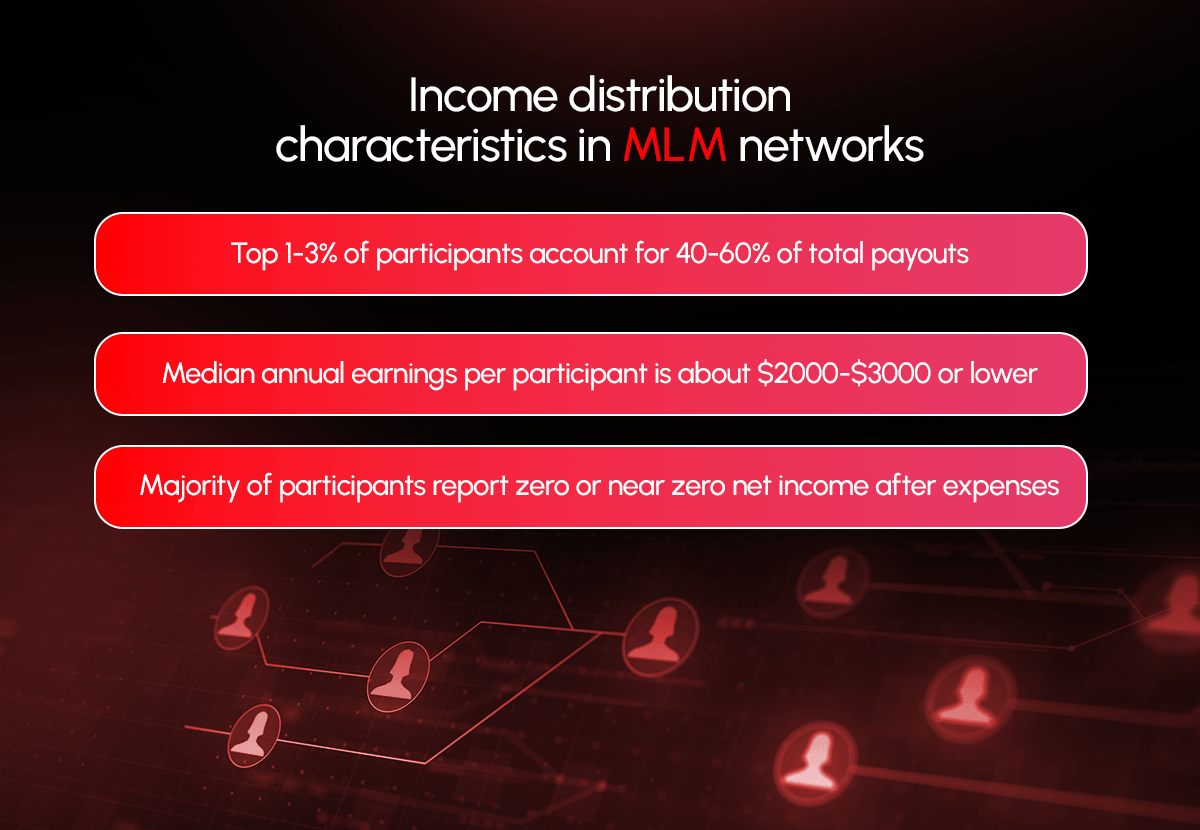
These numbers show the gap between gross commission payouts and actual net earnings, a compliance risk that attracts scrutiny from authorities.
Gross earnings figures as seen in the industry do not represent actual profits earned by a participant. Expenses like product inventory purchases, enrollment and onboarding fees, event attendance and training programs, personal marketing, and promotional spending all affect profits and net earnings is reduced. For participants at the lower levels or those who remain with the brand only for a short time, net income often levels off or turns negative.
Regulators analyze an MLM company’s revenue from retail customers and from internal distributor consumption. In weaker MLM models, retail sales are lower and personal consumption of distributors are higher. Companies also set commission or rank qualifications with purchase limits. When internal consumption is a source for revenue generation, regulators consider the model to be risky and often compare it to a pyramid scheme.
Higher distributor attrition rates cause the company to struggle to maintain stable long-term revenue. Three major patterns as seen in the direct selling industry are early drop-offs (around 40% in many networks), low long-term retention rates, and income concentration among the top tiers. This creates a system in which revenue becomes consistent only when recruitment is prioritized than retail sales, a highly risky affair.
Evaluate your compliance requirements to build a comprehensive compliance management system with advanced AI capabilities.
Contact an ExpertToday’s regulatory architecture in the MLM industry was shaped by different regulatory incidents. Each case in the enforcement history has shaped the MLM industry’s compliance structure to what it is today.
There was one case in the history of MLM that laid the foundation for evaluating an MLM company as a legitimate business or pyramid scheme. The said case, FTC vs. Amway culminated in a major decision with important rules listed that regulators use even today to assess the legitimacy of MLM businesses.
The verdict allowed MLM companies to operate freely in the US with a fair business model which focus mainly on product sales rather than on recruitment. The court, during the course of the case, examined the method by which distributors earned money whether it is through selling products to real customers or continuously recruiting new participants into the network.
The court’s decision stressed on the need for protective business policies to prevent abusive practices that harm consumer and distributor interests. Two important protective measures suggested were inventory buyback policies and restrictions on inventory loading. The inventory buyback policy allows distributors to return unsold products to the company and restrictions on inventory loading mandates companies to refrain from pressurizing distributors to purchase large stock only to qualify commissions and bonuses.
The Federal Trade Commission reached a settlement with Herbalife by which the company had to pay $200 million in consumer redress and restructure their business model to operate in the US. The enforcement action focused on misleading income claims, compensation structures that prioritized recruitment, and lack of verifiable customer demand.
As a part of the settlement around 350,000 distributors received refunds and the company was instructed to implement a system to link compensation to verified retail sales. This case served as a foundation for companies to transform compensation structure to retail-based.
The FTC filed a case against Vemma claiming that it operated on a pyramid scheme model which encouraged recruitment over product sales. The regulatory analysis found the company targeting younger participants with lifestyle-based income claims and incentivizing product purchases for rank or commission qualification. The earning potential of distributors was also misrepresented.
The court verdict put a ban on pyramid-style compensation practices and demanded independent compliance monitoring for 20 years. This case is cited even today in relation to digital marketing compliance and recruitment-driven messaging.
The FTC enforcement principles are always centered around misinterpreted income claims, failure to monitor distributor activities, and compensation structures that promote recruitment. FTC mandates all MLM companies to publish accurate income disclosure statements once every year.
In 2026, at least one global direct selling company exits the US market because of strict regulatory restrictions. The enforcement has to be uniform for all companies and for this, a strict compliance framework is mandatory.
Direct selling companies need to ensure compliance across compensation, income claims, product claims, distributor activities, transactions, and recruitment.
A compliant compensation plan structure will neatly balance sales and recruitment, and ensure profits for distributors and the business. Regulatory authorities will also look into this aspect of the plan. Plans that incentivize recruitment more than product sales are at a higher risk of regulatory attention and might get classified as pyramid scheme. Hence, companies must design compensation structures that promote product sales than recruitment of new members to the network. Companies must also take care not to promote inventory overstocking for rank or commission qualification and maintain a balance in the distribution of commissions across the network.
Regulatory authorities expect companies to disclose distributor earnings on their website so that prospective distributors find it easier to choose between opportunities. But, the income representation should be fair and accurate with expenses and earnings of distributors in each tier detailed.
Income Disclosure Statements (IDS) must include details of all participants including those who earn low or no income along with median and average earnings. Expenses incurred in the process are a “must include” detail as only showing gross earnings can be misleading.
Companies go through regulatory enforcement when they choose selective reporting practices whereby companies publish earnings of top earners alone without representing the majority distributor population. All income disclosure statements must be supported by verifiable evidence with accurate earnings representation.
Claims related to product benefits must be substantiated by proper evidence, especially with health, nutrition, and wellness products. Because unverified claims are a common reason for enforcement action.
Scientific evidence should be produced for claims suggesting medical benefits, disease treatment, or guaranteed results. A company that fails to meet these standards will be subjected to strict legal action including warning letters, fines, or operational restrictions.
Protection measures can help companies save their business model from becoming a pyramid scheme. For this, companies must have a base of verifiable retail customers and genuine product demand, not the one generated by internal consumption for ranks or commissions. Inventory buyback policy is also a must for companies along with strict monitoring of inventory loading practices.
MLM companies are responsible for their distributor’s actions in the market, online and offline. Monitoring distributor content is difficult, given the size of MLM network. Companies must train distributors on acceptable marketing practices, regulations and policies that govern the industry.
Monitoring systems like AI-powered content moderation systems or automated compliance management systems can help MLM companies keep a check on their distributor activities.
Ensure compliance in your global MLM operations with an automated compliance management system.
Request Free DemoRegulators enforce strict measures only to companies that deviate from the set regulatory standards. Past trends in the MLM industry are centered around companies with unethical business practices and unsubstantiated product or income claims.
More than 60 actions were taken against pyramid schemes alone between 2010 and 2020. This is a clear reflection of the commitment by authorities to identify and eliminate non-compliant business models. During the course of an enforcement activity, regulators evaluate every aspect of a company’s operation like compensation practices, marketing strategies, and distributor behavior. This approach helps verify whether a company’s compliance claims are implemented in practice across its operations.
Recent enforcement trends concentrate more on online activities such as digital marketing and social media practices. Social media is used widely by distributors for product promotion and sales. There also appears to be an increased risk of unregulated and misleading content. Regulators have identified issues related to income and product claims that promise guaranteed success or show luxurious lifestyle to lure more participants to the network. Activities like these are considered unethical and deceptive by regulators when they are not supported by proper evidence.
Companies must enforce communication guidelines and take corrective actions as soon as a violation occurs. Every process and distributor activity must be closely monitored every time to ensure full compliance.
Soon after the onset of pandemic, there has been a significant rise in health-related product claims. FTC had sent notices and warnings to MLM companies who claimed disease cure and prevention without any scientific evidence. The enforcement trend in the health and wellness sector has strict controls on product marketing because customer safety is always a concern.
MLM networks expand faster with a tech-savvy salesforce and digital marketing channels. Hence companies are also shifting to a technology-driven compliance infrastructure to train workforce and keep the business compliant across its regions of operation. MLM companies today need to implement an even stricter monitoring system to analyze transactions and distributor behavior across channels and platforms.
An important component of this infrastructure is an automated compliance management system integrated into an MLM software to monitor compensation, payouts, and distributor activities. These systems validate commission payments based on predefined rules that meet compliance. Companies can preset policies and rules to be followed and any violations will be alerted straight to the compliance team for review.
Advanced systems have AI-powered content moderation and communication monitoring features that analyze marketing content in real time to detect non compliant content and block them from publishing. It also alerts assigned content moderators to review content and make necessary modifications before final approval.
Irregular network activity like sudden increase in recruitment rates or suspicious transactions like uneven earnings concentration, repetitive purchasing patterns that are linked to rank or commission qualification are identified by anomaly detection models. The behavior analytics systems can detect sudden changes in distributor behavior to alert regulatory risks.
Comprehensive compliance infrastructure is the one that records every detail for audits and ensures maximum data transparency. Transactions, commission calculations, rank promotions, and distributor activities are recorded in detail with date and time along with individual ownership if applicable. This makes it easier for companies through internal investigations, dispute resolutions, and regulatory audits.
Advanced compliance AI systems are built with adaptive policy enforcement capabilities that allow MLM companies to update rules and policies as and when new policies come into force across federal and state jurisdictions. So, even when regulations change companies can stay worry-free as the system auto-adapts to the new regulatory environment.
Technology can act as a central layer that controls compensation logic, distributor behavior, and regulatory requirements into a single framework that is easy to manage and scalable.
Even when having a strong compliance infrastructure, MLM companies must implement best practices to safeguard the business from regulatory troubles. Detecting risks and gaps early on can help companies take corrective measures that build brand credibility and regulator trust.
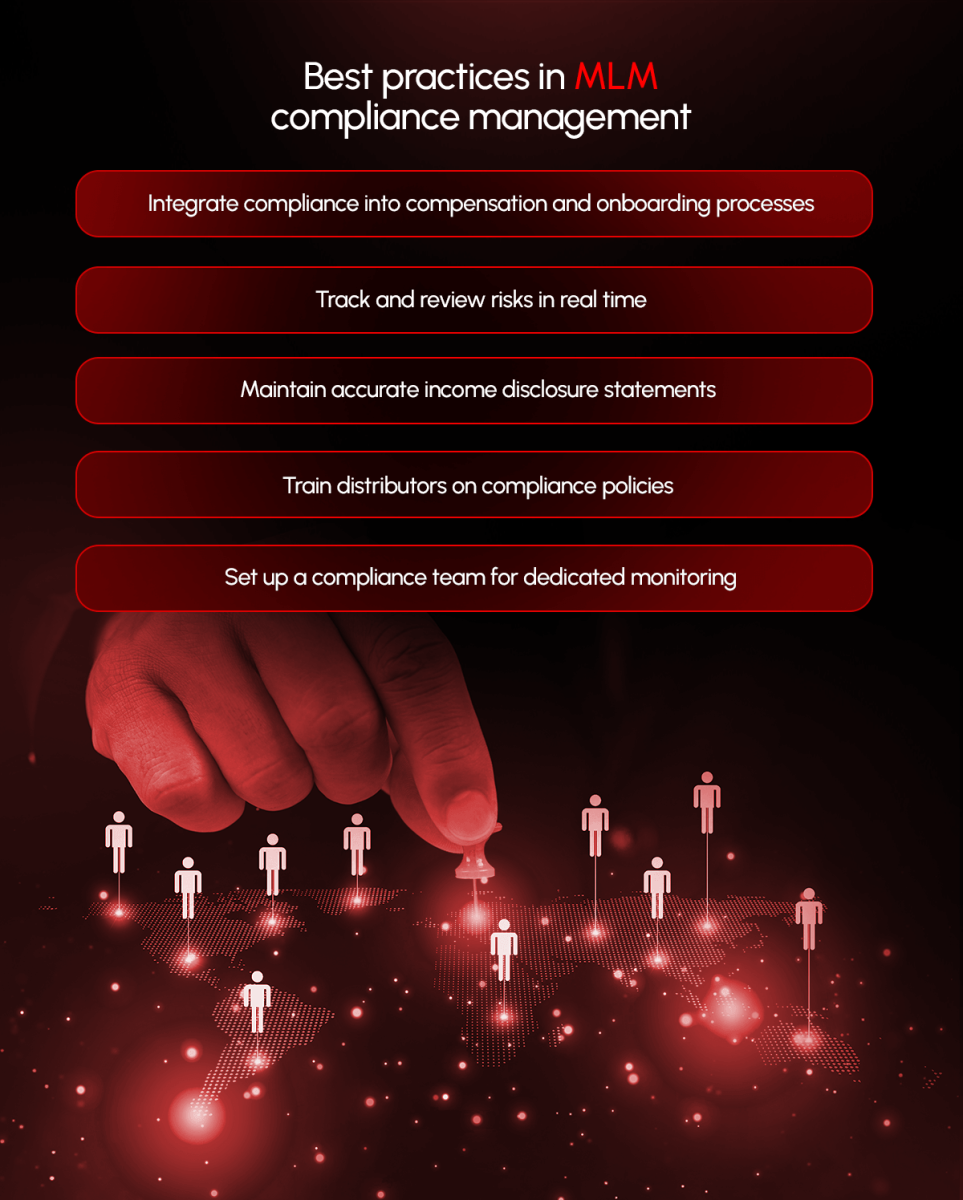
Compliance has to be integrated into all key MLM processes for smoother MLM operations. Compensation structures and onboarding processes must align with related regulations so that companies can prevent compliance gaps and related penalization.
Real-time compliance monitoring systems can identify emerging compliance risks and flag suspicious activities. When risks and policy violations are detected early, companies can maintain compliance alignment even with changing compliance standards.
MLM companies must create and maintain accurate income disclosure statements with clear earnings markings. It should be published on company websites and other channels for prospects to easily access and understand. It should be regularly updated based on current operational data to improve credibility and reduce the risk of misleading representations.
Distributors must be well informed on the compliance policies and its applications in practice. Hence compliance training must be made an inevitable part of their distributor training so that they understand acceptable compliance behavior, prohibited claims, and regulatory expectations. When they are trained properly, it reduces violations and ensures consistent communication practices across the distributor network.
A team dedicated only to oversee compliance related activities will monitor processes regularly and keep everything in check. The team will conduct internal reviews, enforce policies, and design plans to manage violations or risks. This dedicated approach will strengthen compliance and ensure faster responses to regulatory and enforcement concerns.
The US direct selling market is a market with high growth potential but the regulatory complexity is also high. Companies have to comply with both federal and state-level regulations and this can be attained only through careful legal and operational planning.
Also, the consumers are also skeptical toward MLM models which demand complete transparency and fair communication practices. Organizations should prioritize localized policy development and legal validation of business models. Implementation of advanced compliance management systems can also support companies to ensure compliance when entering the US direct selling market.
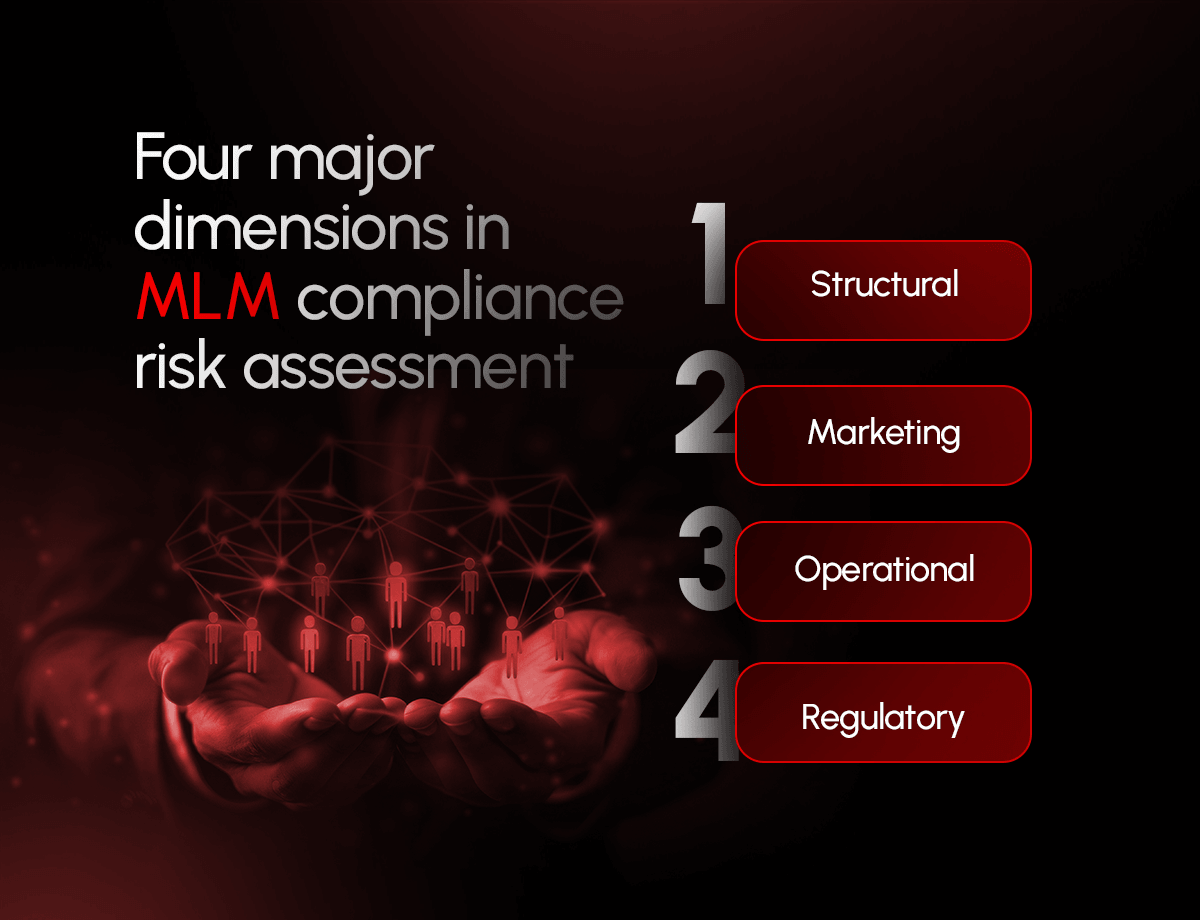
MLM companies in the US need a structured risk assessment framework which evaluates exposure across four major dimensions.
This framework with controls and monitoring systems will identify risks, measure its impact, and apply mitigation measures whenever necessary.
All core MLM processes are analyzed for risk exposures. At the structural level, compensation structures have to be verified for focus on recruitment or product sales. Marketing related risks are identified by closely monitoring distributor activity on various channels, and income representations.
Operational risks are found by assessing system capabilities including transaction tracking, commission validation, and distributor activity monitoring. Regulatory risks arise through gaps in policy drafting and implementation. When existing practices do not match federal or state-level compliance standards, companies face risk of exposure.
Companies need to identify and classify risks through a comprehensive review of compensation structure, distributor activities, communication channels, and compliance controls.
After identifying risks at each level, they need to be classified and prioritized for action depending on the level of impact and likelihood of occurrence. Structural risks, those related to compensation structure are categorized as high impact because any structural deficiency can turn the business model into a pyramid scheme.
Marketing risks related to misleading income or product claims are also in the high risk category because it attracts immediate regulatory attention. Regulatory risks are also considered as high impact risks because non-compliance brings legal action, operational restrictions, or financial penalties. The severity of operational risks alone differ depending on the size of the network it impacts and the level of automation in monitoring systems.
Risks must be prioritized based on the level of financial, operational, and reputational impact.
A clear set of metrics and indicators can help companies easily detect and understand risks and their impact levels. In the structural domain, metrics such as the ratio of retail sales to distributor purchases and the proportion of commissions derived from customer transactions can help assess risks.
Risks in the marketing category can be evaluated by tracking the frequency of non-compliant claims, number of flagged content, and response time for corrective actions. Operational risks can be measured through system audit logs, exception reports, and the consistency of commission calculations.
Audit findings, legal reviews, and the organization’s responsiveness to regulatory inquiries or warnings can help assess regulatory risks. These indicators should be monitored regularly to detect anomalies from the set compliance standards.
Risk mitigation can be done only through proper control mechanisms for each risk category. Structural risks can be controlled with compensation rules that verify retail sales for commission qualification and limit incentives for recruitment.
Risk control in marketing can be achieved through the establishment of approved communication templates, automated monitoring of distributor content, and real-time enforcement for non-compliant behavior.
System-based validations, real-time tracking, and automated alerts can highlight anomalies in transactions or network activity. Regulatory risks can be controlled with timed periodic legal reviews and policy updates rightly communicated to the rest of the organization. Every step in the compliance process must be recorded and made available for future audits.
Risk assessment has to be continuous and embedded into every process so that compliance stays naturally aligned without the need for extra effort. Compliance metrics must be monitored and reports automatically generated for the leadership or compliance team to review. Compliance control mechanisms must also be kept in check to ensure proper functioning as laws and policies continue to change.
Organizations must maintain escalation protocols to address identified risks on time. High risk and high impact issues related to compensation and income claim must be put to immediate leadership attention.
All risk assessment activities like maintaining records of identified risks, control implementations, monitoring reports, and corrective actions taken must be recorded to support future audits and made easily accessible for regulators.
Documentation and record keeping in the compliance realm shows an organization’s commitment and responsibility in aligning with the industry and regulatory standards. This also makes it easier for the organization to manage when a regulatory review or investigation happens.
Decades of legal precedent and enforcement have created a high standard for companies to operate in a market where it is safe for consumers and encourages fair business practices. The 1979 case of FTC vs. Amway still stands as a regulatory reference for the industry along with modern regulatory mechanisms that emphasize transparency in income representation and accountability in digital marketing.
For an MLM business to succeed in the US direct selling market, a right balance between business strategies and regulatory expectations has to be maintained. Every process from onboarding to compensation to training and sales must follow a standard process that upholds ethics and compliance.
Forecast compliance risks across processes and set up real-time intervention mechanisms to secure your MLM business.
Start Free TrialEpixel MLM Software anchored 450+ network marketing companies to success through their business process automation in more than 88 countries. Let Epixel MLM Platform revolutionize your MLM business with 100+ proven features intelligently tuned for small, medium, and large enterprises.
Try our Ultra-modern
Direct Sales Mobile App!!!
Take your business with you. Anytime. Anywhere.


Epixel Enterprises LLC.
300 Delaware Ave STE 210 286,
Wilmington, DE 19801
United States Of America
Solutions
Products
Resources
Get in touch
Epixel Enterprises LLC.
300 Delaware Ave STE 210 286,
Wilmington, DE 19801
United States Of America
 United States+1 650 491 9744



 Canada+1 437 2208998
 Mexico+52 13322545528
 Hong Kong+852 5616 7921