


















Direct selling companies debate on commission percentages and incentive structures to keep their distributors motivated. But one thing they often forget to consider is, “When do these rewards reach their distributors?”. Commissions are not something that only rewards their past efforts, it is also an incentive that fuels their future performance. The gap between performance and payout influences the way a distributor connects their efforts to progress and continue building their business.
Most MLM companies still follow the default monthly weekly setting. Times have changed and demand customization of payout frequency to balance distributor performance and profits. Different payout rhythms create different behavioral effects among distributor networks. Through this article we are analyzing the payout rhythm that produces the most beneficial distributor behavior without affecting profits. Based on gig economy payout research, direct selling industry benchmarks, and aggregated patterns observed across MLM organizations, this article underlines the fact that commission frequency is not a decision to be made by your accounting team because it is an important factor that influences distributor behavior, sales, retention, and profits.
All reliable data has been cited and where the data is limited, the discussion is presented as a hypothesis.
Payout frequency as a powerful growth strategy
Compensation design is always optimized for fairness and administrative convenience. Payout frequency was considered as a processing detail that finance teams decide, but it was never thought of as a growth driver. Gig economy stands close to direct selling because it rewards people for their activity, not fixed salaries just as in direct selling. Gig economy has been moving toward faster payouts and in 2025 more than half of gig platforms were offering instant payment options and nearly half of the users were actively using them.
Instant earnings add to the convenience of participants and improve engagement, loyalty, and retention. When payments are delayed, participants are demotivated and attrition rates rise. Direct selling industry has been slower in treating payout rhythm as a growth strategy because of the compensation plan complexity that makes frequent payouts operationally difficult than it is for a single-task based gig platform.
But through our analysis we found that frequent payout enhances future performance but through a more nuanced way.
The relationship between payment frequency and behavior
Fields adjacent to direct selling like gig work, labor economics, and consumer psychology provide the strongest evidence that establishes the relationship between the two.
The Wharton/Stanford research on payment frequency and spending
Wendy De La Rosa (Wharton) and Stephanie Tully (Stanford) published their research in the Journal of Consumer Research where they share the results of their experiments. They experimented with payment frequency by paying some participants weekly and others daily in the same income level and monitored their behavior.
The findings of the research are relevant to commission design in direct selling.
- Those who were paid daily increased monthly spending by approximately $20 and the annual estimate cited that choosing daily payout over monthly payout would increase a consumer’s total spending by $260 a year.
- People who get paid more frequently feel wealthier than those getting paid less frequently even when their income slabs are the same.
- The impact of payout frequency is stronger for low income earners than high income earners because they provide a sense of financial stability and progress. Since many new and casual distributors fall into this category, payout timing may have a greater influence on their motivation and engagement.
- Receiving earnings often provides repeated reward and progress experiences that make earners feel more optimistic and engaged even when their total income stays the same.
What does this mean for MLM?
The positive emotions and motivation from frequent payouts improve retention especially for new and part-time distributors who need reassurance that their efforts are working.
Impact of payout speed in gig economy
Gig economy has already run the experiment in the past decade and results show that faster earnings improve worker satisfaction and engagement. There were other interesting finds from various other research and experiments.
- The Instant Financial's 2024 Wages & Wellbeing Study found that 85% of workers would stay longer at a job if they received their wages immediately and 77% would work harder and take up extra shifts if they are paid frequently.
- 79% of employees would be more likely to accept a job if same-day pay were available. This shows that faster payouts affect acquisition as much as retention.
- PYMNTS-sourced industry research opines that instant payout is not a perk but an expectation and platforms that fail to provide this lose workers to rivals.
- Payment delays, complicated onboarding, and poor communication negatively impact worker experience and they move to platforms that provide consistent and reliable payment experiences.
Takeaway for MLM
Distributors are comparing the instant payments offered by gig work platforms rather than the compensation plans of competing MLM companies. A 30-day payout cycle may now look outdated to distributors who compare it with other earning apps on their phones.
The limitations of frequency
It would be incomplete to discuss frequent payouts without considering their limitations. When a company increases the frequency of payouts, it is not adding any extra value or incurring extra costs. It only improves engagement and motivation with timely rewards. Faster payouts cannot be masked for the defects in a compensation plan, that remain unchanged.
Not all distributors respond equally to faster payouts. It doesn’t make much of a difference among top earners and this explains the need for segmenting distributor tiers before increasing payout frequencies.
The importance of first commission timing
First commission is always the most important moment in a distributor’s direct selling career. It is a moment of self-assurance, confidence, and motivation. A distributor joins an MLM company with the hope of substantial income but the hope remains unrealized until they receive the money. The first commission is when that hope becomes a reality.
First commission also plays a crucial role in distributor retention. Industry sources may vary by source and definition but the pattern is consistent. The average retention rate for network marketing companies is estimated between 61% and 86%, and other market research cites that distributor retention in direct selling can be about 20% lower than other gig economy sectors. This could also be due to the public perceptions on MLM businesses.
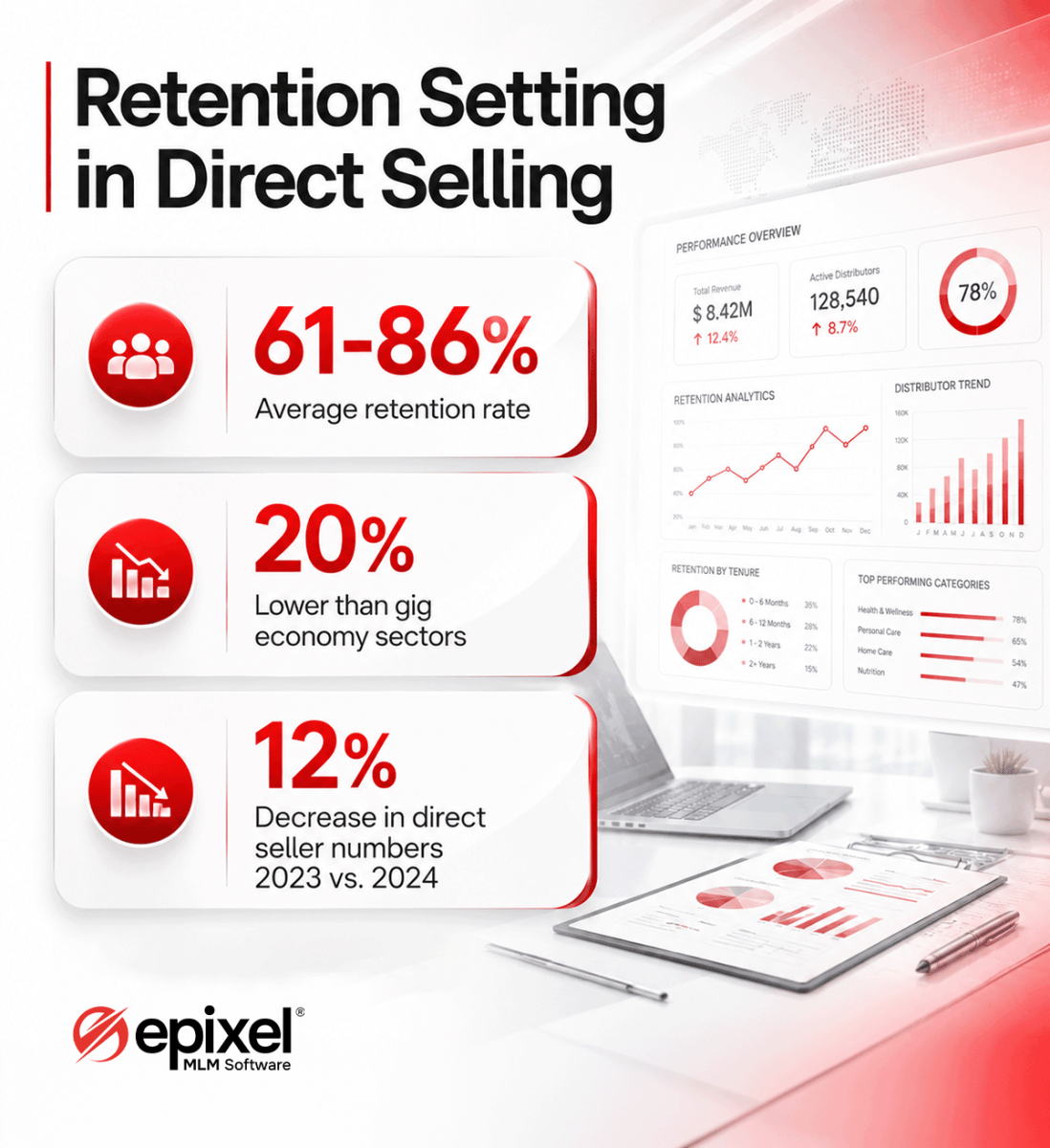
In the US direct selling market, the recent DSEF/DSA Growth & Outlook data recorded 5.4 million direct sellers in 2024, a 12% decrease compared to the previous year. This decline in direct seller numbers show the fragility of early stage distributors.
In Epixel’s view, based on patterns observed across various distributor segments on MLM platforms, the speed of the first commission acts as a factor that helps MLM companies reduce retention risks. Distributors who wait long to get their first earnings lose interest and disengage before the real results come in. This theory is based purely on our observations, and we request companies to consider “time to first commission” as an important retention KPI and measure it.
In addition to that, MLM companies must track the following metrics irrespective of the platform they use.
| Metric | The importance |
|---|---|
| Average time to first commission | Measures onboarding to income velocity. |
| Percentage of new distributors earning their first commission within 7/14/30 days | Segments distributors based on activation speed. |
| Activity level of distributors 30 days before and after their first commission | Filters out the behavioral improvement caused by the commission. |
| Retention at 90 days segmented by speed-to-first-commission cohort | Tests whether early income creates strong engagement. |
| Attrition rate among distributors who never earn a first commission | Measures how many distributors leave before experiencing their first success. |
Recommended internal KPI framework. These metrics are functional in most MLM software platforms by connecting onboarding, order, and commission engine data.
Modern MLM platforms can easily track distributor behavior after first commissions because it has onboarding, sales, and commission data in one place. Older systems have these data stored in different systems which makes it difficult to measure the relationship.
MLM insight
First commission is an influential factor that molds distributor confidence. A compensation engine and onboarding process designed to reduce time-to-first commission without compromising security and compliance is one of the best retention investments available to a direct selling company.
The trade-off between commission frequency and payout size
A pertinent problem in MLM compensation design is to decide whether payouts have to be small and frequent or large and less frequent. This is the same question De La Rosa/Tully tested in their research and the results show that frequent smaller payments create progress and a measurable improvement in financial confidence and spending behavior even when the total income is unchanged. They observed that participants who received income frequently chose more expensive options and spent more money on average, 20% and 10% more respectively.
In the context of MLM distributors, this improvement in confidence and sense of progress is what keeps them motivated to be active for the long term. The research clearly implies that it is not about giving people more money but how people perceive what they earn.
The need for smaller, frequent payouts
- New and casual distributors need a sense of "felt progress" because they have not yet built a downline network to generate substantial monthly bonuses.
- Distributors expect faster payments to make the MLM experience feel more modern and consistent like other earning methods like gig work.
- Frequent touchpoints between the platform and the distributor to increase engagement.
- Reduce the gap between effort and reward to help distributors build positive habits and stay engaged.
The need for larger, less frequent payouts
- Reduce administrative and payment processing workload along with frequent reconciliation cycles.
- A large reward creates stronger recognition moments.
- Larger payouts can help distributors achieve their financial goals than small payouts.
- Leaders and top performers prefer overall earnings to payout timing.
The decision
No research supports small, frequent payouts. The call is for the executives to make. The right payout rhythm depends on the distributor tier, income level, and the behavior the company is trying to create.
Predictability in payouts
Payout frequency does not get attention in boardroom discussions and payout predictability is discussed even less. When we look at the gig economy we understand that payout speed does not build loyalty. It is the reliability of the payout experience. The industry surveys also show us that payout options influence worker satisfaction, engagement, and retention. A comparison of two gig platforms offering quite the same earning opportunities shows that workers prefer the one that gives them on-time earnings.
In multi-level marketing, a distributor who receives unpredictable commission sometimes due to payout delays, temporary holds, or manual reviews has lower trust levels than a distributor who receives consistent income weekly or monthly. Predictability builds trust in the brand and this trust converts to engagement and long-term retention.
MLM compensation and payout system must track predictability related metrics just as it is done in the case of payout frequency.
| Metric | The importance |
|---|---|
| On-time payout rate | Percentage of commissions paid out on time without any delays. |
| Failed payout rate | Percentage of payouts failed due to wallet errors, bank transfer issues, and card declines. |
| Commission dispute and adjustment rate | Percentage of commission reversals, corrections, and manual adjustments made. |
| Time-to-resolution | Time taken to settle disputes, fix errors, and clear payout delays. |
These metrics are not dependent on frequency. In order to set the predictability right, businesses need to work on the commission engine, fraud detection methods, and payout infrastructure especially to withstand peak periods like month-end rank qualification deadlines, when payout volume and complexity increase simultaneously.
Predictability insight
Predictability has to be built into the compensation plan design through right optimization of commission engine, fraud detection systems, and payout infrastructure. This can be done without changing a single percentage of your compensation plan.
Recognition multiplies the impact of payouts
Recognition holds the same power as money in MLM payouts. In fact, it multiplies the impact payouts can have on distributor behavior. Data from the incentive research field strongly suggests the importance of recognition in MLM networks.
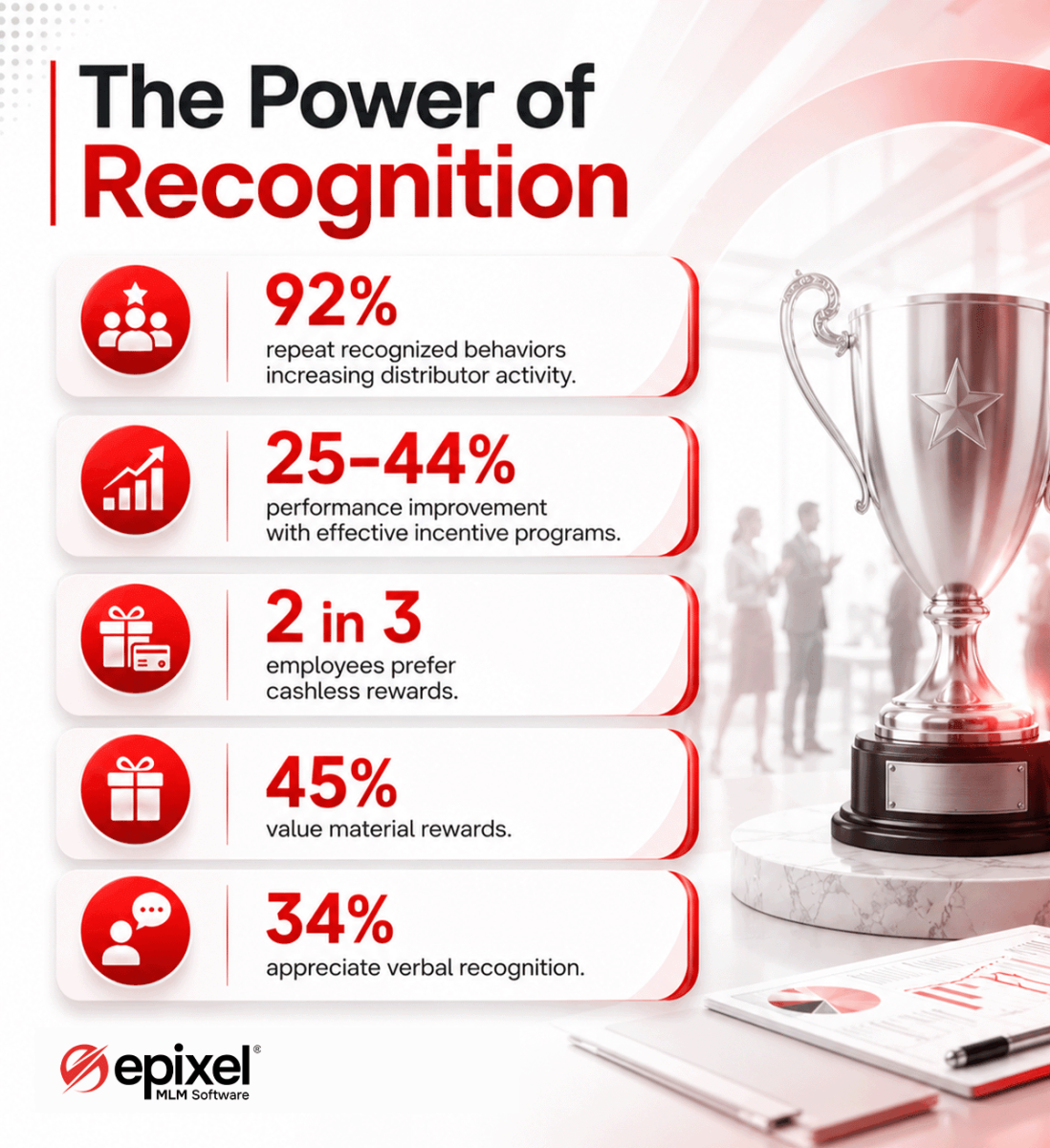
- 92% of workers are likely to repeat an action after getting recognized for it. This finding is relevant to the MLM industry where growth depends on repeated distributor activities such as prospecting, follow-up, training, and team building.
- Recognition works best when it is delivered immediately after an achievement because that enhances the value of their effort and improves motivation. This is similar to “payout speed matters” principle which states rewards are more effective when given in shorter pay cycles.
- The Incentive Research Foundation has recorded that incentive programs can improve performance by 25% to 44% but this is only valid when all issues related to performance and human motivation addressed.
- In Gallup-sourced workplace research about two-thirds of employees say that they prefer cashless rewards. Another survey data reveals 45% of employees need material rewards to feel recognized and 34% wished for verbal praise.
Strategic insight for MLM
A commission payout and a rank achievement are complementary rewards which when paired work better than alone. A payout acknowledges what a distributor has earned, but recognition shows who they are becoming.
MLM compensation plans already have ranks, leaderboards, and recognition events, something many other industries lack. The key is to connect these recognition systems with payouts. The notification and dashboard that show earning notifications should also celebrate recognitions for distributors to see the progress and earnings they are making.
Discover how we build resilient businesses with advanced MLM functionalities



Payout frequency should be a segmented strategy
As discussed earlier, one payout frequency may not be welcoming among all distributor tiers. Hence, the payout design decision needs to be segmented for various distributor segments. The payment frequency and spending research show that the emotional and behavioral improvement are strongest along the low income tiers and reduces as income rises. Also, the first commission research also underlines the importance of speed-to-activation in the earliest days of the relationship. The recognition research shows an altogether different perspective in which a distributor gives importance to status and identity as they advance in their career and build a reputation within the organization.
However, none of these research findings conclude on one payout frequency that serves every distributor segment. Below is an evidence-based segmentation approach.
| Distributor segment | What the evidence suggests |
|---|---|
| New distributors (0-30 days) | Faster payouts and first commission in 14 days of activation. Speed matters more than size. |
| Casual/part-time sellers | Frequent and predictable smaller payouts. Builds habit and sense of progress. |
| Active sellers | A payout rhythm that complements their sales cycle. |
| Recruiters and team builders | Downline earnings visibility and milestone recognitions. |
| Leaders/top earners | Favor predictability and transparency along with public recognition for maximum impact. |
| Reactivated/at-risk distributors | Faster payout cycle during re-engagement efforts. |
Segmentation framework derived from the behavioral evidence presented in the sections above.
Segmentation before deciding on payout rhythm is beneficial for the company and the distributors. It is true that frequent payout improves motivation but it is also operationally strenuous. Hence a segmented approach can help companies accelerate payouts where needed and avoid the cost of giving everyone the fastest payout schedule. Modern MLM platforms can easily handle multiple payout frequencies for different distributor tiers without any delays. It can also help create the behavior beneficial to the company.
Frequency impact on profitability
The final decision on payout rhythm must consider the profitability side of frequency adjustments. Decision makers have to see the cost and behavioral impact each change brings. There is not much data available publicly on this and the below conclusions were made from research on payment systems, behavioral economics, and the gig economy.
- Companies cannot switch to instant payments immediately. It requires technology, payment systems, integrations, and resources. 52% of gig platforms had introduced instant payment systems by 2025.
- The spending is justified as it contributes toward retention and acquisition of workers. Among workers, faster payouts are seen as a differentiator that influences which platform they choose to work with.
- Behavioral research around this clearly states that frequent payouts increase spending and engagement, but it does not increase total income. The benefits an MLM company would receive from faster payouts is behavioral, not a change in the compensation plan performance.
Since there is less data available, it is better for companies to build an internal ROI framework:
Payout frequency ROI framework
- Processing cost per cycle: This is the direct cost like gateway fees, reconciliation labor, support tickets that would be incurred if running an extra payout cycle.
- Incremental activity per cycle: Measure this directly from your platform by tracking logins, orders placed, and follow-ups in the days after a payout compared to non-payout days.
- Incremental revenue attributable to that activity: Connect behavioral improvements to actual order value not just engagement metrics.
- Net comparison: Incremental revenue minus incremental processing cost, evaluated for each distributor segment.
MLM companies can build this framework with their own platform data within a quarter and analysis becomes possible when onboarding, commission, and order data exist in a single system.
Risks and compliance factors in faster payouts
Faster and more frequent payouts are good for growth and engagement but they also carry a risk burden. Compliance issues and risks increase when the payout speed increases. Faster payout cycles reduce the time for risk control activities like fraud pattern detection, refund and commission clawback reconciliation, KYC verification, and tax documentation completion. When these are not given due attention for a behavioral improvement, the risks outweigh results. This is the exact reason behind payout hold periods, minimum payout thresholds, and tiered KYC requirements that many MLM platforms apply before releasing certain payout types.
Strategic insight for MLM leadership
Companies wishing to implement faster payouts should first evaluate whether their commission engine's fraud detection and compliance architecture can support them. Platform capability should be addressed before compensation policy changes are introduced.
Implications for compensation strategy
When we put together all evidence collected, we end up at four major conclusions.
- 1. Payout speed and predictability impact the behavioral aspect.
- Peer reviewed consumer psychology and gig economy data clearly portrays the importance of faster and more predictable payouts in changing earner perception on financial progress and associated behavior afterward the payout
- 2. The first commission is the highest impact factor.
- Reducing the time to first earning enhances distributor confidence and improves performance and retention for direct selling companies.
- 3. Frequency is a segmentation decision.
- Frequency impact new distributors, active sellers, and top leaders in different ways. The analysis favors a system that can run multiple payout cycles for multiple distributor segments and behavior.
- 4. None of these work without trust.
- Even if a company has a faster payout cycle but with disputes and reliability risks, it can impact distributor trust badly. The payout design has to complement distributor preferences along with a proper recognition system that enhances their efforts.
Final thoughts
Payout frequency is filed under finance and operations. The analysis here puts in a new spotlight, under product, retention strategy and distributor experience design. Companies must focus on creating the most credible payout and recognition experience for their distributors to build a mutually beneficial growth path.
Here we conclude our analysis on the note that payout frequency is a strategic growth tool that can be shaped using the right data and technology to motivate favorable distributor behavior.













Leave your comment
Fill up and remark your valuable comment.