


















The positive aspect of a binary MLM plan is its less complex nature. The actual problem is keeping the distributors active on both legs on a weekly basis. This is because schedules turn hectic, the drive reduces, and this leads to lethargy that slowly kills weekly amount, payouts, and self confidence.
Gamification will be useful in guiding the owners of the MLM companies, field leaders, product or IT teams who want to embed gamification to their software to increase interest. This is geared towards letting the distributors do regular weekly jobs free of strains, misunderstandings, and exhaustion. Everything that is said here takes into account the well-being of the distributors and does not involve complex metrics and contributes to the development of the business in the long term.
1. Make important numbers easy to understand
Raw business volume (BV) numbers and tree structures are the only things presented in most dashboards. These are technically true but not always useful as distributors do not know what those numbers convey and what to do next. Gamification is effective when the software translates complex information into easy instructions.
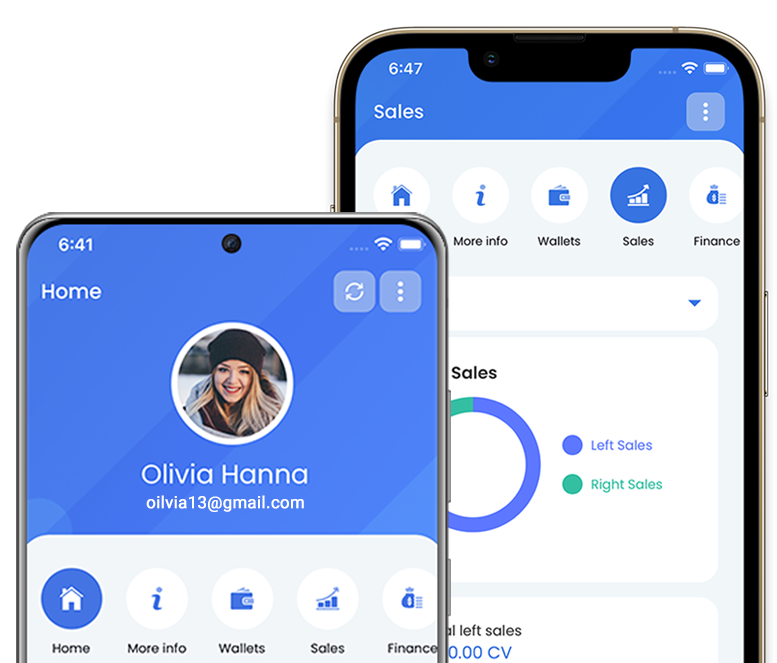
The system should show the improvement of the distributor at the end of each week in regard to their left and right leg. It shows distributors how much percent of their goal have been accomplished in both legs in a week. The progress bars clearly indicate whether they are on course, marginally behind or need some attention. This assists them to estimate the situation in a single look.
Several signals including personal orders, team orders, balance between legs, and actions taken during the week may be streamlined into a binary health indicator. These can be integrated into one status such as green for healthy, yellow for can improve, and red for at risk. The platform is also supposed to provide recommendations like informing the distributor that they should include an extra retail order on the right leg to achieve their goals.
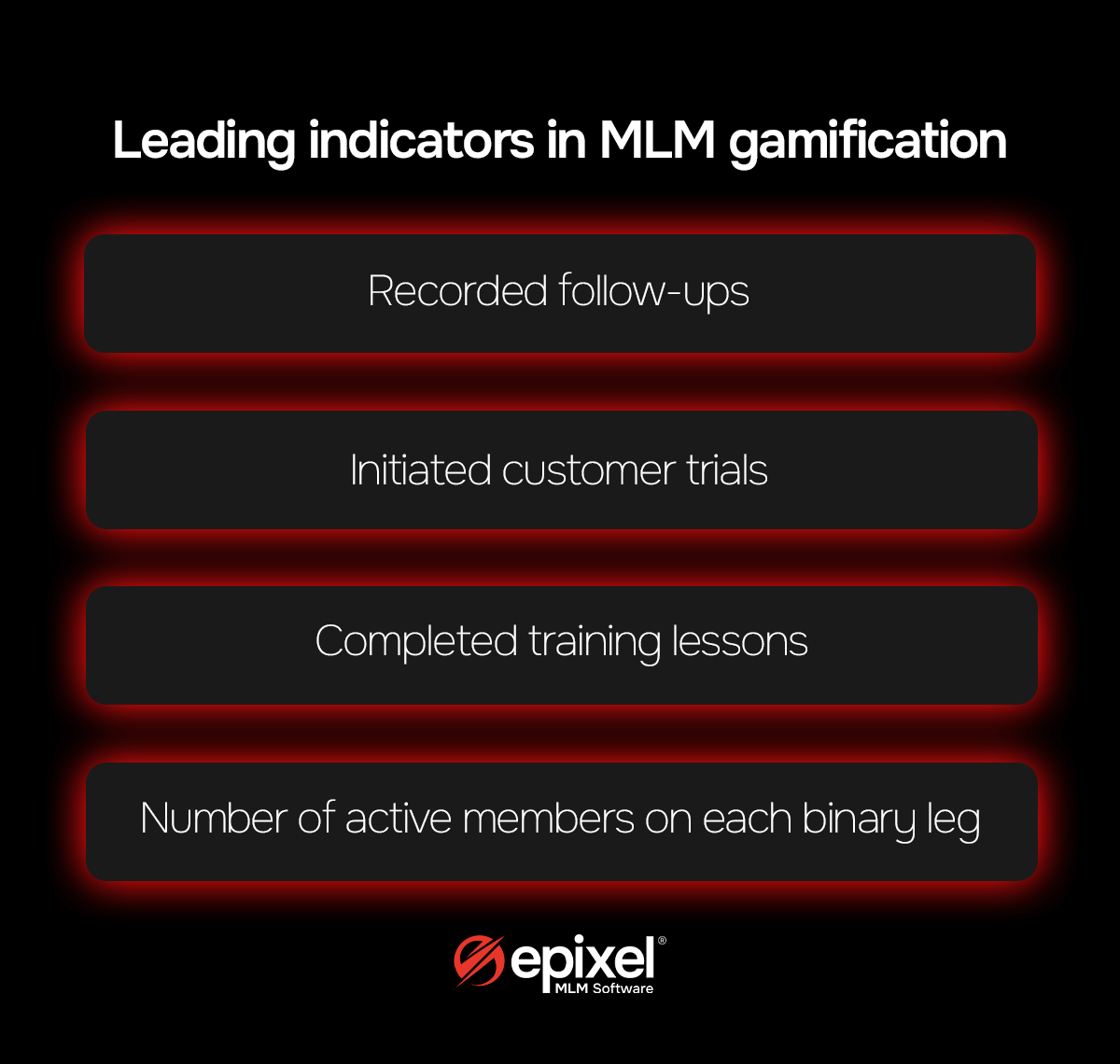
Further design enhancement can be achieved by concentrating on leading indicators rather than lagging ones. Lagging indicators like payouts or BV from the previous week reflect the past. Leading ones indicate what may get affected in future such as the number of follow-ups recorded, customer trials initiated, training lessons covered, or the number of active members on each leg. These early indications enable the distributor to rectify their course of action before the volume plummets.
2. Use streaks for consistency, not exhaustion
Streaks are one of the biggest motivating factors in a gamified system. However, extreme daily streaks can also be the cause of guilt or burnout. A sustainable method establishes consistency with the help of streaks that do not bring about pressure.
A streak is not as effective when it's done daily as it is when done weekly. The system can also compensate the distributor according to their activity levels. This is dynamic and it keeps in track with the schedule of the real life.
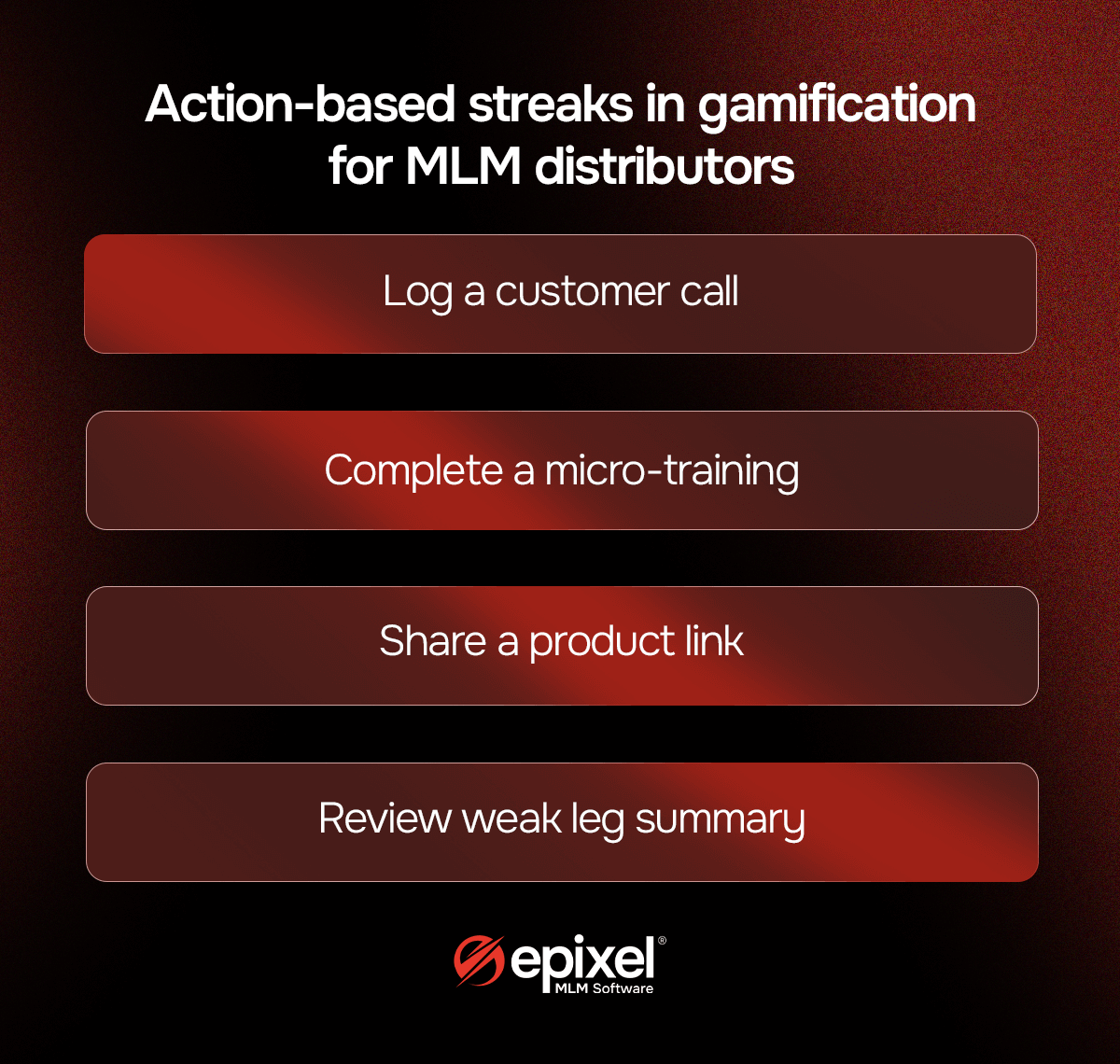
Streaks should be set on meaningful activities as opposed to simple logging in. Streaks can be used in recording a customer call, a short training, posting a product link, or seeing the weaker-leg summary. The system has a number of weeks that can be celebrated such as three weeks of follow-up consistency or four weeks of training habits.
A deeper understanding is that each fourth week must be a light week referred to as a Consolidation Week. The tasks should be smaller and aimed at customers and basic housekeeping tasks. This is a design concept that is borrowed from athletic training where there are periods of work and relaxation. This prevents burnout and makes the distributor stay active over a long period of time.
3. Weekly micro-challenges that target real structural issues
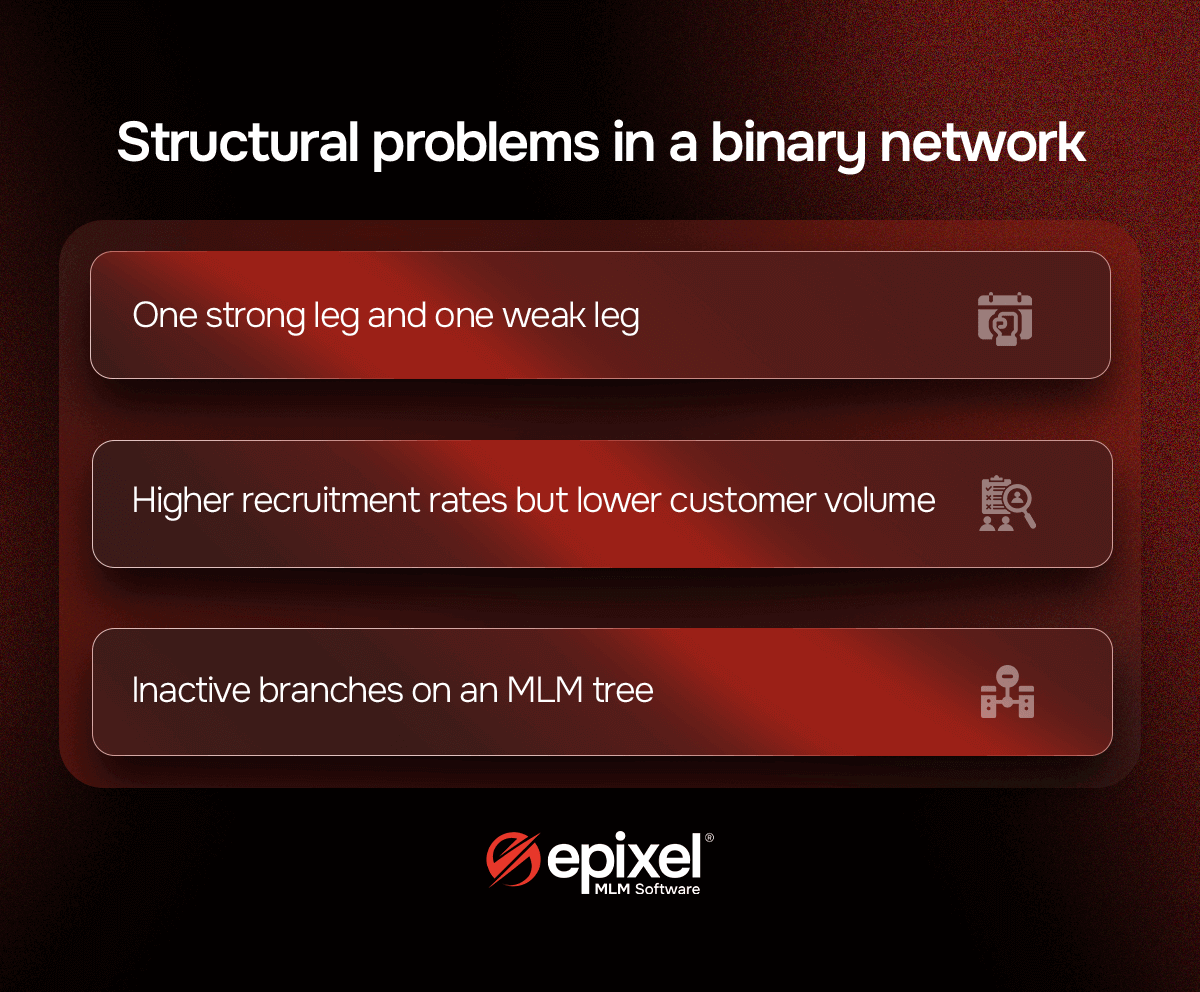
All binary plans have recurrent issues, including one strong leg and one weak leg, high recruitment and low customer volume, and inactive parts of the tree. These problems should be resolved by gamification, not merely to entertain the users.
One of the challenges that are helpful is the Weaker-Leg Focus Week. The system determines which leg is weaker for each distributor and requests them to contribute a tiny portion that is manageable. As an example, it can demand them to add two customer orders or 300 BV on that leg in the week. There is a little tracker displaying the degree of challenge completion.
Customer Volume Week is another strategy. This is limited to customer-based activities like new or repeat orders. They could be rewarded with points, special badge or recognition.
A more cooperative task is Squad Quest. There is a small group of three to five distributors who collaborate. The team may target to have 15 training modules and ten customer follow-ups within a week. The common progress is observed by all, and this creates motivation.
In a more detailed concept of design, such obstacles are approached as a quarterly portfolio. There are weeks of customer retention, customer acquisition, training and strengthening the weaker leg. This balance makes the distributors not lay too much emphasis on any area.
4. Inclusive leaderboards that recognize progress
Normal leaderboards highlight only the top performers. This may demoralize most of the distributors who are still developing their business. A more productive way is the implementation of improvement, effort, and progress in the form of leaderboards.
One of them is the Improvement This Week leaderboard. It does not rank the BV but checks the growth of the previous week. One can say that a person who increases 100 BV to 200 BV is known to double their output though some may have greater totals.
Cohort-based rankings include individuals who have joined in the same month or quarter in order to avoid comparing new members with long-term leaders. There can also be activity-specific leaderboards where it is possible to see rankings in such areas as training completion, follow-ups logged, or onboarding support.
One can use short messages to inspire the distributors by informing them that, although they are not on the leaderboard. A more in-depth look is the percentile bands rather than the raw ranks. When the system informs a distributor that he or she is in the top 40% of people to complete training or in the top 25% to improve his or her weaker leg, they feel motivated and are not embarrassed by a low rank in the list.
5. Reward system that builds capability and stability
Certain rewards such as points, badges, and levels encourage behaviors that strengthen the binary structure and enhance customer activity. Actions that create long-term success like training, recording of customer service activities, compliance sessions or balanced volume in a week should be given points.
Real accomplishments that should be highlighted with the help of badges include keeping the legs healthy, achieving a milestone in repeat orders, or completing all policy modules. The helpful tools such as advanced playbooks and scripts, coaching slots or special templates should be unlocked on levels of Bronze, Silver, or Gold. The platform should clarify well that they are learning and contribution levels not guaranteed income levels.
A more profound understanding is recency-weighted scores where the recent activity influences the score more, as compared to old activity. The past points are gradually erased such that the success of the previous year does not disguise any laziness.
6. Training as a guided, adaptive learning path
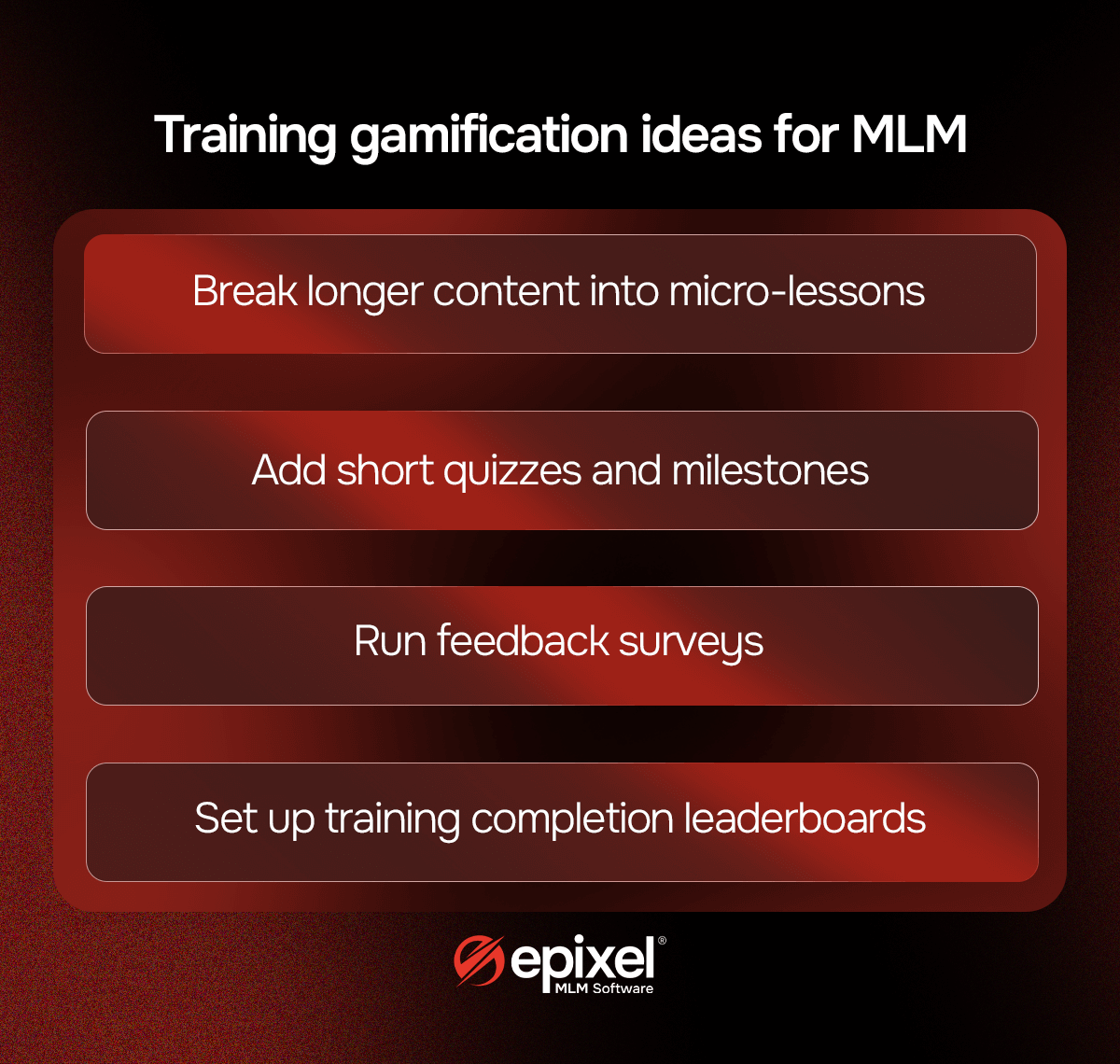
Most distributors fail as they become lost, confused, or even scared of committing errors. The most efficient method of distributor training is to introduce training as a step-by-step process by having brief lessons, quizzes, and milestones.
Three to five minutes micro-lessons assist distributors to learn without feeling overwhelmed. Short quizzes test knowledge and give feedback instantly. The beginners can be provided with learning paths, or specific subjects like customer service or market rules.
The certificates can provide statements about what kind of skill the distributor has mastered, e.g. being able to communicate with customers or know how to balance their legs.
Just-in-time training is a more profound enhancing process. The program is expected to track the behavior and prompt certain lessons when necessary. In micro training, distributors are taught what to do if the refund rate increases and how to handle objections. Personal consumption should indicate training on how to build healthy customer base in case if the personal consumption is high and number of customers is low. This renders the training to be like a helpful ally.
7. Continuous feedback, iteration, and guardrails
Gamification should evolve over time. The distributor should provide feedback to the teams regularly to be aware of the issues that occur frequently and those that appear confusing and stressful. The behavior measurements like frequency of logging in, training, customer to distributor order ratios and frequent support tickets can be used to detect areas that require improvement.
When one feature puts a strain or promotes shortcuts, the system should modify it. Another design requirement that is more detailed is safeguarding the system against manipulation. This involves not making artificial orders, or personal purchases that are not needed, or moves made just to score, etc. Guardrails ought to blend the measure of quantity with the measure of quality and report on the suspicious patterns. The platform must make it clear that rewards will be eliminated because someone will be manipulating the system. This sustains equality and preserves conformity.
8. Adaptive challenge levels by distributor stage
Not every distributor is on the same level, and therefore they are not supposed to have the same goals and targets. The new members should be given simple tasks. Increasing distributors requires more organized activities. Challenges that leaders face must be network-wide.
In the onboarding stage, small tasks must be given to the new distributors as their first login streak, first customer conversation logged in, or first micro-training.
During the growth stage, the issues are moderately challenging like the stabilization of the weaker leg, the establishment of follow-up routines, or completion of important training tracks. In the leadership stage, the emphasis is put on team behavior like completion of training in the team, depth training, and balance in both legs. Adaptive difficulty makes the challenges stimulating and not discouraging.
Discover how we build resilient businesses with advanced MLM functionalities



Conclusion
A binary MLM relies on consistent action per week. The appropriate gamification framework can turn complicated figures into easy directives, create wholesome habits, point out important advancements, firm up customer bases, and ensure that both legs are active. Gamification should be a long-term stable growth generator and not a one-off excitement generator. This will make distributors feel valued, leaders will have foreseeable business trends, and the company will enjoy sustainable, ethical and balanced development throughout the network.















Leave your comment
Fill up and remark your valuable comment.