

















 Epixel Research: Fairness and Compliance
Assessing distributor performance by sales and recruitment numbers belongs to a bygone era. AI and automation are the new performance evaluators. Evaluations thus became more accurate and real-time, but whether that guarantees fairness is often overlooked by direct selling companies. When performance is evaluated, it should not focus only on who brings the greatest benefit to the company, but also on how that performance is achieved and under what circumstances. Without these considerations, any technology, however advanced, can be unfair to certain demographic segments and markets.
Keep decisions fair with bias audits
Your MLM network is diverse with people from different cultural backgrounds, age cohorts, and locations. Each distributor contributes differently, and every minor effort counts. As the brand that holds them together, you must acknowledge their efforts fairly and without bias.
Bias audits will help you identify unfair patterns in commission rules, rank criteria, or in scoring before they turn out to be a compliance or reputational concern for the brand. When you detect these early, you get ample time and clarity to rectify these issues and build trust before it’s lost.
Direct selling leaders can use this practical guide to identify biases, measure it using data, and implement practices that can establish fairness in the processes. The methods here are based on credible and recognized methods such as demographic parity, permutation tests, mitigation checklist, and bias audit report.
Bias audits should be atop your 2026 OKR list
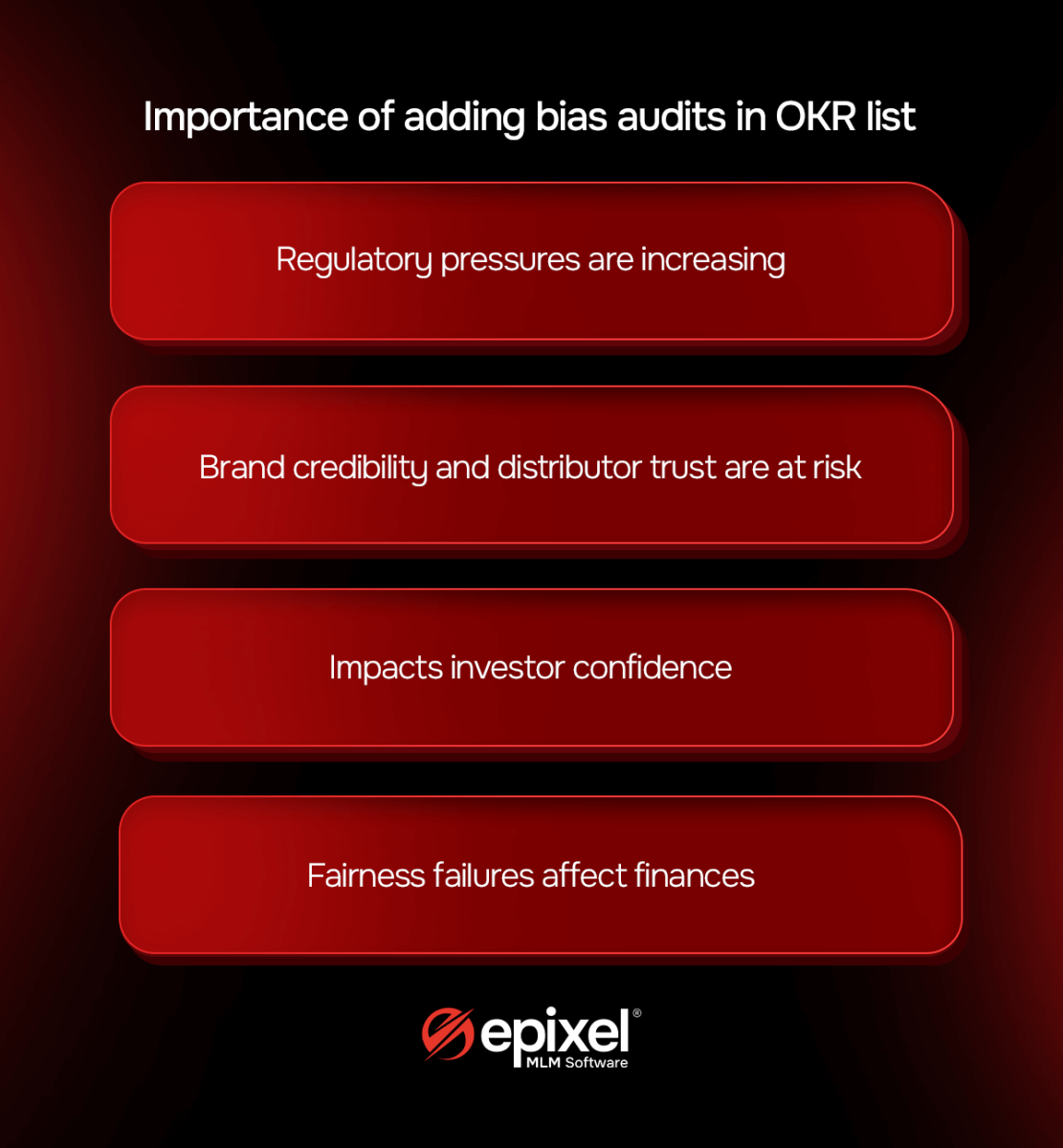
Your objectives and key results (OKR) list for the year would have already been set. If bias audits are not listed, then it must be. Because amid the mounting pressures from markets and regulatory bodies, direct selling companies must ensure that their processes are fair and unbiased for all participants.
Increasing regulatory scrutiny
NYC Local Law 144 has made bias audits compulsory for companies that use Automated Employment Decision Tools (AEDTs). These audits are to be performed by a third party every year and results published on the company website. This is applicable for all companies with gig, incentive, and commission systems. Europe also controls and monitors AI use through its AI Act. The Act imposes strict monitoring through bias audits in high-risk AI systems that involve compensation handling. Non compliance with these laws will cost companies an approximate six percent of global revenue along with public listing that damages brand reputation.
Brand credibility and distributor trust are at risk
When scoring systems are considered to be unfair or biased by distributors, it slowly erodes their confidence and trust. And when trust fades, enrollment rates drop, churn rates rise, and intensity of reputational damage multiplies through social media. Rebuilding trust takes time and revenue.
Investors are watching more closely
Bias-related business risks also impact investor confidence. Investors expect businesses to include bias risks and fairness representations in proposals and agreements. Hence direct selling companies looking for funding and partnerships will face impediments if biased processes are not monitored or managed.
Fairness failures affect finances
Automated commission and rank qualification processes that are not properly monitored can bring forth biased outcomes and financial losses. Reputational damage and social media criticism weigh down the brand, but today the effects are far more severe. Penalties, compliance actions, public disclosures, and operational disruptions can result in loss of partner, customer, and distributor trust, and your brand value falls.
When bias audits become a part of your OKRs, they are tracked regularly and reviewed by the leadership. The responsibility of maintaining fairness by leadership reveals that the brand is growing with fairness and sustainability. Investor confidence grows, distributor trust builds, and regulators do not see a need to intervene.
A quarterly bias audit framework
Running bias audits quarterly can help identify risks and keep them in check. Every quarter should have a new audit team running the same process step by step to ensure there are no biases in any of the business processes. Automated scoring systems that calculate commissions or rank advancements should be fair and explainable to the network and to the regulators.
Phase 1: Decide what and who you are auditing
Set up an audit team with members from sales, compliance, finance, legal, DEI, and data science teams. Audit models and processes that are directly related to lead scoring, rank advancements, and commission eligibility. When concluding the phase, you will have the list of models and processes to be audited and an agreement that the results will be accepted and implemented.
Phase 2: Identify biases and measure impact
Through this phase, you must check for biases, if at all they exist within your system, and ensure that all distributor segments are treated fairly. Use past scoring data for the past two years and group people into broader segments. Compare different groups to see if their performances are rewarded equally and no biases impact their earnings or career advancements. Shuffle comparisons across different segments and run simulations to check if gaps are real or random. The completion of phase 2 will show the areas where gaps really exist and evidence to ensure gaps are real.
Phase 3: Implement remediations to fill the gaps
After the identification of biases and their depth, launch initial steps to curb recurrence and remove the biases completely without interrupting the business. Adjust data used for training the model, alter the rules, and the decision making process. Minor biases go away with small technical fixes but complicated processes might need a detailed human review. The systems still must remain fair and explainable to the leadership, network, and regulators. When phase 3 is through, unfair gaps are reduced, and the model becomes more trustworthy.
Phase 4: Manage fairness into the future
Quarterly bias audits ensure that the system and the business are in no way biased or unfair to the participants. It manages gaps without interrupting the operations but only when performed regularly. Audit findings, solutions, and mitigation checklists of each quarterly audit should be documented and shared with the leadership team. Controls and checks should be implemented to ensure future changes do not affect fairness checks.
Fairness metrics for your bias audit
You find biases and fix it, does not necessarily make your system completely fair. When quarterly audits are run and practices are in place to reduce risks, the next step is to measure the fairness levels. Measuring fairness should be based on outcomes, performance, and statistical tests.

Demographic parity ratio
Scoring, promotion, and eligibility rules are different for different levels in multi-level marketing. By measuring demographic parity ratio, you will get to know whether different distributor segments are fairly treated across scoring, promotion, and eligibility processes. This is calculated by dividing the positive scores of one group by that of another. Ratio anywhere between 0.8 and 1.25 is acceptable in accordance with the 80 percent rule in the US.
Equal opportunity difference
Each distributor group will have top performers, and this metric ensures that their efforts are recognized fairly through positive decisions irrespective of the group or segment they are in. The difference in positive results of two groups against the same qualification criteria gives the Equal Opportunity difference. A small difference, say five percentage points is generally acceptable to confirm that the system rewards high performers fairly.
Permutation p-value
The permutation p-value tells you if the gaps you identified occurred by chance or are a real systematic difference. The test reshuffles group labels and recalculates the gap to estimate the likelihood of the difference being random. P-value above 0.05 shows that there is no systemic bias. This is also strong statistical evidence that your legal and compliance teams can rely on.
Calibration
Calibration checks the scoring accuracy of systems against the real outcome. If the system assigns 0.7 as the score, calibration checks whether roughly 70% of people with that score actually succeed across all groups. It is measured using an R-squared value above 0.9 for each subgroup to ensure that the predicted probabilities in scoring are trustworthy. Poor calibration can make forecasts and decision making difficult.
Measure the intensity of bias with permutation tests
When differences between groups are observed, running permutation tests can tell you if the variations are real or random. It involves various steps that have to be carefully followed to get a reliable result. In order to carry out permutation tests, you will not need complex systems or advanced technology infrastructure. Many business intelligence or analytics teams can implement the test with basic data tools and a short Python script.
Null hypothesis
Start the test by assuming that there is no bias, that is, the system assigned scores are not influenced by the segment a person belongs.
Shuffle the labels
Run tests with mixed up group labels and scores to check for random variation. Shuffling the labels will remove any real connections that may exist between group and score.
Recalculate fairness metrics
After each shuffle, demographic parity and Equal Opportunity difference must be calculated and the process repeated 10,000 times to create a random distribution of gaps that could happen by chance.
Calculate p-value
P-value is the fraction of shuffled scenarios where the gap is larger than the gap as observed in real data.
Make the decision
P-value less than 0.05 means the bias is systemic and not by chance but if the p-value is greater than or equal to 0.05, the gap could be random.
The complete bias audit report
A bias audit report must be complete with each step and remedials mentioned after each audit. The structure of the bias audit report, like any other report, will have the details of the model audited and the key findings with date and ownership. Key findings must be listed and highlighted using a traffic light table so that executives can easily identify high risk zones.
A short summary of the data used including the quantity, time period, and number of persons in each group that were subjected to the audit must be mentioned. In the metrics section, detailed representation through charts and graphs such as score distributions, ROC curves of each subgroup, and Equal Opportunity curves help readers understand the behavior of the model across all subgroups.
The root cause analysis section should explain every change as noted in the audit with heatmaps and SHAP summaries. This will help identify factors that favor performance and risks that cause biases. For the bias audit report to be complete, a section on actions to address the issues identified along with ownership, timeline, and expected improvements must be listed. A final attestation with confirmation that the findings have been reviewed and accepted with separate sign-offs from Data Science, Legal, and Compliance team members makes it credible and acceptable.
Create insightful executive-friendly bias audit reports with our downloadable bias audit report template.
Checklist to reduce biased decisions
Findings in the bias audit should be tracked and actions made accountable. The checklist has every identified risk, its deadline, owner, and status so that leadership teams have a point of contact and status visibility to ensure no remedial actions are missed or pending. You can copy and paste this mitigation checklist to ensure that every action to curb bias in the system is efficiently carried out.
| # | Action | Owner | Due | Status |
|---|---|---|---|---|
| 1 | Remove “Distributor Age” proxy features (e.g., “joined before 2015” flag). | Data Science | M+1 | |
| 2 | Re-train model with fairness thresholds. (DP gap < 3 pp). | ML Engineer | M+1 | |
| 3 | Monitor DP & EO and provide real-time reporting via Grafana dashboard. | DevOps | M+1 | |
| 4 | Update privacy and disclosure notices to explain the use of automated decision systems. | Legal | M+2 | |
| 5 | Activate human review for scores in 45-55 range. | Sales Ops | M+2 | |
| 6 | Train leaders and distributors to recognize potential bias signals. | HR / DEI | M+3 | |
| 7 | Schedule the next quarterly bias audit | Comp Ops | M+3 |
Managing bias audits
Direct selling companies must treat bias audits as a routine business process with absolute fairness and responsibility. The comprehensive model for operating bias audits will cover broader responsibility of people responsible for maintaining fairness, the actions they must undertake, and the frequency at which they must repeat the process.
Biases in the system will eventually end up risking and defaming the brand. Hence board members must review the high level fairness metrics at least once annually and set limitations in score variations to let the team know how much is acceptable.
Below the board level, an AI steering committee must be set up to review bias audits quarterly with controls in place based on board-level decisions. The committee will have the authority to review and approve remediation plans. Responsibility of model accuracy will rest on model owners who will record every change and audit them with the checklist. Any issue detected will result in the blocking of the current release.
An internal audit team reviews a random sample of scoring decisions monthly to ensure that the automated outcomes align with organizational fairness standards. This audit cycle should align with commission and pay cycle updates to ensure that fairness is ensured before every payout release.
Bias audits in 90 days
| Week | Milestone | Outcome |
|---|---|---|
| 1-2 | Identify and list all models that influence distributor progress like pay or rank. | A clear list of areas with chances of bias occurrence. |
| 3-4 | Choose metrics, acceptable scoring standards, and SOP. | An approved audit charter from the leadership. |
| 5-6 | Build a technical infrastructure to collect and process data and create permutation test notebooks. | The first measurable baseline before fixes. |
| 7-8 | Create a plan to remove existing and reduce biases in the future. Test in one market first. | Measure the impact with preset metrics. |
| 9 | Create the full bias audit report with sign-offs from the teams involved. | Report ready for leadership review. |
| 10-12 | Automate bias monitoring with alerts or dashboards and schedule the next audit. | Bias audits become a natural organizational process. |
Above and beyond fairness
Bias audits give companies an advantage more than just fairness and trust. It brings value across various business areas such as recruitment, market expansion, investor relations, and product innovation.
Bias audits become the script for your recruitment narrative through which people understand that success with you is purely based on performance. A bias-free system gives you an opportunity to find new markets and talents that you may have overlooked in the past. The transparency and risk management efforts put in to bias audits increase the value of your business to prospective investors.
Bias audits help you find areas where your system attention bypasses opportunities in social engagement rate, referral data, or demographic coverage. These could present incredible insights for product or feature optimization.
Discover how we build resilient businesses with advanced MLM functionalities



Conclusion
Bias audits give distributors trust, investors confidence, and your brand a reputation for fairness and integrity. Fair scoring attracts top talents, and transparency improves retention rates. The impact of bias audits in direct selling is proven and the path is clear. So, design your roll out and let fairness power your growth.












Leave your comment
Fill up and remark your valuable comment.