















English
- English
- Español

- 简体中文

- Français

- Deutsch

- Italiano

- 日本語

- 한국어

- Portuguese, International




The executive playbook to lead in times of war, recession, and disruption
Ever since the 1973 Arab Oil Embargo, the direct selling industry has seen lot many crises including the current Middle East Conflict. But the industry successfully withstood every crisis and emerged stronger each time. Technologies and strategies have helped it navigate each trial, but resilience also comes from the structure of the model itself. Today, standing amid a global energy crisis, let us evaluate how the industry is impacted and how it will evolve through this.
According to the WFDSA 2024 report, the global retail sales in the direct selling industry was $163.9 billion with 104.3 million representatives. An interesting fact to note is that this result comes after the post-pandemic normalization. The same industry grew 5.8% in 2020 (excluding China) when the traditional retail went through a sudden collapse. It also grew through 9/11, expanded during the 2008–2009 financial crisis, and turned digitally faster than any other channel during COVID-19.
This white paper analyzes the survival tactics the industry has adopted through its 50 years of history and provides an actionable framework for direct selling and MLM leaders who are struggling to build their teams and manage operations amid crises.
Through every crisis, direct selling industry saw a new ground for growth by helping crisis-affected groups to earn income and build their career during times of uncertainty. This turned mutually beneficial as the companies got a purpose-driven network of distributors who contributed consistently to the growth through and post crises.
In 1973, when the OAPEC implemented the oil embargo, the oil prices shot up sharply from $2.90 to $11.65 per barrel. With this, the traditional manufacturing and retail fell due to stagflation and energy crisis panic.
Even in this setting direct selling companies saw improvements in growth and revenue. Amway expanded in the 1970s and Herbalife was founded in 1980, on the backdrop of the oil-shock decade. The resilience pattern was clearly set from the start. When a crisis disrupted income, direct selling offered alternative income opportunities in the most accessible way.
The history repeated with oil price hike during the 1990-91 Gulf War when Iraq invaded Kuwait. This resulted in the global recession with GDP of G7 nations contracting and in the process, many lost their jobs.
Direct selling companies used this period to expand to Eastern European markets. Nu Skin founded in 1984 grew rapidly even through the early recession months of the 1990s. The industry validated the strategy of geographic expansion and recruitment during downturns.
The 9/11 attacks deeply affected consumer and business confidence. The sectors that underwent immediate contraction were travel, services, and traditional retail sectors. Even though the Dot-Com bust impacted internet-based companies and stock markets, corporates had to resort to mass layoffs. This created a network expansion opportunity for direct selling companies.
This period also saw direct selling companies switching to online training, email marketing, and early ecommerce capabilities.
The Great Recession impacted every sector in almost every country. The unemployment rate in the US was 10% in October 2009 and traditional industries had to execute mass job cuts. Thousands went jobless and income-anxious consumers caused uncertainty in customer-focused businesses.
Amway’s performance during this period was remarkable. In 2008, approximately 66% of Amway’s global markets saw an increase in sales, including 40% growth in India (Business for Home, 2011). In 2009, global sales of the company were $8.4 billion, followed by $9.2 billion in 2010. The company even celebrated their 10th sales increase in 11 years.
The job and additional income seeking population increased and direct selling, with its flexible low-capital requirement entrepreneurial alternative attracted many to the industry.
| Crisis | Macro impact | Direct selling response | Outcome |
|---|---|---|---|
| 1973 Arab Oil Embargo | Oil prices increased by 300% causing stagflation and recession. | Better recruitment growth. Herbalife founded in 1980. | Decade of industry expansion. |
| 1990–91 Gulf War | Oil spike to $46 per barrel and led to global recession. | Expanded into Eastern Europe post-communism. | Geographic diversification accelerated growth. |
| Dot-com Bust and 9/11 attack | Consumer and business confidence collapsed. Traditional travel and retail affected | Relationship model and early digital adoption saved the industry from disruption. | Digital foundation established. |
| 2008–09 Financial Crisis | US unemployment rate peaked at 10% and global GDP contraction. | Amway sales increased globally. $8.4 billion (2009) to $9.2 billion (2010). | Industry served the needy as an income alternative. |
| 2020–21 COVID-19 | Global GDP fell by -4.5%, retail by -89% (clothing), and 800K retail jobs lost (US). | Global direct selling grew by 5.8% in 2020 (ex-China), reps increased by 4.3% to 125.4 million. | Record US sales $42.7 billion in 2021. |
Sources: Federal Reserve History, Business for Home, WFDSA Global STATS Reports 2020–2025, Statista
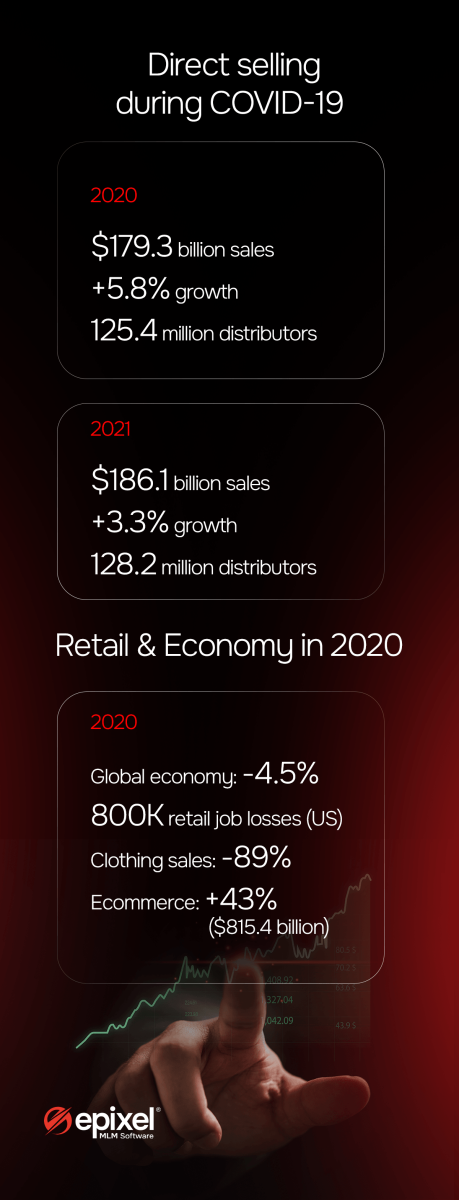
The direct selling industry was put to a real stress test during the pandemic, the most difficult in its history. The results are clear and validated by the DSAs, WFDSA, and Statista. In the first year of pandemic impact, 2020, direct selling industry saw its sales reach $179.3 billion. This was during a time when the global economy contracted by approximately 4.5% but direct selling industry showcased a 5.8% year-over-year growth (excluding China). In the following year, sales hit $186.1 billion with a global year-over-year sales increase of 3.3% (excluding China).
The global direct selling salesforce also grew by 4.3% to 125.4 million independent representatives in 2020 and 128.2 million in 2021. The US direct selling industry also recorded $42.7 billion in 2021 with 44.6 million preferred customers and discount buyers. CAGR during the three-year pandemic period, i.e. 2019-2021, was 3.8%.
The traditional retail scene in the US along the same period was a bit complex with 800,000 job cuts in 2020. The sales in clothing scores fell by 89%, and department stores faced a 45% decline in the initial pandemic months. Among these falls was a rise, the US retail ecommerce grew 43% to $815.4 billion in 2020, a smart opportunity seized by many direct selling companies.
After a rise in retail sales, it normalized after 2021 settling at $167.6 billion in 2023 and $163.9 billion in 2024. The WFDSA termed this as an “inflection point” for the direct selling industry which is heading toward a growth rebound in 2025. 45% of global direct selling markets improved, and the representative numbers also increased slightly, marking 104.3 million. About 21 markets posted one billion or more in annual sales. This is considered a consistent growth phase as the industry enters the next crisis.
The Middle East conflict and the resultant energy crisis have impacted supply chain, inflation, consumer confidence, and employment anxiety. The crisis backdrop is somewhat similar to the 1973 oil embargo and for direct selling this creates risks and opportunities.
Product supply: The disruption in supply chain is affecting product delivery and manufacturing. International passage closures have made sourcing of ingredients difficult through affected corridors.
Consumer spending: Consumers have become wary of spending amid income uncertainty and inflationary pressures.
Distributor confidence: Distributors are concerned about facing objections without having a clear explanation to the rise in product prices and company status.
Currency risk: Currency have been volatile since the conflict affected the international markets, especially the ones that are directly affected by the rise in oil import costs. This includes the Asia Pacific markets that source 80-90% of energy through Strait of Hormuz.
Recruitment increase: The income uncertainty increases distributor recruitment with people looking for an additional income. As per regional DSA reports, whenever there was a rise in unemployment rate there had been an increase in new business inquiries.
Relationship building: Consumers prefer trust-based sales relationships and authentic recommendations during uncertain times.
Wellness demand: Wellness is a leading product category in direct selling with 36.2% of global direct selling sales in 2023. When uncertainty strikes, people become health conscious to manage stress and protect their overall well-being.
Digital infrastructure: The digital capabilities acquired during COVID-19 need to be revved up to break the geographical barriers in training, team building, and protecting the business against localized physical disruption.
Competitive opportunity: Financially strong and resilient companies have opportunities to acquire weaker competitors who are struggling and create opportunities for market share growth.
The major contributors for the success of a direct selling business are C-level executives, Chief Sales Officers, senior field leaders, senior distributors, and business leaders. Each role makes its own contributions and hence needs to shoulder unique responsibilities during a crisis. Collectively, they can support the survival of the organization.
The first 90 days decide the future direction of the business for the next 24 months. This makes it crucial for C-level leaders to design the right strategies and make smarter decisions.
C-level executives must convene a team for crisis management with members from all operational teams such as operations, finance, supply chain, sales, and communications. This team should meet daily for the first two weeks and after that weekly. A full assessment of crisis exposure should be done to identify risks in the supply chain, check which regions have more distributors, which products are more vulnerable, and evaluate your financial strength. The findings should be shared with your board and apply the 72-hour rule.
A stress-test of your financial position is essential with a modeling of revenue scenarios at 80%, 60%, and 40% of current run rate. Identify break-even points and cash runway for each modeled scenario.
Activate supplier diversification protocols for all single supplier dependencies and add at least one alternative supplier for your top 10 products. Distributor support has to be strategized with improved training, talking points, online selling tools, and special recognition program for top performing distributors during the crisis.
Analyze all regional markets to identify the ones with strong recruitment opportunities. Designate a team and additional network development resources for those markets. Evaluate products to identify the ones that have a strong potential during crisis and the ones that are facing challenges.
M&A, distribution, or partnership opportunities should be identified because good acquisition opportunities appear during peak uncertainty. Stay closely connected to your distributor networks with reliable and transparent updates. This improves retention rates. Keep investing and planning in digital infrastructure because the value doubles when the market recovers.
During a crisis, CSOs take the role of information manager, morale architect, and performance coach because all distributors look up to how they show up and what they say to guess the business’ condition. Distributor retention, itself, becomes a competitive factor because distributors are confident about companies that communicate more frequently and clearly during times of crisis.
Communication frequency needs to be increased immediately. Even daily briefs contribute a lot to the emotional support of distributors. Top 500 field leaders must be given talking points for addressing three questions:

Is this the right time to start a business?
Can I afford the startup investment?
Will your products still be available?
Identify and celebrate your crisis champions who are trying hard to grow their business in the current crisis environment. Their success stories can be your most powerful recruitment and retention tool. Host virtual community events specific to the current crisis that cover product education, business training, and community connection. Social isolation during crisis periods creates a demand for community that direct selling companies are good at providing.
The crisis will reveal who the real, long-term leaders are and who participate in short-term gains. Distributors who stayed active during the crisis came out stronger 12-18 months later with larger organizations and distributors who waited for the situation to get better ended up losing momentum and had to rebuild from scratch once the situation reversed.
Increase your personal prospecting activity because recruitment opportunities increase during an economic crisis. Today, more people are more worried about losing income and flexibility during disruption than in the past three years.
Increase communication frequency with your team members because downlines need reassurance and support from you during this challenging time. If you stay active and engaged, they will have the confidence to perform and if you fall silent, they will fear the challenges.
Work on your skills and learn new tools, strategies, and systems that you were planning to master. Skill investments that will give you the highest ROI are digital selling, social commerce, and video prospecting.
Document your crisis leadership success stories and strategies because those will become your most powerful recruitment content for the next five years.
Explain the counter cyclical nature of the direct selling industry and give an honest update on the current situation to your top 20 distributors.
Advanced technology and strong digital infrastructures can cushion a direct selling business from risks and disruptions during a crisis. Companies must incorporate digital and technology needs as a part of their crisis strategy for the same reason.
The COVID-19 pandemic brought permanent changes to the direct selling model. Home parties and face-to-face events went virtual, door-to-door calls changed to social commerce and AI-powered CRM tools totally changed routine distributor activities of lead generation and prospecting. Companies that already had a digital infrastructure before pandemic were less affected. The 2026 crisis creates a similar pressure but in a slightly different way. Energy cost inflation and geopolitical uncertainty tightened travel and physical event budgets. But, this also created demand for community connection and income opportunities. Digital delivery solves both problems together.

Most sales professionals depend on social selling tools to attract and convert prospects. Businesses also need personalization tools that can tailor brand approaches for customers and distributors as it helps improve conversions and average order value. When the disruption hits, distributors will have to work remotely and virtual event technology-powered platforms can connect field leaders with teams and distributors with their prospects. Mobile-optimized platforms can help your network stay connected with your brand through push notifications, in-app messaging, and short-form video content which is highly preferred among younger generations.
Artificial Intelligence is enhancing the capabilities for direct selling companies in three areas for navigating crises.
Predictive supply chain monitoring with AI systems can analyze supplier data, shipping route disruption patterns, and commodity price changes to provide advance warning of supply disruptions by four to six weeks.
Machine learning models can analyze distributor activity and identify distributors who are at a higher risk of attrition. Companies can thus formulate reengagement strategies to reduce retention rates.
Personalization AI can provide product recommendations by matching past customer purchase histories with relevant product categories and promotions. This can bring improvements in customer lifetime value and distributor engagement.
Board members, C-level Executives, and top leaders must know what should be conveyed, when, and how during a crisis to support customers and network members. This brand communication also defines the stability of the brand to markets and competitors. When communication fails during a crisis, growth declines and attrition rates increase. When corporates fail to address their situation to the general public, it gives rise to rumors and assumptions.
Board members and investors must meet weekly when the disruption is high and convey the financial and supply chain status through executive brief and data dashboard. Scenario planning and actions to mitigate risks and disruptions should also be on their agenda.
Senior Field Leaders can meet once in two weeks with weekly written updates and talking point document through live video call. They must discuss and decide on messages to be sent regarding company stability, supply chain assurance, compensation plan, and recruitment.
Uplines and leaders must meet with their downline teams every week or on a daily basis with standup meetings. Messages to be communicated on product availability, company position, historical resilience data, and success stories can be sent through push notifications, short videos, and FAQ documents.
Customer communication should be activated as needed, but supply updates should be done in real time. Messages about products, value proposition, and the relevance of health and wellness can be conveyed through email, social media platforms, or directly by a distributor.
Customers are confused during a crisis and the most important question almost all of your distributors will face is “Is this really the right time to get into this?”
Your distributors must have the right answer to this. Every major crises since the 1970s have hurt traditional employment, but direct selling remained consistent. For example, the industry grew 5.8% during COVID-19 and through the 2008 financial crisis the industry continued growing even with high unemployment. During the Gulf War recession, expansion still happened.
Distributors have a strong point with this industry context and they must make prospects understand that crises don’t weaken direct selling, it increases participation even through adversities. Individuals should not wait until things get worse to start looking for new income opportunities. They must do it now.
After every crisis disruption, the industry has experienced a recovery phase. In the initial days of a crisis, sales might have declined and retention could have been a tiring challenge but companies who stayed active with strategic investments has bounced back on the growth phase without much delay. The COVID-19 data stands as a testament to this with the US market alone generating $35 billion in 2019 to $42.7 billion in 2021. This is not a normal bounce but a major leap in market position.
Analyzing the past WFDSA data, we see the leaders clearly with outstanding crisis recovery patterns.
The strong direct selling markets in the US, Mexico, and Brazil that showed highest growth rates in 2024 will retain America in top markets’ list.
The region holds 40.3% of global direct selling retail sales according to WFDSA 2024 data. Asia Pacific was affected by the current energy cost exposure but its large population, strong relationship selling culture, and emerging market income growth makes it a medium-term recovery booster.
Emerging direct selling markets like India, Colombia, and Malaysia, showed sales increases in 2024. This will continue with the current income opportunity demand and relationship-based commerce culture.
The wellness and nutrition category represents over 36% of global direct selling revenue and is expected to grow its share as health consciousness intensifies amid the geopolitical stress conditions.
Crises have seen so many capable professionals losing jobs, and the ones who entered direct selling have become the next generation of leaders. The current crisis is creating this group in real time.
Direct selling companies and senior distributors who are contributing to the making of this cohort with authentic content, professional onboarding, and leadership development will create a strong network of highly skilled capable individuals who will accelerate organizational growth in the coming years. The leaders thus recruited during the crisis with proper support tools to succeed become the most loyal and productive members of the organization.
The 2026 Middle East crisis is not like any other disruption. It will separate reactive organizations from strategically prepared ones and reinstate the principles of direct selling such as low entry barrier, flexibility, relationship-driven trust, and digital adaptability into growth opportunities. Digital capability of companies will be another deciding factor on speed and resilience to recovery.
Companies must recognize the advantages that the crisis brings and operationalize them to achieve stable, structured growth.
Epixel MLM Software anchored 450+ network marketing companies to success through their business process automation in more than 88 countries. Let Epixel MLM Platform revolutionize your MLM business with 100+ proven features intelligently tuned for small, medium, and large enterprises.
Try our Ultra-modern
Direct Sales Mobile App!!!
Take your business with you. Anytime. Anywhere.


Epixel Enterprises LLC.
300 Delaware Ave STE 210 286,
Wilmington, DE 19801
United States Of America
Solutions
Products
Resources
Get in touch
Epixel Enterprises LLC.
300 Delaware Ave STE 210 286,
Wilmington, DE 19801
United States Of America
 United States+1 650 491 9744



 Canada+1 437 2208998
 Mexico+52 13322545528
 Hong Kong+852 5616 7921