















English
- English
- Español

- 简体中文

- Français

- Deutsch

- Italiano

- 日本語

- 한국어

- Portuguese, International



Building responsible AI systems for sustainable growth in direct selling and MLM

Artificial Intelligence has created myriad possibilities for businesses to expand and grow. In direct selling, it has redefined core processes, from onboarding to order delivery. The feature and experience enhancements it brings benefits businesses with improved customer satisfaction and a stronger network. But there are hidden risks, that when uncontrolled can threaten a business’ existence.
The threat is not the technology alone. It is the way it is used and managed. Especially for an industry such as direct selling with globally scattered networks and customer bases, this threat is real.
The US direct selling industry is one of the largest direct selling markets which generated $34.7 billion in retail sales in 2024 with about 5.4 million active sellers. Even among the actively recruiting markets, two forces are colliding that will determine the survival of companies and senior distributors in the next five years.
The first force is AI adoption. Businesses across industries are employing AI to improve efficiency and productivity and with this the AI-powered MLM market was valued at $4.80 billion in 2025 and is expected to reach $128.31 billion by 2035 which is at a CAGR of 32.2%. Companies who have adopted AI are already reporting around 40% increase in distributor retention, 30% higher conversion rates from personalized AI recommendations, and a 70% reduction in manual prospecting tasks. AI has become the main operating component of the direct selling industry.
The second force is regulatory and trust pressure. In April 2024, the FTC published an updated guidance on MLM business practices and in the following September, it released a staff report after analyzing about 70 income disclosure statements and finding that most participants earned less than $1000 a year. In January 2025, the FTC mandated a written substantiation for every earning claim made by the company or its distributor. The regulatory scrutiny is not new to industry. In one way it helps curb malpractices, but it also puts legitimate MLM businesses under a distressing situation.
This white paper explains the solution for both the forces and that is, governed AI framework. Companies that use AI should make the processes human-centered with transparency and auditability, a top priority. Companies can adopt AI with confidence and satisfy regulators without friction when governed properly. Companies that are negligent will face model failures, compliance exposure, and field-level resistance to every data-driven recommendation they try to make.
Designing and developing an AI governance model for a direct selling business require a clear understanding of the current market condition because the current stats carry an important weightage to consider which most experts leave out.
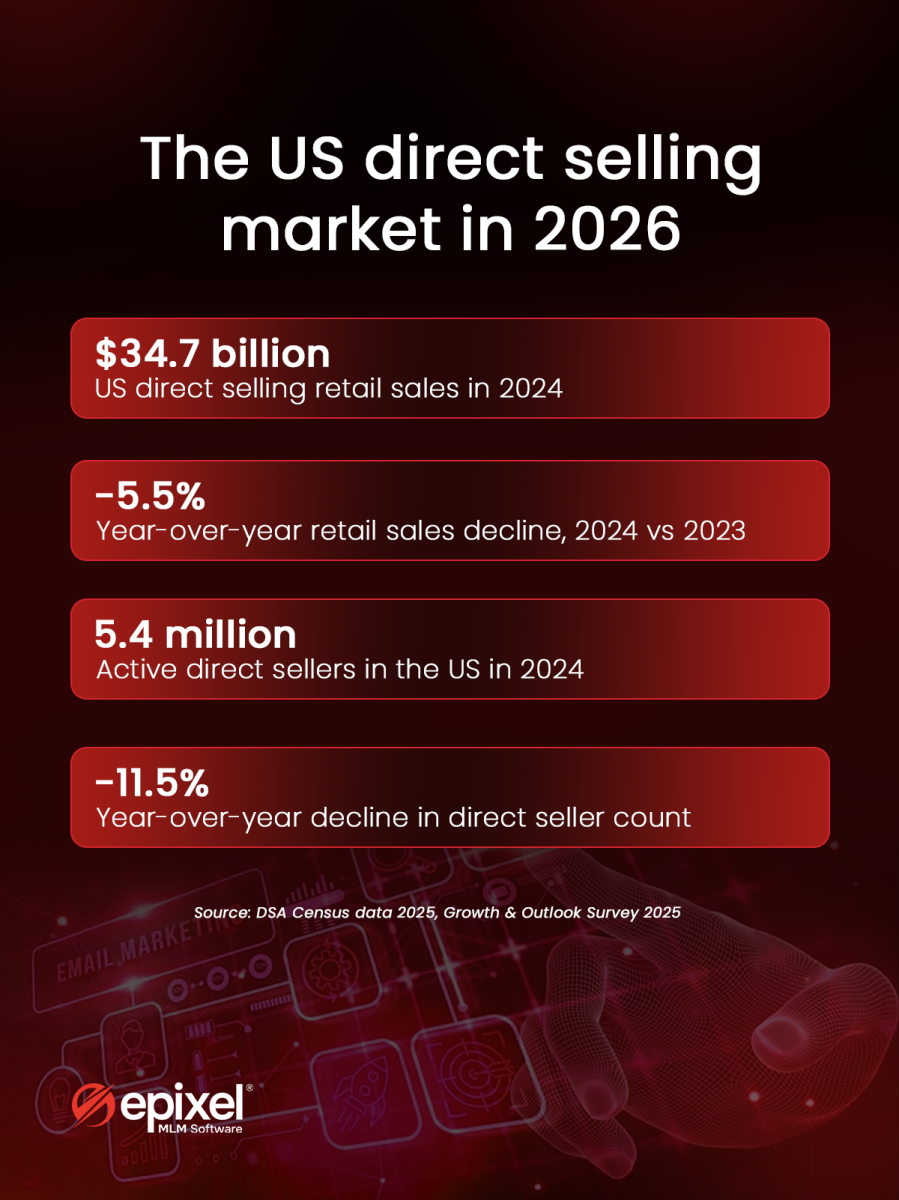
The market shrank both in terms of revenue and direct seller population, but it still remains dominant, with Germany in a distant second place at $19.8 billion. Wellness still leads product categories with 32.5% share and services sector grew faster to generate 14% of total retail revenue. The demographics trend in the country is also interesting with Millennials and Generation X constituting 46% of the seller population. Nine US states including New York, California, Texas, and Florida generated over $1 billion in retail sales. The potential of the US market is real, what it needs is a professional-grade management.
The period of undisciplined growth caused by the pandemic-era buying behavior has ended. The industry must steer itself toward growth now. In such a situation, direct selling leaders need AI intelligence than behavioral momentum because advanced analytics can reveal where distributor churn is building, where customer acquisition cost is rising, and where the best growth opportunities are hiding before your competitor sees it. AI can easily build this infrastructure for you but it must be built responsibly.
Early adopters of AI have already started seeing the results. 47% of direct selling companies were already experimenting on AI for lead prioritization as per a 2024 report from Statista. Even among sales professionals, AI usage nearly doubled in a year, from 24% in 2023 to 43% in 2024 (HubSpot's State of AI in Sales survey). Another research by Gartner shows that sellers who effectively uses AI are 3.7 times more likely to meet their quota.
The already reported outcomes of AI adoption in the MLM market, that is, higher retention rates and conversions, are not just vendor claims. They are real results as depicted in various independent studies on AI deployment outcomes.
So, AI has to be adopted but how controlled, defensible, and explainable has to be determined by companies.
Regulatory considerations are an integral part of all business strategies in the US, and AI is no exception. The FTC’s stance in 2024 and 2025 has created an even stricter environment for direct selling business in the US. The updated Business Guidance states that general disclaimers are not sufficient, they must be replaced by what a participant earns actually including expenses. The income disclosure statement analysis also revealed outliers obscuring the real participants’ earnings. FTC has made income claims with evidence mandatory and available to consumers on request.
If your AI models generate distributor income projections, forecast high-earning potential, rank distributors by predicted future earnings, or inform any communication about income opportunity, those results are subjected to the same FTC scrutiny as any other earnings representation.
Using an AI model does not shield a business from liability for a claim, it is the system that generates the claim, and responsibility still rests with the business.
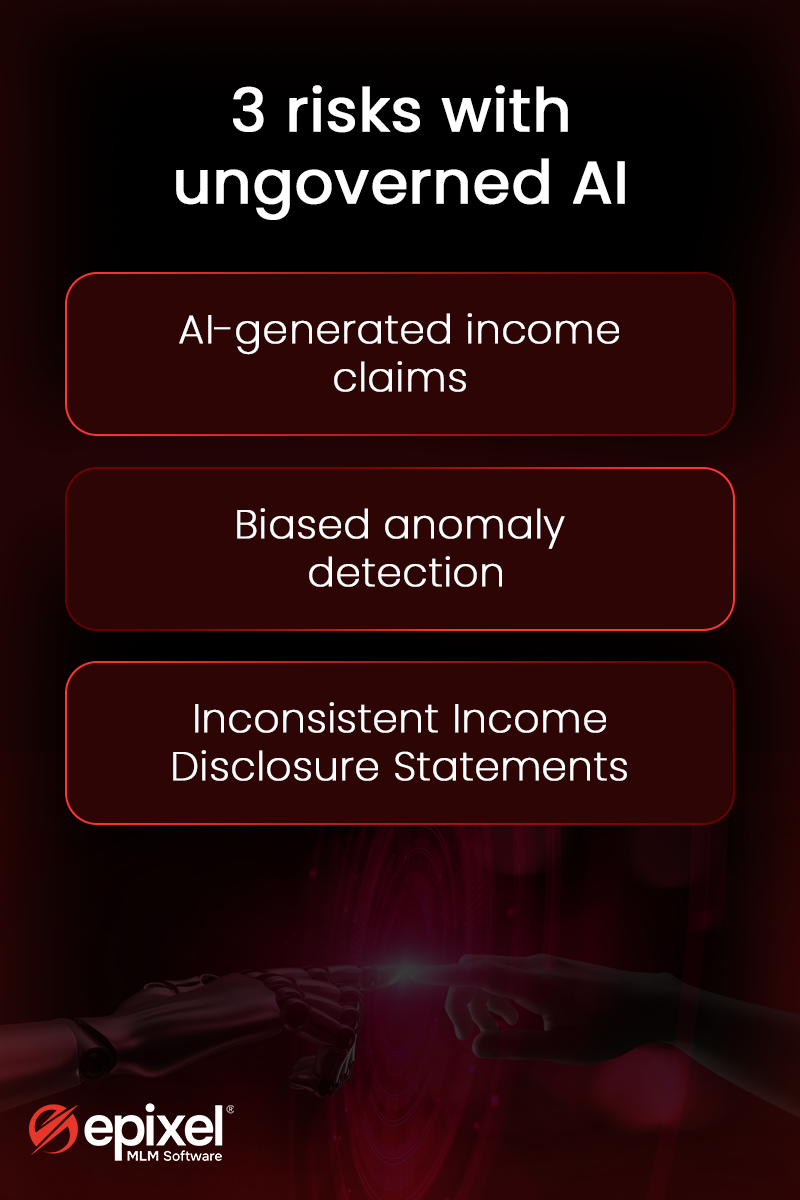
In other industries, when AI makes a mistake, the damage is clear and seen as approving a wrong loan or missing a medical issue. But in direct selling, it affects relationships, trust, and distributor confidence. Unfair payouts, wrong performance assessment, or erroneous rank calculations can create trust issues among the network. This makes it impossible for systems to detect and mitigate.
Every wrong decision made has a ripple effect as it spreads faster across the distributor community. When a model makes a wrong decision about a distributor’s lead allocation, rank status, or payout eligibility, the distributor tells their upline, downline, and their entire social network. If an AI system in lead generation allocates best prospects to already successful distributors, other performing distributors lose trust in the system. It damages engagement, increases attrition rates, and causes resistance from distributors for every future analytics initiative.
Exactly for this reason, a fairness monitoring system or a Commission Fairness Index Calculator becomes critical for AI-powered MLM businesses.
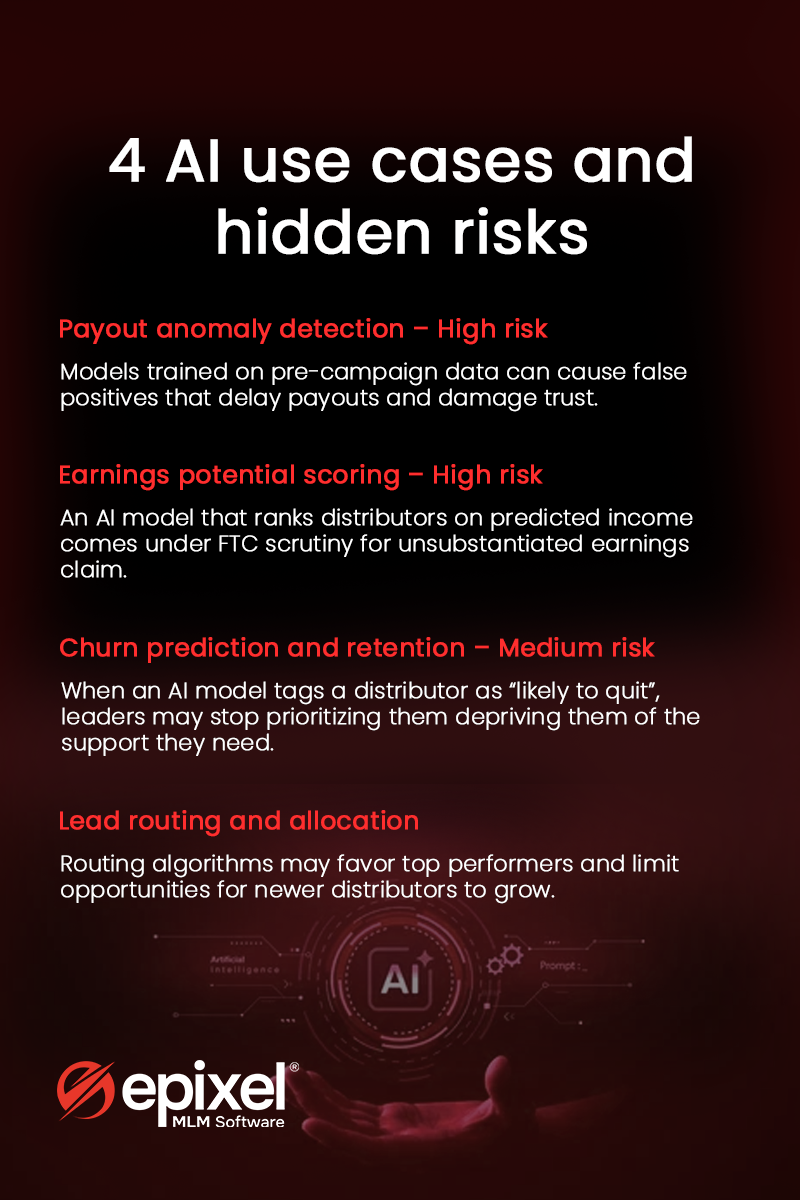
Direct selling businesses are highly sensitive to behavioral changes. Distributor behavior changes with change in compensation plans, incentive campaigns, social commerce trends, and economic pressures. AI models are trained to recognize and adapt to these trends but a model built in Q1 may go wrong by Q3 without anyone noticing because the system is still predicting outcomes based on Q1 inputs.
The silent failure of AI models in direct selling happens when it does not reflect the buying behaviors of people today. When a plan changes, the model may consider new and normal behavior as a warning sign, or a rank prediction model may apply irrelevant assumptions to new distributor cohorts after expansion. The model won’t crash but it is silently making wrong decisions.
In order to counter the problem, we do not need a complex AI system but continuous monitoring of the existing system to keep a check on whether the model is delivering relevant outcomes that match today’s reality. After every major business change, the performance of the system must be closely monitored with a control to pause or retrain the model whenever needed.
Building a governed AI model is embracing a set of operational practices that determine how

Data is classified.
How the organization checks and approves AI models before using them.
How outputs are monitored.
How the organization respond when something goes wrong.
Let us analyze how this looks in direct selling practice.
Distributor data varies by cohort and performance, and each carries a different level of risk. A distributor’s login frequency is low risk data and payout eligibility is high-risk because it directly affects income. If the MLM analytics model applies the same rules, checks, and controls to both, it’s a mistake. Data in the high-risk category needs stricter validation and monitoring. Here’s a data classification framework by risk level.
| Category | Examples | Governance standard |
|---|---|---|
| PII | Name, SSN, bank details, tax ID, identity documents | Strict — Access controlled with full audit logging |
| Sensitive Business | Earnings, rank status, compliance flags, KYC outcomes, disciplinary notes | High — Approval gates, access by role only, retention limits |
| Operational Behavioral | Login frequency, training completion, app activity, event attendance | Medium — Aggregation preferred; individual tracking must be documented. |
| Financial Transaction | Commissions, bonuses, refunds, chargebacks, wallet balances | High — Payout-linked decisions require human review. Model outputs are not final. |
| Customer-Linked | Purchase history, product browsing, returns, support tickets | Medium-High — Consent-based on usage; aggregated use preferred for model training |
Every AI model uses inputs called features to make predictions. Direct selling companies think that with more data they can build a better AI model. But the reality is that a model can be accurate but still can use wrong or inappropriate data. Data that enters an AI model must be classified into four categories:
A model card is a short business document that help executives understand the functioning of an AI model including the type of data it uses, the dos and don’ts, the approval and monitoring process, and how it can be controlled.
Important sections that should be included in a model card and visible to all executives of a US direct selling company are:
The business decision it supports.
The impact if it goes wrong.
The approval chain.
The monitoring plan.
The control AI can have over a direct selling business must be pre-determined because it is not wise to automate all decisions. Decisions with low impact like product recommendations can be automated, but those with higher business impact like payout or rank must be in human control. AI can assist in the decision making process but giving full control can affect fairness and this can break trust quickly.
Below is a decision framework direct selling companies can use to build a governed AI network.
| Decision type | Automation level | Required human role |
|---|---|---|
| Product recommendation | Automated with opt-out | Periodic review of recommendation patterns to ensure fairness |
| Training priority | Advisory — Manager reviews output | Field manager reviews and applies judgment before action |
| Churn risk alert | Advisory — Recommendation only, needs human oversight | Regional or field lead reviews distributor context before outreach |
| Payout anomaly flag | Triggers review — Does not pause payment automatically | Finance and compliance team reviews with full audit trail before action |
| Rank eligibility determination | Rules-based calculation only — No ML without explicit policy | Full human review for exceptions; audit-ready documentation required |
| Lead routing allocation | Partially automated with fairness review cycle | Quarterly fairness audit to detect allocation concentration |
Direct selling companies have extensive data on distributors including login activity, training status, event attendance, browsing behavior, recruitment, and attrition. This data is valuable for decision making but using it without discipline can bring serious problems. AI analytics in direct selling must be based on using the least data to make fair and reliable decisions.
Using only the necessary data helps a direct selling business in several ways. It reduces the impact of a data breach or unauthorized access. Lesser data makes compliance easy with fewer regulations and easier data handling. When data volume is low, systems are easier to build, monitor, and maintain and justification to distributors also becomes easier.
FTC guidelines do not mention “data minimization” as such but they expect company decisions about distributors to be based on accurate and defensible data. When companies minimize the usage of data, it automatically reduces risk, improves clarity, and builds trust along with compliance.
Data cannot be stored forever just because a company has the infrastructure to retain. Data retention should depend on the risk level of each decision; longer for high-risk data and shorter for low-risk data. Direct selling companies in the US must build a data retention framework like the one below.
| Retention period | Data type | Description |
|---|---|---|
| 90 days | Operational prediction logs (e.g., product recommendations, training suggestions) | Low-impact personalization data |
| 12 months | Churn prediction outcomes, retention model performance, backtesting data | Used for validating the model and tracking performance |
| 3 years or longer | Payout anomaly decisions, rank dispute records, compliance flag history | High-impact decisions; required for audits, disputes, and legal defense |
| Indefinite | Model cards, governance documentation, approval records | Treated as evidence for audits and not operational data |
| Active deletion | Training datasets of retired models, outdated personal data features | Must be deleted when no longer needed or when models are taken out of use |
Data deletion and retention cannot follow a policy. It should be built into the workflow else even if a company claims the deletion of data, it can still exist in different locations such as vendor systems or downloaded spreadsheets.
In most companies, AI approval is a formal process where data team presents a model, business users like the outputs, and the model gets implemented. Later when the legal and compliance teams discover that the model has been influencing sensitive decisions without documentation or human review, issues would have started cropping up.
The seven questions create an approval checkpoint that decides the authority of the model in making business decisions.
1. Does the business decision taken by the model affect a distributor’s rank, money, or access?
If the answer is yes, then a stronger approval process should be in place along with human review and proper documentation.
2. What is the worst outcome that the company would have to face if the model is wrong for 90 days before anyone notices?
This again depends on the risk level. If a product recommendation model goes wrong for 90 days, it affects conversion rates but if it’s a payout anomaly model, it could incorrectly flag and delay distributor earnings across the network which brings trust and legal consequences.
3. Is the model advisory or automatic, and is it right for the specific decision type?
Automation may not always work, hence for high-risk decisions human review is more effective, fair, and acceptable by distributors. If we are looking at the costs, wrong decisions through automation can cause more damage than the cost involved in human review
4. Can a senior leader, distributor, or a compliance officer easily understand why the model made a specific recommendation?
A complex model cannot work well for distributor-facing decisions because in direct selling explanations must be simple and clear for users to understand.
5. Do any of the outputs from the model come under income, earnings, or recruitment claim?
FTC guidelines require all MLM companies to make claims that have concrete evidence. So, even if an AI model indirectly makes a claim, the company must have a substantiation or a different model design.
6. Who is in control of the model and do they know it?
Every AI model in direct selling needs an owner with an authority to control the model. During times of emergency, if you do not know who is in control, the model can become a risk.
7. Can we regenerate any output from this model after six months with the same data and model version?
A prediction questioned by a distributor after six months still should have a valid explanation on how the model predicted it. If not, you cannot defend the decision.
Building a governance architecture for your AI model is about creating a disciplined system where every step is documented and monitored. Direct selling companies with a strategic 90-day plan can implement this without many complexities.
Start by inventorying all active models currently in use, scoring systems, and automated workflows, and then classify all data used in analytics based on its sensitivity levels. As a next step, identify the business decisions that are dependent on AI and the top 3 models with highest risk by impact and automation level. Review and record who has the authority to access sensitive data and pause the model during emergencies.
Create model cards for the top three high-impact models and design approval process for each. Set monitoring rules and regular checks to detect when they start giving wrong or unusual results. Assign owners who shoulder responsibility for each model. Define the type of data each model uses and whether it is appropriate for the purpose. Most importantly, ensure that the recommendations and insights provided by the model do not imply income or earnings claims that could cause regulatory issues.
All model requests should be launched with an AI release checklist. Keep ready an incident response protocol with persons authorized to handle the event. Create an audit evidence folder for each high impact model. Develop a governance dashboard for executives to track model performance. Train product, data, compliance, and distributor teams on the model and its functions.
After 90 days of completing the model, proper monitoring has to be set up because our goal is to create a disciplined system where decisions are reliable and accurate. Documentation, monitoring, and approval will be your no-compromise workflows because strict management of AI models decides the sustainability of your business.
A governed AI system is equally important for a direct selling business as understanding its impact on senior distributors and field leaders, who put AI-driven insights into practice. They therefore have the right to understand how these models work.
A direct selling company using AI analytics uses distributor data such as sales patterns, recruitment activity, training engagement, and purchase history. These are features that are fed into the AI system to influence decisions on what resources they receive, how their team's performance is scored, whether their payout patterns trigger review, and possibly how their rank advancement potential is assessed.
A senior distributor can question the company’s AI models that influence lead allocation, payout review, or rank eligibility. They have the right to understand how they function, especially when it impacts their progress and earnings. Distributors must understand how AI will influence their growth in the company before they commit themselves to the brand. Companies with strong AI governance will give clear answers.
Top leaders recruit more people into the network and the well-informed recruits ask harder questions. They want to ensure that the compensation plan is fair, income claims are evidence-backed, and the company operates within a strict compliance environment. A leader representing a company with proper AI governance can easily explain how its analytics work and how decisions are taken. This enhances trust and confidence in the opportunity.
If we divide governance maturity progression by 4 stages, most direct selling companies sit at stages 1 or 2. The strategic goal, however, should be stage 3 by the end of 2026 and stage 4 by the end of 2027.
| Stage | What it looks like | Core risk | Target timeline |
|---|---|---|---|
| Stage 1 — Informal Analytics | Analytics depends on dashboards, spreadsheets, and ad-hoc models, with less documentation. Data is frequently exported and access controls are inconsistent. | No visibility into what decisions AI is influencing or how. | Exit within 30 days |
| Stage 2 — Controlled Analytics | Data classification has begun, access is reviewed, and key dashboards are documented. Some sensitive use cases are identified and flagged for review. | Governance exists on paper but depends on individual discipline, not systems. | Current floor; 60-day improvement target |
| Stage 3 — Governed AI Operations | Model cards, lineage maps, approval gates, monitoring dashboards, incident response protocols, and audit logs are fully implemented and operational. | Adoption may lag initially, as teams adjust to structured governance even with improved visibility and control. | Target by Q4 2026 |
| Stage 4 — Trust-by-Design Analytics | Governance is embedded into the platform, with every high-impact model including built-in lineage, monitoring, explainability, and audit-ready documentation. | Competitive advantage established. The challenge is to maintain consistent governance as complexity increases. | Target by Q4 2027 |
Governance does not slow AI adoption. In fact, it makes the process faster because executives are confident in approving processes without caution. When the AI infrastructure can catch problems efficiently, companies can experiment confidently. It’s just that proper governance framework needs a solid strategy and investment to build.
AI governance in direct selling is a collective responsibility. Individual teams only see a specific part of the problem like IT team may focus on systems and technology but may not understand how the decisions impact distributor relationships. The case will not be any different if it is individually managed by compliance or data team. Compliance team may only concentrate on reacting to the risks instead of building solutions and data team may prioritize model accuracy without considering fairness, trust, or legal defensibility. Only when the teams work together, the whole system becomes accurate, reliable, and fair.
| Role | Key Governance Responsibilities |
|---|---|
| CEO / Executive Sponsor | Defines organizational risk tolerance level and approves high-impact AI decisions. They also provide escalation authority and reviews governance performance metrics. |
| CTO / CIO | Oversees platform security, data infrastructure, access controls, system architecture, and vendor risk management for analytics platforms. |
| Chief Compliance Officer | Reviews AI outputs for compliance risk and ensures FTC alignment. Oversees audit readiness and verifies income claims for evidence. |
| General Counsel | Manages privacy compliance, reviews legal and contractual risks, evaluates claims exposure, and monitors evolving AI-related regulations. |
| Chief Financial Officer | Oversees payout and commission analytics, reviews financial model risks, and monitors anomaly detection processes. |
| VP Field Operations | Evaluates the impact of AI decisions on distributors, reviews fairness in lead routing and distributor training systems, and develops field-level adoption strategies. |
| Data / Analytics Lead | Maintains model documentation, monitors model performance and deviations, governs feature usage, and manages model retirement processes. |
Companies must understand that even a slight model change can impact decisions which can strain relationships and trust. Clarity is important and hence ownership and documentation become two core aspects of building a governed AI network.
The US direct selling industry is experiencing sales and seller count declines along with increasing regulatory scrutiny but this does not mean that the industry is failing. It is maturing and to rise during the process, it needs to be more disciplined. AI analytics has helped the industry improve its conversion and retention rates, and it will continue to do so but with a governed and explainable model. Proper governance removes risks and fear of adoption making the channel more efficient and ready for growth. A governed AI model will provide direct selling companies with the power to satisfy regulators, earn distributor trust, and survive market changes even when the tides are rough.
Epixel MLM Software anchored 450+ network marketing companies to success through their business process automation in more than 88 countries. Let Epixel MLM Platform revolutionize your MLM business with 100+ proven features intelligently tuned for small, medium, and large enterprises.
Try our Ultra-modern
Direct Sales Mobile App!!!
Take your business with you. Anytime. Anywhere.


Epixel Enterprises LLC.
300 Delaware Ave STE 210 286,
Wilmington, DE 19801
United States Of America
Solutions
Products
Resources
Get in touch
Epixel Enterprises LLC.
300 Delaware Ave STE 210 286,
Wilmington, DE 19801
United States Of America
 United States+1 650 491 9744



 Canada+1 437 2208998
 Mexico+52 13322545528
 Hong Kong+852 5616 7921