















Download Free Payments, E-Wallet and KYC Vendor Selection Matrix
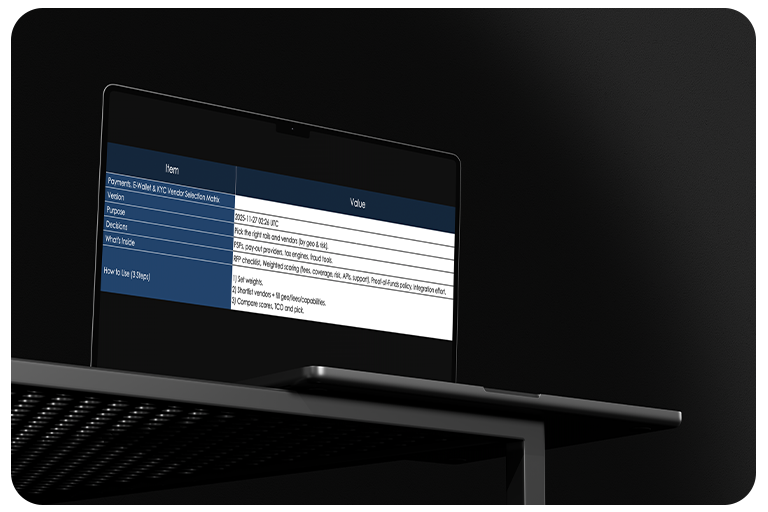
Finding a suitable vendor and setting up payment channels for multiple countries can turn cumbersome due to various reasons. The total cost of ownership varies from vendor to vendor. There will be uncertainty about whether a particular vendor operates in a specific country and the company will be unsure whether the technical team is on board with the proposal. As a practical and ready-made solution to such complications, this template provides a single weighted score, prepares a request for proposal checklist, and calculates the total cost of ownership. It studies which payment providers, wallets, and KYC vendors work in different countries.
The pre-filled sample data in the template helps shortlist potential providers, compare each country based on the same criteria, and align compliance requirements. Since it's a flexible template with an organized structure, it works well in both Excel and Google sheets.
Learn about different vendors suitable for a country, compare various payment providers, and get a final single weighted score using this template.
*No email required.
Get to know the functions of each component of the template
| Tab | Purpose |
|---|---|
| README | Gives a quick overview of what the workbook does. Explains the scope and shows a simple 3-step guide so anyone can use it correctly. Helps teams understand the workflow before diving in. |
| Criteria & Weights | Lets you assign importance to each decision factor like fees, coverage, APIs, and compliance. The weights add up to 1.0 so the scoring stays balanced. This ensures the final ranking reflects what your business values most. |
| Vendor Universe | Provides a ready-made list of PSPs, payout providers, KYC vendors, and fraud tools. Saves time by giving you a strong starting point for your vendor search. Helps you avoid missing major players in the market. |
| Fee Schedule | Shows all vendors side-by-side with MDR, cross-border fees, FX markups, payout fees, and chargebacks. Makes it easy to compare cost structures quickly. Also shows settlement timelines so finance can plan cash flow. |
| Capability Scores | Rates each vendor from 1–5 on coverage, compliance, APIs, speed, support, and proof-of-funds fit. Gives a simple, comparable view of strengths and weaknesses. Helps you shortlist vendors faster. |
| Geo Fit Matrix | Shows which vendors support each country, APM, and payout rail with a clear Yes/No. Helps you see coverage gaps instantly. Perfect for deciding who can handle your top 10+ target markets. |
| RFP Checklist | Lists 30 requirements across payments, compliance, fraud, and legal. Helps you track Must/Should/Could items like tokenization, webhooks, marketplace splits, and DPA/SCCs. Ensures your RFP is complete and audit-friendly. |
| Integration Effort | Estimates developer and QA effort needed to integrate each vendor. Evaluates documentation quality, SDKs, and webhook readiness. Helps Engineering understand the lift before committing. |
| Risk & Compliance | Summarizes each vendor’s KYC tiers, sanctions sources, fraud tools, PCI level, and GDPR options. Helps you understand regulatory fit quickly. Ensures compliance teams have what they need from day one. |
| Weighted Scoring | Combines vendor scores with your weights to create a final normalized score. Automatically ranks vendors based on what matters to you most. Makes shortlisting objective and defensible. |
| Proof-of-Funds Policy | Provides an editable policy for reserves, early payouts, dispute holds, and instant payout limits. Helps you set clear internal rules for fund availability. Ensures decisions stay consistent and risk-aligned. |
| TCO Model | Calculates expected monthly cost by combining MDR, FX, payout fees, and chargebacks. Lets you input your transaction volumes and mix. Helps finance compare true total cost across vendors. |
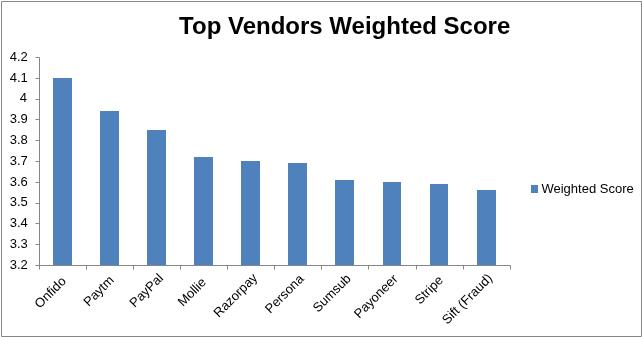
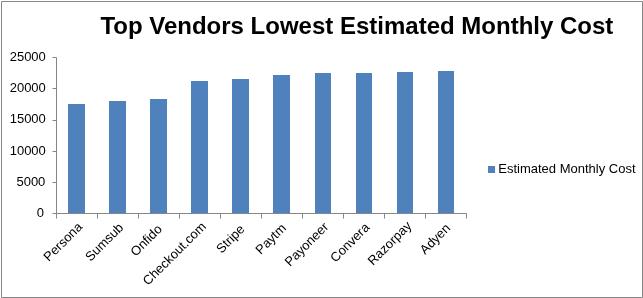
| Dashboard | Gives visual charts for top vendors by weighted score and lowest estimated monthly cost. Makes executive reviews quick and data-driven. Helps leadership make confident final decisions. |
Who will benefit most by using this practical template?
C-suite and Founders: Executive level officials who want to compare countries, assess risk profiles before raising a proposal to a vendor. This template helps them foresee potential frauds, high chargebacks, and countries with stricter regulatory frameworks. This helps them decide which vendor would be suitable for a region.
Finance (CFO or Controller): Finance teams can calculate the full cost of using a vendor, the amount the vendor will withhold to protect against fraud, and how fast the cash goes in and out.
Risk or Compliance and Legal: The risk or compliance and legal teams adopt various methods to protect the company from fraud, ensure the company doesn't break any law or get involved in illegal activities. Picking the wrong vendor who breaks laws, uses their vendor platform for money laundering, affects the company's reputation. Hence, the company chooses vendors who adhere to rules, follow payment card industry standards, and implements multiple security authentication processes.
Engineering or IT: The template helps the engineering or technical team calculate how much effort and time it takes to integrate your website or app to the payment provider’s software. The team learns about any SDK provided by the vendor to make integration faster and easier. The engineering team also ensures that the vendor sends real-time updates promptly.
Ops and Country Managers checking country or APM coverage and payout capabilities: The operations team that runs the ground reality check, whether customers are able to pay, and distributors receive payments on time. They ensure that the chosen vendor processes orders and refunds without delay. But payment processing and behaviors are not a one-size fit across the globe. Hence, country managers step in to understand local payment habits, vendors suitable for a country, and ensure the MLM system fits the country’s regulations.
Why this Payments, E-Wallet, and KYC Vendor Selection Matrix work

The template shows how much time it will take for the technical team to integrate the MLM platform with the vendor. This visibility helps the C-suite executives to get an idea on integration and gives an estimated time each vendor integration would take. Integration-effort tab poses questions for the engineering team to calculate the time and work required so that they don't underestimate and lose time.
Vendor claims such as 'only 2% fee' can feel vague. The template calculates all hidden costs and finally provides the total cost of ownership of each vendor, which gives transparency to the network marketing company.
The template is audit friendly as it includes an RFP checklist along with a compliance tab to present the vendor details to the regulatory authorities at the time of inspection. This is to demonstrate in a board-ready format that the company selected the right vendor.
How to access the matrix and start using it in 3 simple steps
Prioritize the factors, then set weights and assumptions accordingly. The template would provide a brief idea on the fees, coverage, and risk of choosing each vendor.
For the template to select the right vendor, it is essential in the next step to collect all vendor data and add in. This includes adding data such as fees, countries in which the provider operates, payment methods in each country. The template calculates the total cost, ranks all the vendors, and generates a single score based on the same criteria applied for all vendors.
The final steps involve reviewing all vendors based on the weighted score obtained and rankings. Vendors are shortlisted, and cross-functional teams come together to approve the list. To finalize upon a vendor, the dashboard is made presentation ready with charts, graphs, scores, and rankings.
Are you an MLM company that has presence in multiple countries and is facing issues finding the right vendor? Contact our expert to receive guidance on how to use this free selection matrix, which makes payment easier.
Download a US-market ready payments, e-wallet and KYC vendor selection matrix to shortlist suitable vendors, compare, ensure they follow compliance regulations, and a visually driven dashboard.
*No email required.