
















English
- English
- Español

- 简体中文

- Français

- Deutsch

- Italiano

- 日本語

- 한국어

- Portuguese, International





The accuracy, frequency, and efficiency of a payout process quietly decide the success and sustainability of a direct selling business. Payout efficiency in turn is decided by several other factors such as time, duration, frequency, and most importantly, the structure. Setting up a compensation structure represents only a fraction of its scope. Even a perfect structure can’t help the company win but the whole design of setting up, implementing, and processing makes the real impact.
The white paper analyzes the economics behind payouts, which payout methods are better for various global markets, compliance rules that should be set for each market, and the innovation that companies could bring in their payout processes. This is paired with a 12-week rollout plan, checklists for managers, KPIs for businesses, and an ROI simulator. The sole aim of this white paper is to help leaders ensure safer and faster payouts even during compensation plan changes, peak sales seasons, or market expansion.
Most companies still run on monthly payouts just because that has been the tradition down the decades. They still rely on traditional bank systems, finance cycles, and compliance practices. But the distributors’ perspectives are not the same anymore. They expect to earn and get paid faster and are impressed by brands who offer modern tools and real-time support. The direct selling scene itself has shifted from face-to-face to online social media channels.
The question today is not “weekly or monthly?” but to identify which frequency and payout method combos work excellently together and which ones lag behind.
Frequency decision might seem simple and easy to make but there are associated risks that are building up in the background.
Each payout frequency has its own benefits and risks. Weekly payouts might be appealing to distributors as commissions reach them faster but for the business, it holds risk of errors and overpayments. Monthly payout frequency involves fewer transactions and are easier for finance teams to record and manage but delayed payouts can slash down distributor motivation and increases support tickets on payout day. A hybrid approach by weighing performance to payout frequency can improve motivation and inspire productivity.
Automated MLM platforms can handle the case with reduced costs but then again businesses are to decide the frequency, payment methods, and regional settings.
Payment rails are the channels through which a payout moves from the company to the distributor like bank transfers or ewallets. Corridors are the payment routes from one country or region to another. Transaction fees, exchange rates, speed, KYC, and compliance are all different for each payment rail and corridor. More complex are the concerns related to international payments. Policies governing these payments have to be strictly followed and updated in the payout processing system. If not, your business might end up in legal turmoil.
If 1099-NEC and 1099-K reporting are primary considerations in the US, in Europe it is PSD2 and SEPA rules and in UAE it is VAT and remittance regulations. So paying commissions faster is not the right strategy. When designing a payout system for your company operating in different international markets, reporting policies, verifications, and regulations of each country must be respected and followed.
The current pay cycle data must be holding important insights that hint at the efficiency or inefficiency of the design. We recommend you to run a three-step evaluation of your existing pay cycle data to analyze its performance and the impact, whether positive or negative, on your business.
Measure the cost and performance of your current pay cycle design with the data you finance teams already have. You must calculate the total cost for every $1000 paid including fees, exchange rates, cost of failed or retried transactions, support time in payout-related issues, and impact on capital reserves. In order to create a reliable baseline data, you must consider 12-month data with failure codes, foreign transaction fees, and average handling time for support tickets.
Once you understand the economics of your current cycle, you enter the second step which is to group your distributors and markets. The segments can be based on value such as number of orders or lifetime value and related risks including quality of KYC data, transaction failure rates in the past, and the reliability of payment corridors. Top performers in the low risk segment can be rewarded through weekly payouts and low performers in the high risk segments can remain in the monthly cycles. This lays the foundation for hybrid payout models.
The third and the final step is to replace any manual process involved in payout with an automated system which can identify the efficiency of payment gateways in each corridor and update policies for each payout combo. The automated payout management systems can be configured to pay for a set combo like a distributor with a specific rank in a particular market and the like. Even failures and retries become safe and recorded for future audits. In addition to accuracy and promptness, it ensures faster payouts are processed only where it cultivates value.
When a multi-level marketing company changes from manual to automated payouts, their resources free up and costs drop considerably. There is more room for finance teams to close books faster and support teams to enhance customer experience. Operations team gets more time to review exceptions and optimize processes.
New distributors expect to see returns in the first few days itself because that is an important source of motivation. Companies who can pay people faster increase their confidence in the brand and thus improve retention.
When user identities are verified, payout failures decrease and compliance increases. KYC verification using an MLM software during the onboarding process is a cost-effective method to reduce fraud and non compliance.
Hybrid payout model spreads the payouts across the month and reduces month-end cashout burdens. This also makes it easier for finance teams to predict payout costs. Companies can plan their budget with foreign exchange and other transaction-related expenses.
Setting the payout frequency is important for a motivated distributor network and strong finance structure. The right frequency will ensure your network’s health and organizational growth.

Revenue comes mainly from top rank distributors.
Verified and reliable distributor groups.
Domestic payouts or reliable international corridors.
Mobile-first distributor groups.
Markets with frequent small orders.
New markets with poor documentation and KYC verification.
Payout corridors with high payment failure rates.
International transfers with fluctuating exchange rates.
Complex tax policies which demand reporting and batching payments.
Faster where risk is low and value is high.
Slower where value is low and risk is high.
Tie rank promotions to faster payout eligibility.
Estimate the ROI for each pay cycle design with a detailed expense analysis with our Pay Cycle ROI Simulator
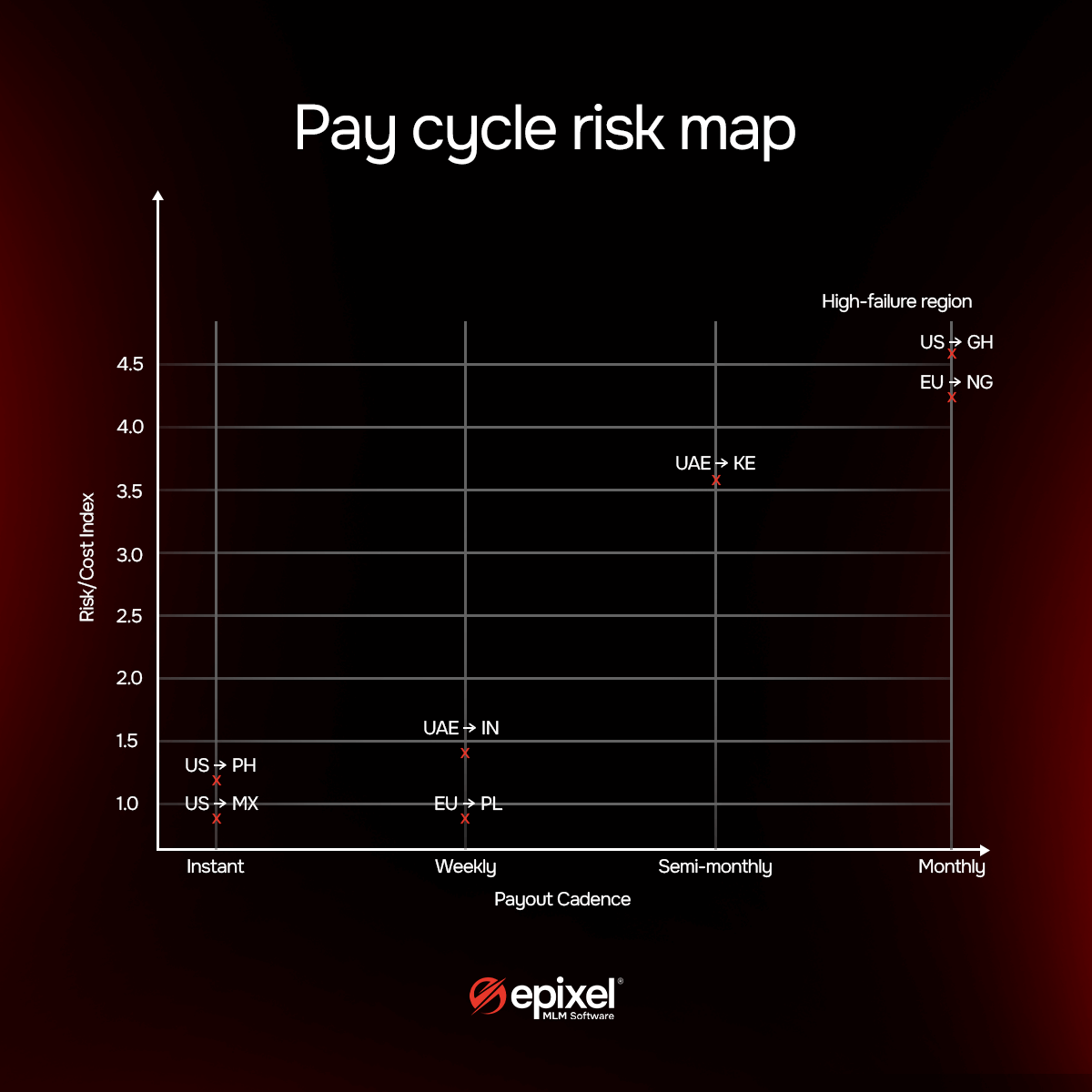
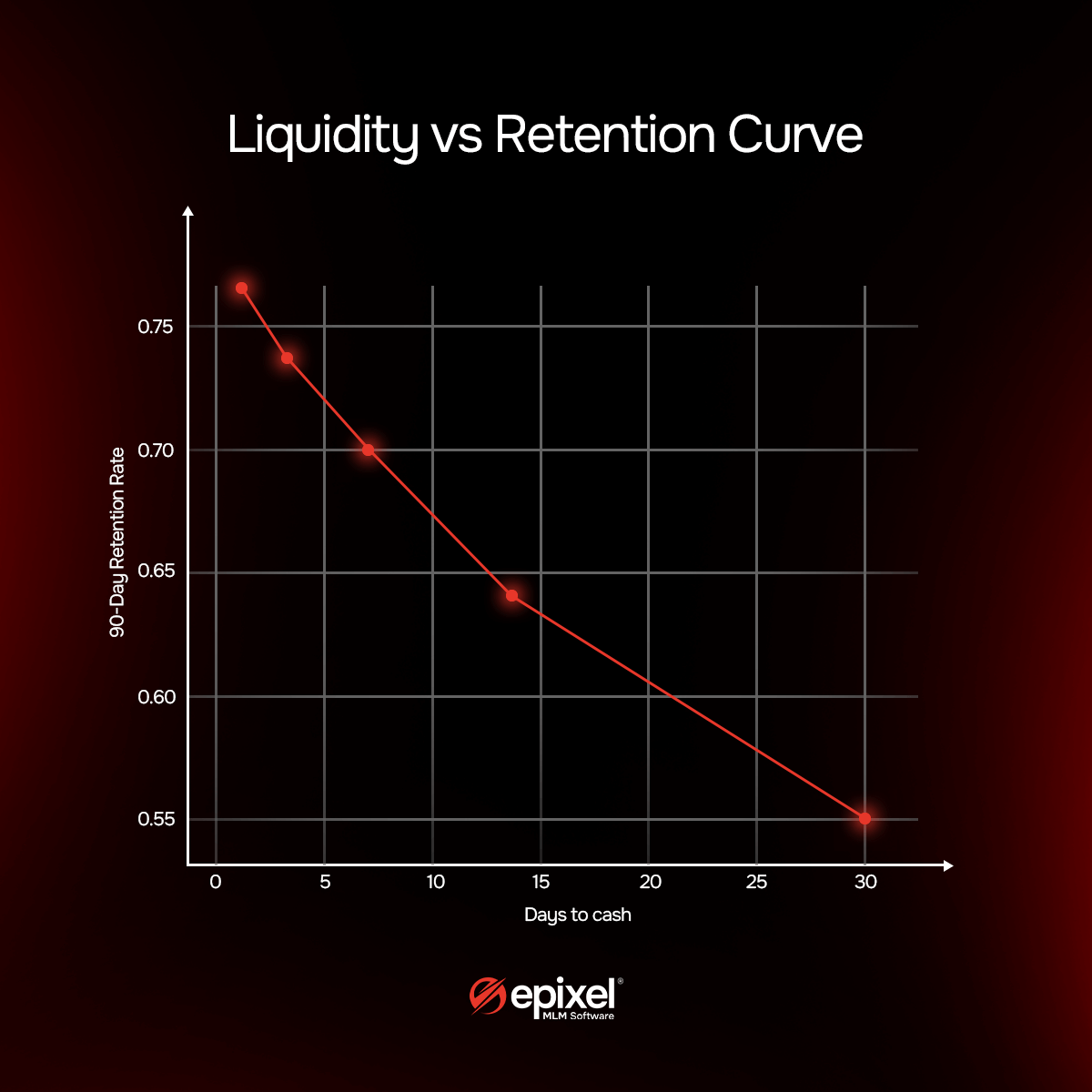
The three mandatory reporting of payout analysis include three major visual representations. These figures offer visual insights and trend patterns on pay cycle design and liquidity management.
The map shows the relationship between payout frequency and the risk or costs associated with it. The X axis represents frequency and Y axis measures the risk and costs. The corridors are denoted in separate colors with regions in high risk grade marked for quick reference.
The curve is a representation of how payout frequency affects distributor retention rate over a 90-day period. The X axis shows the number of days taken to make commission payments, and the Y axis represents retention rates for each duration. The figure above shows that retention rates are high when commissions are paid instantly and the same reduces as the duration increases.
The rail suitability matrix measures the efficiency of payout rails against a number of factors such as corridor coverage, speed SLA, managing foreign exchanges, predicting fees, KYC strength, tax and reporting compliance etc. Each of these is scored on a scale of 5 and the top rated rails are highlighted for companies and their finance teams to compare.

When companies run in the “Batch Payouts” model, the system, the company and the whole network suffers. Retention drops, so do the profits. Because in a manual system transaction failures are detected late which gives rise to the number of “where is my pay?” support tickets.
An automated payout model replaces all the negatives of manual handling with a single orchestration API that can calculate, process, and distribute payouts through available rails. A policy engine selects the correct payout rail and frequency automatically based on the distributor’s rank, corridor risk, and KYC status.
The system can automatically retry the failed transactions without making duplicate or overpayments. KYC verifications are carried out automatically on preset periods especially before the first payout to ensure that there are no issues related to non compliance and fraud. The system uses the same FX rate from the designated source for every calculation so that there are no mismatches.
The automated payout model also boosts distributor confidence in the process by giving them a transparent overview of each commission transaction which includes the timing, FX fees, and taxes applied.
The system does its job, so should the company’s people and processes. Whenever a change is introduced in the payout process like in the structure, corridor, or frequency, there should at least be two people reviewing it apart from the one who drafted the change.
Every corridor should be reviewed during designated intervals for fees, speed, and failure rates, and necessary changes implemented. Payment teams and support teams within the organization should use the same error codes and each person involved should be well aware of the same to improve diagnosis and resolutions.
A new payout model should be preceded by FAQs which explain timing, fees, and rails. This should clearly state what distributors should expect to reduce end minute confusion and support tickets.
A single pay cycle design for global operations is not a feasible idea. Moreover, it is a high-risk strategy because each region has different laws and policies. Tax rules, banking processes, verification requirements, and payout structures have to comply with each region of operation.
The largest direct selling market also has some of the strictest regulatory bodies like FTC and SEC. In the US, payout timing and documentation must align with IRS reporting rules for 1099-NEC and 1099-K. The payout history and statements should be ready for audits with details and timelines mentioned.
Distributors of MLM companies operating in the European Union should be verified using Strong Customer Authentication (SCA) in compliance with PSD2 before onboarding. The recommended payout rail for the European markets is SEPA because of lower costs and reliability. In the markets where SEPA instant is available, top performers can be paid faster.
Payouts in the UAE must align with VAT rules and commissions must be documented. Expenses excluding commissions must be separately recorded for audits, and any international transactions from UAE must comply with policies of different countries.
The risks and limitations in implementing a pay cycle are attributed to factors like corridor reliability, data quality, and change management. Companies changing pay cycle designs during launch or in the middle should consider the constraints for successful implementation.
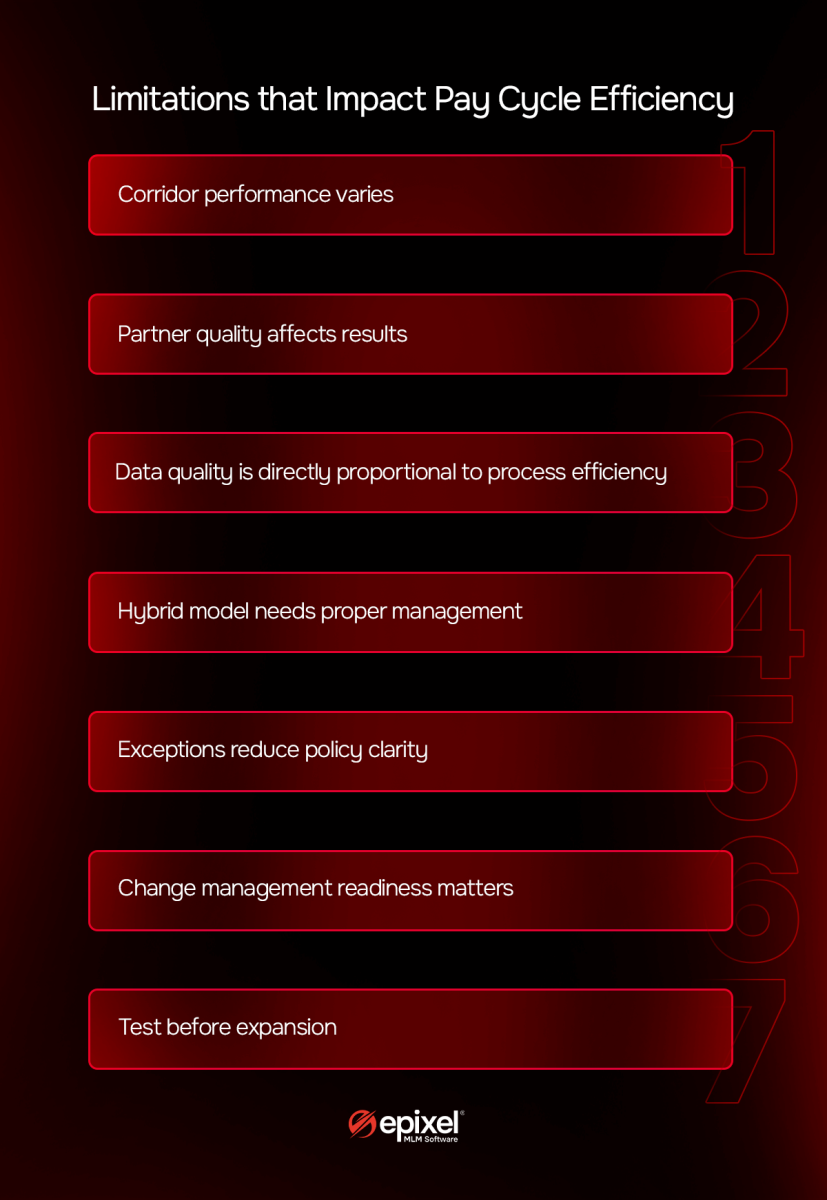
MLM companies operating in multiple countries might face complications with differing banking systems, regulations, and processing time. Quality of payment partner and data also affects the speed and reliability of payouts. In addition to this, organizational changes to pay cycle, its implementation, and adoption impact results and operational efficiency. Too many exceptions in the payout policy bring confusion and risks. Disciplined policy practices are necessary to uphold trust and prevent disputes.
Any process which involves collecting, storing, and processing data must be dealt with extreme caution. Privacy regulations lay on one side of the balance while ethical considerations on the other. Minimize data usage with IDs instead of full data and secure them with role-based access, so no unauthorized access affects your data security standards.
Income Disclosure Statement (IDS) should be transparent and changes communicated to your network in real time. Refrain from guaranteed earning claims and allow grace period during changes. Every dispute that might arise along the way must be addressed transparently and with utmost priority.
Pay cycle design once finalized needs a strategic plan to implement. This includes testing, implementing, and communicating to the entire network of participants.
The current pay cycle performance has to be interpreted to get a full and final view of its shortcomings. Payout data over a 12-month period with failure codes, FX rates, fees, and support times have to be counted in. Using this data, your team will calculate the current pay cycle performance considering factors like the time taken to pay distributors, the number of failed transactions, costs incurred for every $1000 paid, and the number of support tickets. The results of these findings become the foundation for comparing new design with the old.
After the evaluation of the existing pay cycle design, the team will analyze the fitting rails and corridors by assigning scores to list the primary and secondary channels. Payout segments are created based on ranks, regions, or verification levels to decide where to implement weekly and monthly payouts. Once this is completed, team must create standard operating procedures for internal teams and FAQs for distributor networks.
The system is fed with real payout data and rigorous testing is carried out. Through the testing process error codes are finalized, and controls are added to prevent duplicate payouts or overpayments. KYC verification is set up with re-verification triggers in case of risks or non compliance identified.
The new design is rolled out with weekly payouts in one segment or in one or two low risk corridors. All other groups, for the time being, will function with monthly payouts. The pilot model is then tested by the team using a real time dashboard that monitors failures, costs, and support load.
After the pilot, if the results are reliable and look stable, then additional corridors and distributor segments can be added. Policies should be strictly checked and updated for each corridor and payment rail. Payout statements should be maintained and refined based on feedback. Support teams are trained on new error codes and escalation procedures to handle payout tickets efficiently.
The report is presented to the finance team for approval. The team will compare baseline and final hybrid pay cycle design for costs, failures, speed, and retention rates. Once it is approved, reporting and tax policies for US, Europe, and UAE are implemented accordingly to ensure annual filings remain compliant.
The new payout model is launched widely across markets and distributor tiers and expectation communicated clearly at the beginning itself. The performance dashboard is shared with leadership and operational teams. The company will hold a quarterly review after implementation to see the results and optimize the process if necessary.
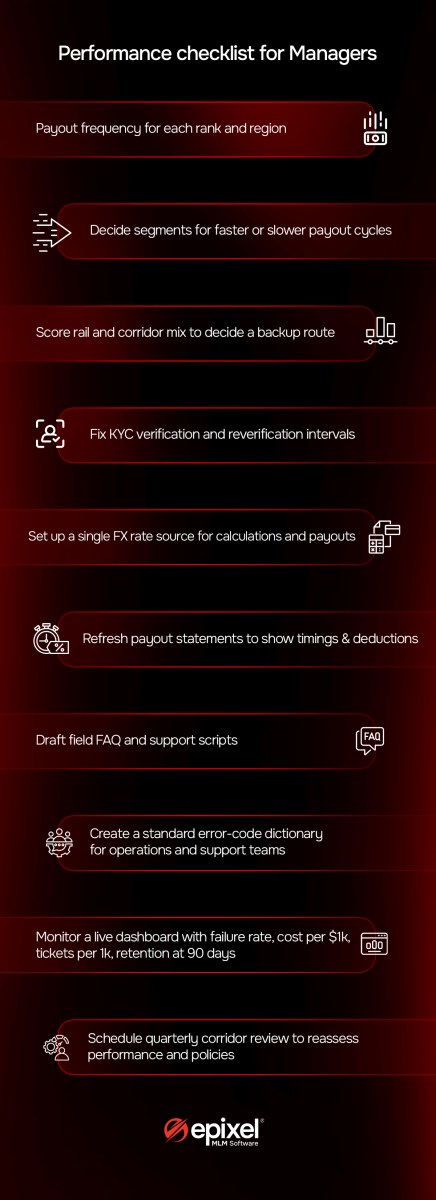
The implementation and further reviews will reveal the effectiveness of the pay cycle design, yet it is important to measure its performance across various operational aspects. Here is a consolidated list of primary and secondary KPIs that must be monitored and optimized constantly to ensure the effectiveness of the implemented model.
Cash-to-field (days) by rank and corridor
Payout Failure Rate (%) with top failure-code Pareto
Manual processing effort (Hours per run)
Support tickets per 1,000 payouts
Cost per $1,000 paid (Fees + FX + reprocessing labor)
Compare weekly vs monthly cohorts on payout frequency and their resulting retention rates at 90 days.
Fast-track payout mix (%) made through instant or weekly share
US 1099-K/NEC coverage accuracy (%)
EU PSD2/SCA exceptions rate and resolution time
UAE VAT documentation accuracy (Sampling pass rate)
Change in FX rate (Estimated vs actual during payout)
Our strategic analysis of different pay cycle designs thus leads to the conclusion with hybrid model takes the top spot in terms of speed, value, risk, and market reality. But an important concluding point to be noted is that in any hybrid model strict discipline must be followed with fewer exceptions and stricter KYC verifications. Every region with a new pay cycle implementation will verify processes from onboarding to compliance verification and reporting. The process doesn’t end there. Constant monitoring and updating of policies and processes and communicating effectively to participants will remain a critical area to ensure efficient payout operations.
Epixel MLM Software anchored 450+ network marketing companies to success through their business process automation in more than 88 countries. Let Epixel MLM Platform revolutionize your MLM business with 100+ proven features intelligently tuned for small, medium, and large enterprises.
Try our Ultra-modern
Direct Sales Mobile App!!!
Take your business with you. Anytime. Anywhere.


Epixel Enterprises LLC.
300 Delaware Ave STE 210 286,
Wilmington, DE 19801
United States Of America
Solutions
Products
Resources
Get in touch
Epixel Enterprises LLC.
300 Delaware Ave STE 210 286,
Wilmington, DE 19801
United States Of America
 United States+1 650 491 9744



 Canada+1 437 2208998
 Mexico+52 13322545528
 Hong Kong+852 5616 7921