
















Download Free Hybrid MLM Compensation Plan Template
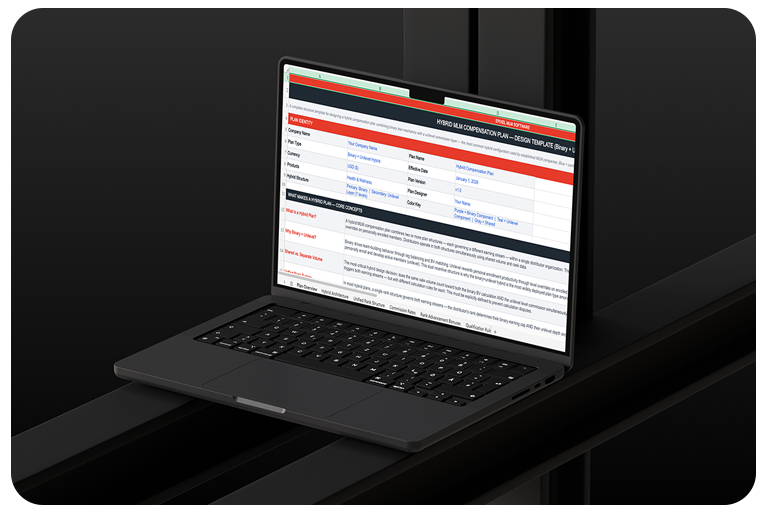
Hybrid MLM compensation plan has a complex structure as it combines the specifics of two core MLM plans. The plan holds two plan structures under a single organization, needs two genealogy trees to operate together, and aligns compensation rules of both the plans in perfect balance. The Free Hybrid MLM Compensation Plan Template helps you easily create a working hybrid plan with bonus and rank structures that will not turn into a payout liability.
When we do not know how the elements in each plan interact with each other, it is hard to guess the reasons behind disputes, overpayments, and software implementation failures. The Hybrid MLM Compensation Plan Template is an Excel workbook that can be configured with rank, commission, and bonus rules according to business requirements.
This template models the most popular binary-unilevel hybrid structure along with a seven-level unilevel overlay and an optional matching bonus. It is prefilled with sample data and works perfectly well with all MLM platforms including Epixel MLM Software.
Design a fully functional and impactful binary+unilevel hybrid MLM plan with our free Hybrid MLM Compensation Plan Template.
*No email required.
Structure of the Hybrid MLM Compensation Plan Template
The template is built as a downloadable workbook with seven sheets and a tricolor design system in which purple indicates binary components, teal for unilevel elements, and gray for shared and unified rules. This makes it easier to understand and build the plan.
| Sheet | Purpose |
|---|---|
| Plan Overview | Understand the working of hybrid plan before configuring. It covers eight hybrid plan concepts like the definition, common binary+unilevel pairing, shared vs. split volume policy, unified rank system, binary component mechanics, unilevel component mechanics, matching bonus as a third earning method, and total payout exposure implications. It also has a comparison table of five common hybrid configurations which can help with your final decision. |
| Hybrid Architecture & Volume Rules | This sheet cannot be seen in many plan templates but is one of the important aspects of a hybrid plan. It governs how the two plan structures work with shared volume policy, tree separation (placement tree vs. sponsor tree), unified vs. separate rank system, calculation sequence, and matching bonus on/off decision. Binary component settings (purple) and unilevel component settings (teal) are configured and presented separately. These interaction rules implemented rightly reduces distributor disputes and software implementation failures. |
| Unified Rank Structure | Define all 7 distributor ranks using hybrid plan criteria. Each rank needs binary BV thresholds (purple cells) and unilevel enrollment criteria (teal cells) to be met simultaneously. Binary earning caps of each rank, unilevel depth unlocking, and rank advancement bonuses are also configured here. The three-color system is designed to recognize which criteria belong to which component. |
| Commission Rates | Model all three hybrid earning streams in one sheet. Part 1 covers binary commissions based on weaker-leg BV, with a flat rate, rank-based earning caps, and automatic BV-to-cap calculations. Part 2 covers unilevel commissions with a 7-level × 7-rank commission matrix and total exposure formulas. Part 3 covers matching bonuses with rank-based rates, eligible enrollment depth, and qualification conditions. Include total exposure calculations for each earning stream. |
| Rank Advancement Bonuses | Structure one-time cash bonuses, physical rewards, recognition events, travel incentives, and monthly bonuses for each rank. Include a design note that explains the importance of advancement bonuses during the early BV-building stage, before binary commissions and deeper unilevel earnings become significant. Add a 12-month liability summary with automatic calculations. |
| Qualification Rules | Records all operational policies for the hybrid plan, including active status, shared volume rules, binary mechanics, unilevel commission rules, matching bonus eligibility, rank qualification criteria, and compliance policies. Includes an explanation as to why each policy exists. This is the most detailed policy sheet in the template, as hybrid plans have the most comprehensive qualification rules. |
| Payout Exposure Calculator | Model combined commission liability across Conservative, Base, and Optimistic scenarios. Three earning streams are calculated and displayed separately as binary commission, unilevel level commissions, and matching bonus. This is then combined into a single weekly total exposure figure. A red-flagged guardrail shows that hybrid plans carry the highest combined payout exposure than any other plan type and provides a prioritized sequence for reducing payouts if profit margins are tight. |
Who will get the most value from this template?
Founders of MLM companies will find this template useful in making design decisions that govern how each element in both plans work before consulting with a software vendor, legal team, or top leaders.
Direct selling consultants and plan designers can take advantage of the template for managing clients operating with complex binary + unilevel hybrid plans. They can create a working design document outlining every plan component for review and approval, or to hand over to an implementation team.
Finance and operations teams can model the affordability of implementing the hybrid plan and calculate the three earning streams separately before totaling them into a single figure. Legal and compliance teams can use the template as a complete policy framework to govern both plan elements simultaneously like shared volume disclosure, two-tree structure, retail sales ratio, income disclosure across all three streams, and cross-component manipulation prohibition. All these can be recorded in one place before finalizing the distributor agreement.
MLM software implementation teams can create accurate hybrid plan specifications of any MLM plan combinations. Binary+unilevel hybrid plan is difficult to implement with entirely different tree structures, shared volume logic, rank evaluation, and matching bonus calculation.
Direct selling leaders and investors can evaluate if a hybrid plan is financially sustainable even when the network expands. They can also model the three earning streams with a practical network size and activity assumptions before finalizing the hybrid plan structure.
Create a well-documented hybrid compensation plan with rules, ranks, commissions, and payout calculations.
*No email required.
What makes this template different
The Hybrid MLM Compensation Plan Template documents the plan layer by layer accurately. An entire sheet is dedicated to these plan decision layers so that everything is clear before building the rate table. The three-color design system makes the plan easily understandable with color codes for individual plans and the combination. Anyone can easily differentiate the plan elements and see which rule belongs to which plan and the rule that applies to both.
Three earning streams are modeled and reported independently. The total payout cost of a hybrid plan is the sum of the three individual streams. The template keeps the calculation separate so that the business can know the cost contribution of each.
Matching bonus is sometimes wrongly designed in a hybrid MLM plan with rate too high, depth too generous, or eligibility too broad. This can take the total payout cost above the payout limits that affect margins. This template designs it thoughtfully with rate-by-rank, depth-by-rank, and eligibility conditions, and structures its cost separately in the payout calculator.
Rank eligibility criteria are displayed with color codes for each plan component. Rank promotion in hybrid will only be processed if a distributor meets both unilevel plan and binary plan criteria. In the sheet, the former is marked in teal and the latter in purple so that users can understand which criteria belong to which plan.
Compliance monitoring for hybrid MLM plan is stricter with the template as there are higher risks of position loading and personal purchases. Hence, the Qualification Rules sheet includes the retail sales ratio requirement, inventory loading prohibition, cross-component manipulation ban, and income disclosure obligation across all three streams to ensure full compliance.
The reliability of the template is attributed to the fact that it is built by experts with 15+ years of industry experience in plan development, consultation, and implementation. The sample data reflects the real-world business scenarios across health and wellness, beauty, coaching, and consumer product sectors.
Getting started with the template
In order to use the template, you need to first open the Plan Overview sheet and review the five hybrid configuration options in the comparison table. The template uses binary+unilevel so ensure that the plans are right for your business model. If you want to switch the plan type after configuring rates and ranks, then you will need to rebuild it from sheet 2.
Open the Hybrid Architecture & Volume Rules sheet and finalize the architecture decision before starting with rate fixing. You must confirm the shared volume policy, tree separation, rank system, calculation process, and whether matching bonus is enabled. These decisions impact every other sheet and changing them after configuration impacts results.
Go to the Unified Rank Structure sheet and set the rank criteria with binary BV requirements (purple cells) and unilevel enrollment requirements (teal cells) in such a way that both the plan elements are honored.
In the Commission Rates sheet, configure all three earning streams in order. Set binary rates and caps in Part 1. Unilevel level commission rate must go into Part 2. You can review the total exposure as you adjust rates at each depth. Configure matching bonus rates, depth, and eligibility in Part 3. Before you proceed, review the exposure for each stream.
Open the Rank Advancement Bonuses sheet and design the milestone incentives for the hybrid earning curve. Rank Advancement Bonuses retain distributors through the long and tiring hybrid plan ramp where BV must accumulate, enrolled members must build volume, and matching bonus eligibility requires reaching Leader rank.
The Qualification Rules sheet is where you need to replace all default policies to your plan’s rules. Be careful when shared volume disclosure, two-tree structure explanation, and matching bonus calculation basis because these are the policies that create the greatest number of distributor disputes in a hybrid plan. This should be shared with legal team before finalizing.
Open the Payout Exposure Calculator and test all three scenarios with your projected network assumptions. First review binary, unilevel, and matching bonus as separate streams before looking into the total combined exposure. If the combined total is above the set limit in the Conservative scenario, follow the prioritized reduction sequence in the red-flagged guardrail. Reduce binary rate first, then unilevel depth, and then try reducing matching bonus rates or eligibility depth.
Download the free Hybrid MLM Compensation Plan Template to create an implementation-ready plan with clearly defined architecture, commissions, ranks, and payout calculations.
*No email required.