













Download Free AI Vendor Evaluation Scorecard for MLM Companies
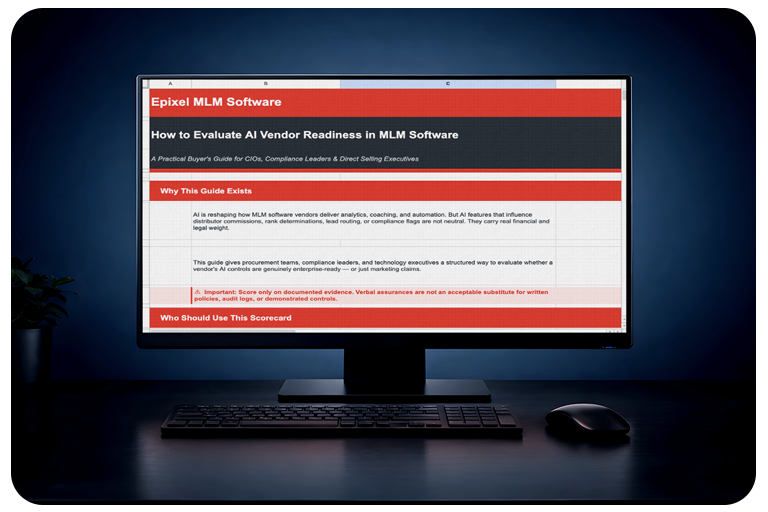
AI feature claims are all over the software marketplace, and selecting a vendor who provides real AI capabilities is a tough task. MLM companies must be careful when analyzing the marketing claims against real AI software features.
Our AI Vendor Evaluation Scorecard can be used as a checklist for vendor shortlisting whereby direct selling companies can assess AI capabilities of a vendor with a weighted scorecard. The analysis will tell you whether the vendor truly has ready-to-launch AI products or is just AI-branded.
The AI Solution experts at Epixel MLM Software with 15+ years of experience designed this scorecard which covers every MLM domain where AI influences commissions, rank decisions, lead management, and compliance.
Differentiate real AI-powered MLM software vendors from fake AI marketers with our free AI Vendor Evaluation Scorecard.
*No email required.
What does the AI Vendor Evaluation Scorecard cover
The scorecard can be downloaded as an Excel workbook with six tabs for evaluation, decision making, and ready-to-use scripts for lead generation.
| Tab | Purpose |
|---|---|
| Buyer's Guide | This acts as a complete guide to selecting a new software vendor by helping you evaluate AI vendor readiness. It tells you the evidence to request, how to read scores, and how to integrate this scorecard in your buying process. |
| Executive Dashboard | The dashboard gives a full summary of overall vendor readiness score, categories, critical fail count, weighted points total, and recommendations. |
| Vendor Scorecard | There are35 weighted evaluation questions in seven control categories. Each requirement is scored on a scale of 0–5 based on recorded evidence and not on marketing claims. |
| Evidence Checklist | 20 distinct documents are listed to request from vendors during procurement, with priority levels and tracking columns for status, owner, and vendor document links. |
| Scoring Guide | You can interpret the scores here. It explains what each score level means, what evidence standard is acceptable, and how to use the final recommendation for purchase assistance. |
| Completed Example | This is a pre-filled sample evaluation showing how a buyer might score a vendor across all 35 questions. You can use this to optimize your own review. |
Who stands to benefit from the scorecard?
CIOs and CTOs can use this scorecard to assess and compare the AI architecture of different vendors to understand which one suits their business requirements.
Compliance and legal teams in direct selling companies can understand the regulatory issues, data controls, AI risks related to MLM like earnings and product claims, and fairness in distributor payouts.
Leaders in the data and analytics team can review the practices around the accuracy and reliability of the AI model and track whether accuracy declines over time. They can also understand the explainability standards of the AI model and analyze how well the system records AI activities and decisions.
It is mainly beneficial for software procurement teams who need to conduct complete background verification of vendors before RFP, demo, and contract signature.
Executive sponsors can use this scorecard to act as a defensible document on their AI platform decisions.
Operations team and field leaders whose teams will be affected by AI-based commission reviews, rank advancements, and lead management processes can use this scorecard to ensure the efficiency of the AI platform.
Present a comprehensive vendor verification document for your MLM teams in the software purchase process to reduce procurement risks.
*No email required.
7 control categories evaluated with the scorecard
- Governance and accountability: It checks whether the vendor has a written AI policy, a special person designated for governance, list of all AI models in use, model documentation, and formal approval processes before AI features go live.
- Data protection and privacy: The scorecard tracks how the vendor classifies, minimizes, and controls PII, financial, behavioral, and sensitive distributor data. It evaluates if the vendor can support regional privacy requests, automated data deletion workflows, and sub processor disclosures.
- Model risk management: The validation and backtesting of models before release are verified for reliability and accuracy. It checks for drift monitoring after market or compensation changes. The scorecard ensures if AI outputs are explainable to users and that important settings can only be changed after an approval process. The need for human review for important decisions is also evaluated.
- Auditability and transparency: It analyzes if the vendor can track how AI predictions were made from the original data to the final business action and whether records are maintained for AI outputs, user actions, approvals, and manual changes.
- Security and access control: The scorecard ensures that distributor data and AI dashboards are restricted by role-based access controls. It assesses the vendor’s capability to provide access logs and checks if the development and production environments are kept separate. It verifies the existence of a documented process for responding to AI or data security incidents.
- MLM-specific AI controls: The scorecard helps you check whether commission payouts are not impacted by automatic AI-driven actions, rank and commission eligibility are explainable and auditable, and the lead routing process is fair. It verifies whether the earning claims are monitored with guardrails and whether distributors can request a human review of AI-assisted decisions.
- Vendor readiness and support: It checks whether implementation documentation of AI configuration is available, if admins and compliance teams are properly trained on AI use, and are SLAs defined for AI incidents and governance questions.
How does this scorecard help in vendor decisions
The AI Vendor Scorecard is not designed on any random AI checklist. It is built on real purchase experience across enterprise direct selling software evaluations. Model risk, security, and compliance are the areas that need attention and the scorecard rightly prioritizes them. Critical requirements section in the scorecard ensure vendors cannot achieve a high score if necessary controls are missing. The main highlight of the scorecard is that the evaluation criteria are MLM-specific. Compliance and procurement teams can prepare for vendor discussions with the included Buyer's Guide.
How to use the AI Vendor Scorecard
Open the Vendor Scorecard tab and enter the name of your vendor at the top. Run down through the 35 questions. Score it yourself on a 0–5 scale based only on the evidence you have received. Do not score it based on vendor marketing promises. Use the Evidence Checklist tab to track the documents that have been requested and received. As you assign your score, the Executive Dashboard tab updates automatically.
Assess and compare AI software vendors with our free AI Vendor Scorecard designed for risk-free procurement and compliance requirements.
*No email required.