















English
- English
- Español

- 简体中文

- Français

- Deutsch

- Italiano

- 日本語

- 한국어

- Portuguese, International




Minor flaws in the compensation structure and payout processes can cause profit loss for direct selling companies. Commission leakages usually account for 1-3% of profit margin and often go unnoticed. In due course, these can lead to a major cut down in profit and the company’s overall growth.
Leakages happen due to payment of commissions that shouldn’t have been paid. Delays in return approvals, commissions paid before returns, and payouts made twice caused by manual or system errors also cause leakage if not properly monitored. International MLM companies also carry the risk of transaction fees that go unnoticed when making international payments. Through this white paper let us analyze where commission leakages hide.
Commission leakage is not something inevitable. It is caused due to rule gaps and process misuse. In the payout graph, it shows up as slight and silent variations in overpayments, mis-credits, unqualified orders, or FX fees.
It is called “silent” because it does not trigger a complaint, it only reduces margin. Distributors never complain about overpayment, and your finance teams cannot notice the thinning margin easily.

Teams can fix it with corrected policies and processes and do not need a complete revision of the compensation structure.
When the fix is delayed, you lose more profits.
It is visible to the board. Fixing it right improves EBITDA with visible differences in profits to show investors and the board.
Leakage does not show up in one place. It hides in everyday processes. The major leakage possibilities can be divided in seven categories to give a detailed overview of where, how, and why the leakages occur.
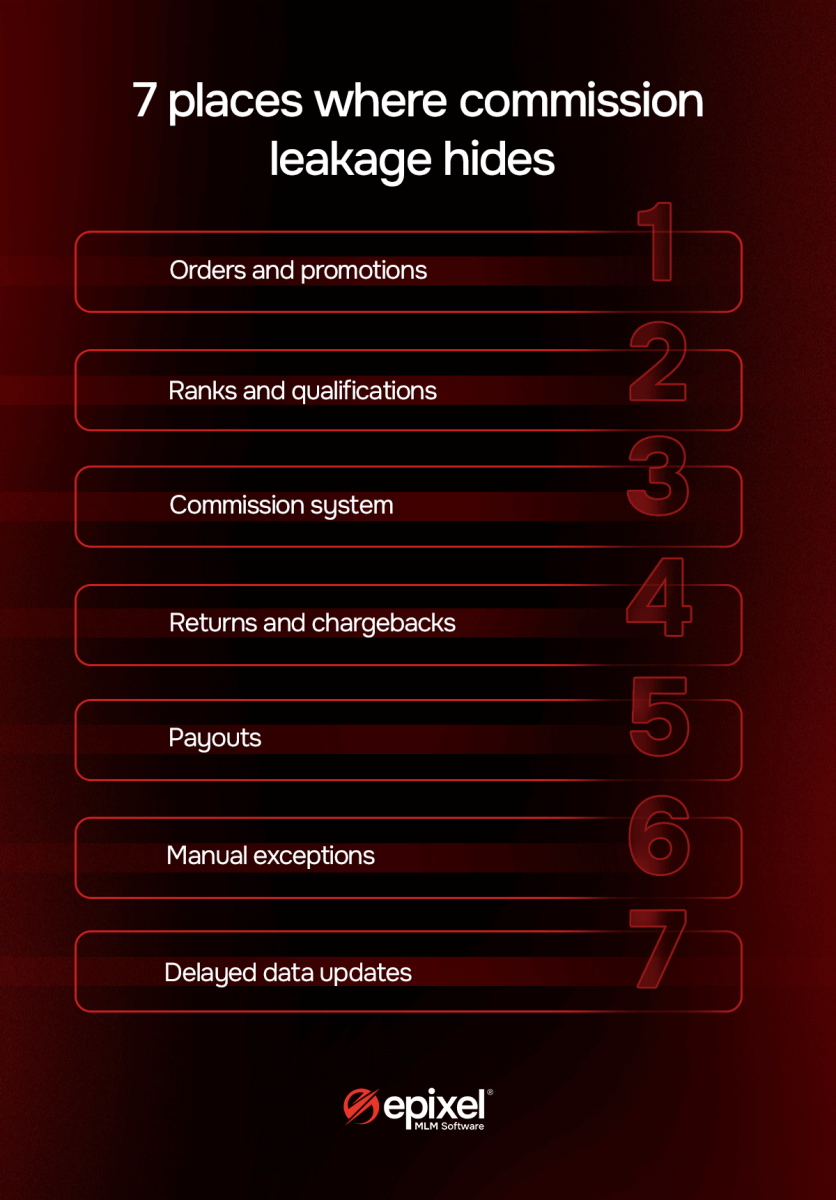
Promotions once introduced should be set to expire on the scheduled date. Otherwise, this can increase your budgets when users reapply promotions even after the promotion period. Products with offers or discounts should be updated else it can lead to customers getting double discounts when it is not actually meant to be.
Distributors who are not entitled to promotions can wrongly benefit when rank qualifications are extended. This can also lead to increasing the payouts and the company suffers loss.
Errors and overpayments happen with automated processes due to system issues.
Commissions paid on returned products after the refund period creates a leakage when not taken back or adjusted in the next payout cycle.
Leakages through payments occur with duplicate payouts, incorrect foreign exchange, and payment processor fees incorrectly applied.
Commission adjustments made manually without proper approvals may not get registered in the system. The system thus ends up paying more than what is eligible.
Payout data entered after the calculation period, wrong system settings, or duplicate data entries can create confusion in the payout process.
Benchmarks help in comparing your existing standard with the required standard every time a change is made.
Promotions and eligibility: ~0.3–0.8% of commissionable volume
Returns and chargeback timing: ~0.2–0.6%
Rank qualification anomalies: ~0.1–0.4%
Payout/FX/fees slippage: ~0.05–0.3%
Treat these as guidelines, these are not exact targets.
During audit, replace these percentages with your actual results.
Change the audit results into dollars to show the real impact on EBITDA.
MLM companies of all sizes in all industries can use this checklist to check for margin leakages in their commission process. Run it with two months’ data, one during a peak sales period and off-sales period. Adjust the frequency as you progress, weekly for the first four weeks and then monthly after you understand the patterns. You must record each aspect of your investigation like what you tested, the results you found, how much margin was affected, and who is responsible for the fix.
Download the complete governance checklist to manage and secure your leakage sources
Do not rest your results on technical formulas. Communicate the results in terms of financial impact that really matters to the Board. You can present your report using the following sample.
Baseline leakage – “We are paying $X that we shouldn’t.”
Target in 90 days – “We will remove Y% of that.”
EBITDA improvement – “That would create a profit improvement of $Z.”
Payback – “Minor tweaks in policies and processes takes only months not years.”
Additional benefits – Lesser disputes, proper audits, and simple quarter endings.
Convert your audit results into EBITDA and payback outcomes for your board with our Commission Leakage Calculator
Commission leakages in multi-level marketing may be caused by people, faulty processes, or inefficient technology.
If people are the cause, then introduce maker-checker for commission rule changes which assign one person as the rule maker and the other one as the rule checker.
Create an “Exceptions Review Team” to review commission exceptions within a two-day time frame so that issues do not build up.
Conduct a monthly compensation review to ensure compliance and identify anomalies in the commission system.
If faulty processes are the cause, then
Instill accountability for new changes in commission rules before it is implemented. Record brief summaries of the change with reason and ownership details for future reference.
Set a 24-hour period for returns so that commission reversals are processed promptly and accurately within the same payout period.
Create a standard procedure for handling failed payouts or retries to ensure that commissions are not accidentally paid twice.
If inefficient systems or tools are causing the leakage, then
Maintain all versions of your commission rules so that you can replay old versions to check if payouts were correct at that time.
Build a strong payout logic which can prevent duplicate payments on retried transactions.
Establish a single, reliable exchange rate source for all currency conversions to prevent inconsistencies between calculation and payment systems.
Put checks in place to detect repeated or missing events and set up alerts for system drifts.
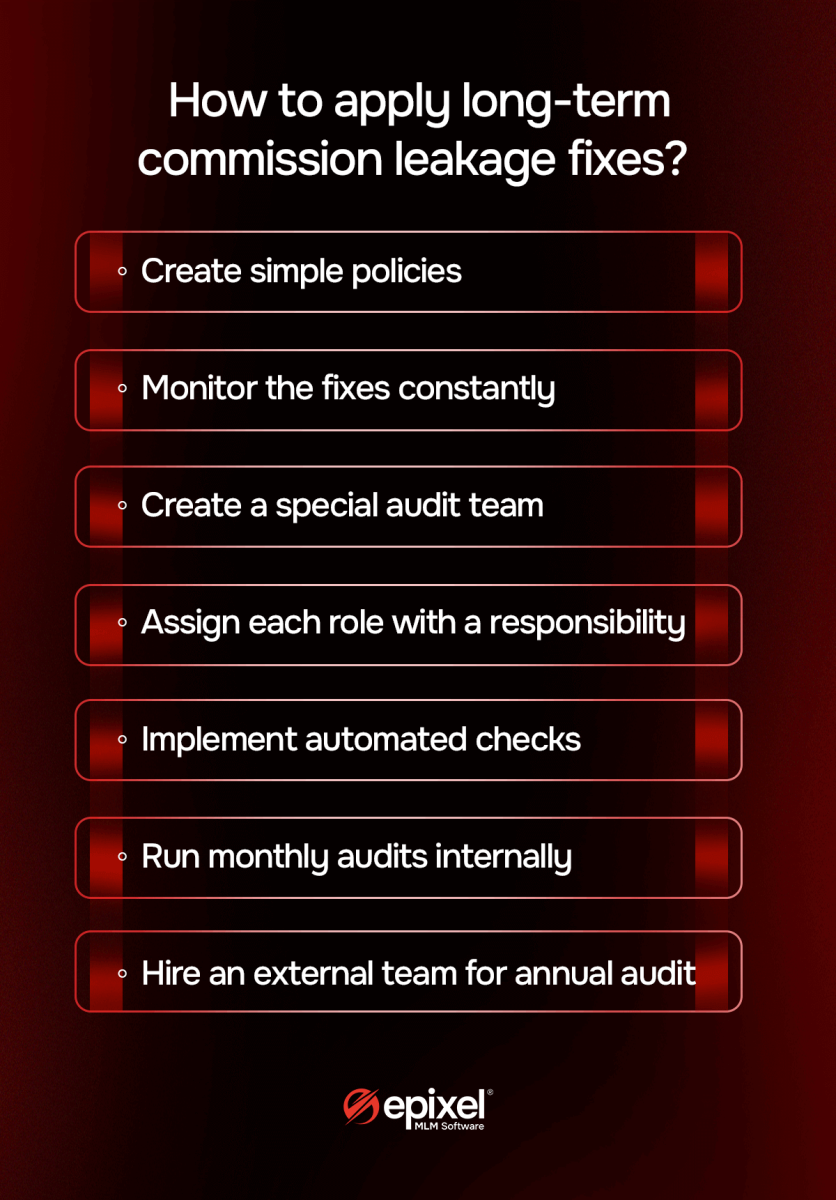
Policies should be in simple language, something even a third-grader would understand. Complex legalese can make it difficult for distributors and team members to understand and implement. Policies should cover everything from promotions, commission reversal rules, returns, and income claims. These policies become the standard on which your organization will operate on. So, ensuring there are no confusions or “gray areas” is important to avoid misuse or errors.
Once the leakages are fixed, constant monitoring will decide its effectiveness and longevity. Make quarterly reviews a mandate with responsible leaders to ensure that the compensation rules remain intact without leakages. Responsibilities should be rightly assigned to separate roles. The person creating the rule should not be the one approving it. Implement automated checks to ensure that issues in the past do not reappear.
A special team must audit the fixes monthly and provide updated reports to the board and compensation heads. An internal sampling should be done quarterly to manually verify that payouts and commission reversals are working correctly. Run an annual audit with an external audit team to examine your payouts and commission process.
Every step in the compensation process must be recorded with change dates and clear explanations. Set a graphical representation of the version history to see how commission rules have changed over time.
In weeks 1-2, collect two months’ reports from peak and off-peak periods. This is the time to find simple issues and should be immediately fixed, like duplicate payouts and foreign exchange concerns.
Weeks 3-4 will use the checklist to find the top five leakage reasons and put fixes in place during the weeks 5-6. Next is the time to fix policies, processes, and technical changes that cause leakages. In week 7, a manual verification of the fixes will show if they are working fine.
Consider weeks 8-9 as a maintenance period to implement controls like maker-checker, dashboards, alerts, and a monthly compensation risk review. Your finance team will walk in week 10 to validate the new leakage fixes and to confirm the improvements. This updated report will be the forecast for the remaining year.
The final launch will happen in weeks 11-12 with fixes implemented in all regions. Board should be updated and monitoring scheduled regularly.
These following metrics have to be reviewed regularly by teams who are responsible for each process.
Leakage percentage of commissionable volume shows how much profit is lost due to leakage.
EBITDA impact over the recent 12-month period tracks how much profit has come in after the fixes that were made the previous year.
Disputes per 1000 orders is indicative of payout accuracy which measures how often order disputes arise.
Percentage of exception queue resolved shows how quickly manual exceptions and errors are corrected.
Duplicate payout rate displays the inefficiency of systems and processes by counting the number of times commission was paid accidentally.
Foreign exchange spillage from calculation to payout determines how much a company is losing in foreign currency transactions between calculation and payment.
Number of promo stacking incidents tracks the number of incidents where multiple promotions are applied together.
Rank maintenance exceptions indicate the frequency of exceptions that keep distributors qualified for ranks they may not have earned.
Late RMA rate is the percentage of product return requests received after the allowed time.
Manual override ratio calculates how often system-calculated values are manually changed. This is useful to flag weaknesses in processes.
Leakage waterfall by driver shows where leakage happens in each process and where to apply fixes.
Top reasons that cause payout disputes in each payout cycle.
Payout failure map shows the region or payment method that faces frequent failures or delays.
Return-to-reversal delay measures the time between a return and a commission reversal.
Regulatory standards have to be respected when changing commission data and communicating the changes.
Use only the data you need and limit the use of personal information. Customer data should be protected to reduce risk and ensure privacy and compliance.
Good communication standards help in building good relationships with distributors. You should tell your teams about the change in compensation or policies such as reversals, grace periods, or other changes for them to understand the importance and the impact.
Always use language that is safe when making earning and product claims.
FTC, DSA, and GDPR policies should be followed. Members in the network should undergo KYC verification. Returns and manual adjustments should go with tax and VAT policies.
Commission leakage is a minor concern but in due course it makes a major impact on the company's profit graph. It is a signal that shows the efficiency of your processes, limitations in your technology, and management oversights. When audits are done and fixes are applied commission leakage turns from a financial challenge to an opportunity that builds trust among distributors and growth in profits.
Epixel MLM Software anchored 450+ network marketing companies to success through their business process automation in more than 88 countries. Let Epixel MLM Platform revolutionize your MLM business with 100+ proven features intelligently tuned for small, medium, and large enterprises.
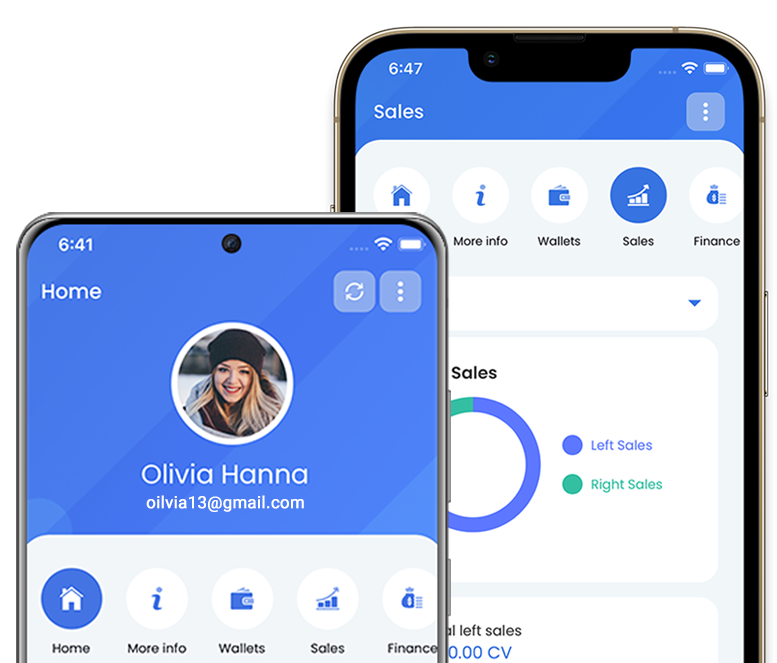
Try our Ultra-modern
Direct Sales Mobile App!!!
Take your business with you. Anytime. Anywhere.


Epixel Enterprises LLC.
300 Delaware Ave STE 210 286,
Wilmington, DE 19801
United States Of America
Solutions
Products
Resources
Get in touch
Epixel Enterprises LLC.
300 Delaware Ave STE 210 286,
Wilmington, DE 19801
United States Of America
 United States+1 650 491 9744



 Canada+1 437 2208998
 Mexico+52 13322545528
 Hong Kong+852 5616 7921